
For years, the logistics and manufacturing sectors have viewed humanoid robotics as “innovation theater”—impressive demonstrations lacking scalable return on investment (ROI). That narrative shifted decisively this month.
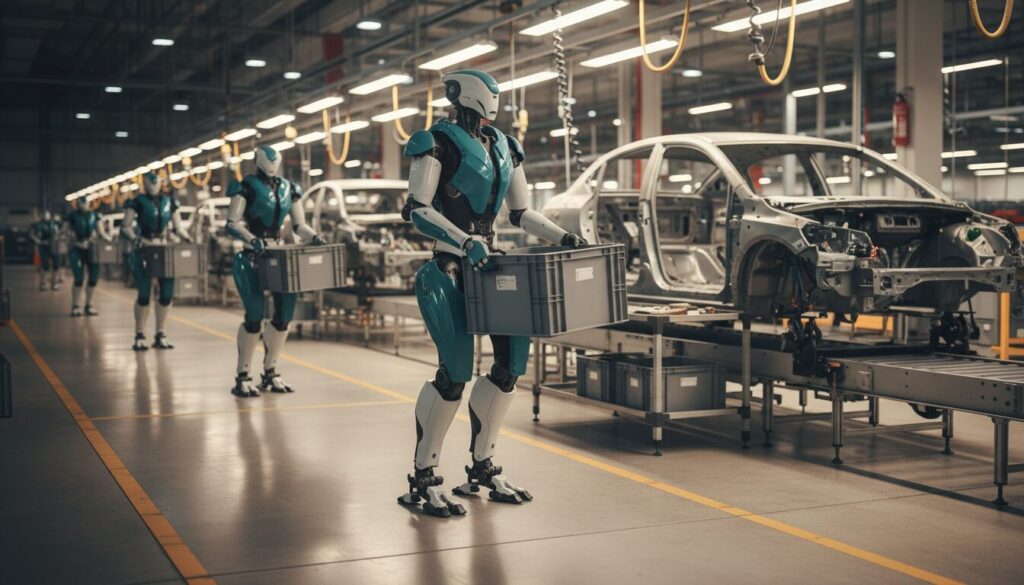
Toyota Motor Manufacturing Canada (TMMC) has officially transitioned from pilot to production, deploying seven Agility Robotics ‘Digit’ units at its RAV4 plant. This is not a limited R&D test; it is a live commercial deployment bridging critical gaps in the assembly line.
For global strategy executives, this signals the beginning of the “Brownfield Automation” era. The question is no longer if humanoids can work alongside humans, but how to integrate them into existing legacy infrastructure without disrupting operations.
Why It Matters: The End of “Pilot Purgatory”
The global supply chain is facing a dual crisis: a chronic labor shortage for repetitive tasks and the high cost of retrofitting existing facilities (brownfields) for traditional fixed automation.
Toyota’s move addresses both. By utilizing a Robots-as-a-Service (RaaS) model, TMMC has bypassed the massive Capital Expenditure (CapEx) hurdles usually associated with robotics. This deployment serves as a blueprint for global logistics leaders: humanoids are now a viable OpEx strategy to handle the “last 10 feet” of intralogistics.
This development is part of a broader acceleration in the sector. As discussed in our analysis of the IFR Names Top 5 Global Robotics Trends of 2026 for Logistics, autonomy and flexible scaling are becoming non-negotiable for supply chain resilience.
Global Trend: The Race for Humanoid Dominance
While Toyota’s Canadian deployment is a significant milestone for North America, it must be viewed within the context of a fierce global competition. The US, China, and Europe are adopting distinct strategies to commercialize embodied AI.
Regional Strategy Comparison
The following table outlines how major global regions are approaching the integration of humanoid robots in logistics:
| Feature | North America (US/Canada) | China | Europe |
|---|---|---|---|
| Primary Focus | Software Integration & RaaS Models | Mass Manufacturing & Cost Reduction | Safety Compliance & Precision |
| Key Players | Agility, Boston Dynamics, Apptronik | Unitree, Fourier, Xiaomi | Sanctuary AI (partnerships), Figure (BMW) |
| Deployment Style | High-value pilots (Auto/Logistics) | Rapid scaling (Factory floor) | Pilot programs in premium auto |
| Strategic Goal | “Bridge Automation” (Brownfield) | Supply Chain Dominance | Workflow Optimization |
The Asian and European Context
In China, the scale of investment is staggering. Market forecasts have been revised upward significantly, driven by state-backed initiatives to dominate the hardware supply chain. For a deeper dive into these numbers, see China’s Humanoid Surge: 28k Units & Supply Chain Shift.
Meanwhile, European manufacturers like Mercedes-Benz are taking a similar path to Toyota, partnering with US-based Apptronik to validate humanoids in low-value material handling tasks. You can read more about that capital infusion in Apptronik Raises $520M for Humanoid Logistics.
Case Study: Toyota (TMMC) and Agility Robotics
The deployment at Toyota’s Cambridge and Woodstock plants offers a granular look at what successful integration looks like. After a year-long pilot, Toyota has identified the specific “killer app” for humanoids: tote handling.
The Problem: Islands of Automation
Modern automotive plants are highly automated, but they often suffer from “islands of automation.” Automated Guided Vehicles (AGVs) or tuggers bring parts to the line, but a human is still required to physically lift the tote from the tugger to the conveyor.
- The Bottleneck: This transfer task is repetitive, ergonomically straining, and adds no value to the product.
- The Constraint: Traditional robotic arms require safety cages and precise positioning, which takes up valuable floor space that existing plants do not have.
The Solution: “Digit” as Bridge Automation
TMMC deployed seven ‘Digit’ robots to act as the bridge. These bipedal robots can navigate the same narrow aisles as humans and require no safety cages or facility redesigns.
Key Operational Metrics
- Task: Unloading totes from automated driverless tuggers onto flow racks.
- Capacity: Digit is designed for multi-purpose utility, capable of lifting up to 35 lbs (16 kg).
- Software: The deployment utilizes Agility’s ‘Arc’ cloud platform. This is a critical differentiator. Arc allows fleet management, monitoring, and rapid reconfiguration without coding new behaviors from scratch.
The Financial Model: RaaS
Perhaps the most innovative aspect of this case study is the financial structure. Toyota is not buying the robots outright; they are contracting them via Robots-as-a-Service (RaaS).
This shifts the risk profile:
- Lower Upfront Cost: No massive CapEx approval required.
- Maintenance Included: Agility manages the uptime, charging, and repairs.
- Scalability: TMMC can increase or decrease the fleet size based on production shifts.
This mirrors the shift seen with other major players. For comparison, see how Hyundai is utilizing its subsidiary’s technology in Boston Dynamics’ Atlas Pilot: The Humanoid Logistics Shift.
Key Takeaways for Logistics Leaders
For innovation leaders watching this space, the Toyota-Agility deal offers three specific lessons.
1. Target “Bridge Automation” First
Do not attempt to replace complex assembly tasks yet. The immediate ROI lies in connecting two existing automated systems (e.g., Tugger to Conveyor). This “bridge” role eliminates the most ergonomically dangerous tasks for humans while keeping the robot’s function simple and predictable.
2. The Data Ecosystem is Critical
The robot is only as good as the data feeding it. Agility’s ‘Arc’ platform highlights that the hardware is secondary to the fleet management software. As we move toward larger fleets, the ability to process “embodied AI” data will determine success. Companies like Noitom are already building the infrastructure for this data-heavy future.
3. RaaS De-risks Innovation
If your organization is hesitant about the reliability of humanoids, push for RaaS contracts. This aligns the vendor’s incentives with your operational success. If the robot stops working, the vendor stops getting paid.
Future Outlook
Toyota’s decision to contract seven Agility humanoid robots for its Canadian factory is a signal that the technology has graduated. We expect TMMC to use this fleet to gather data on reliability and cycle times before potentially expanding to hundreds of units across its North American network.
What to Watch in Q3/Q4:
- Standardization: Will Toyota push for a unified API to manage mixed fleets (e.g., Agility and Boston Dynamics robots on the same floor)?
- Battery Density: As shifts get longer, can these units maintain 99% uptime through opportunity charging?
- Union Response: How will labor organizations in the US and Canada react as these pilots turn into permanent fixtures?
The era of the “general-purpose” logistics robot has arrived. The companies that learn to integrate them now—using flexible financial models and smart software platforms—will define the efficiency standards of the next decade.