
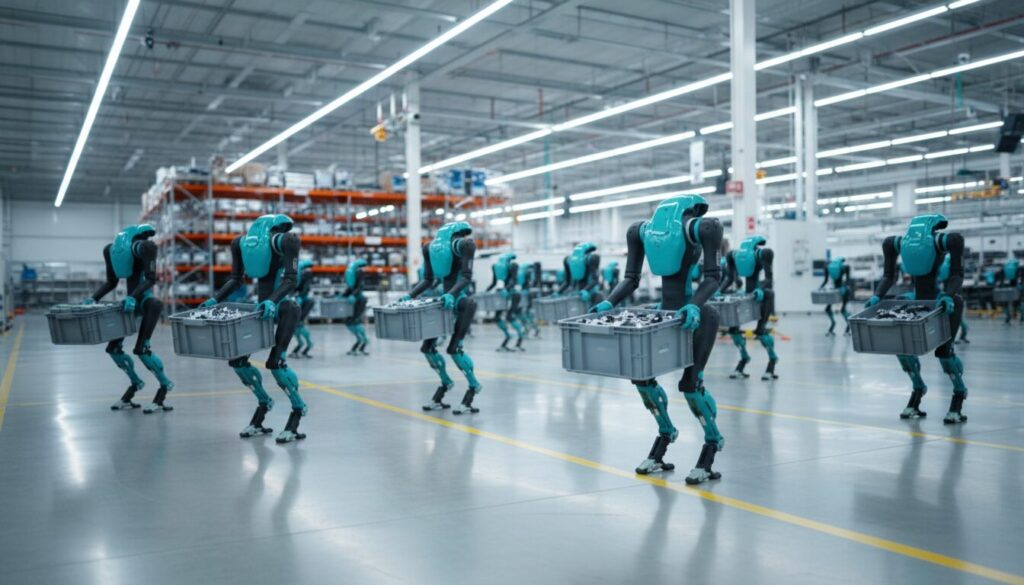
The era of “robotics theater”—where humanoid robots were mere showpieces for innovation labs—is officially over. We are now entering the phase of operational integration.
In a move that signals a paradigm shift for global supply chain strategy, Toyota Motor Manufacturing Canada (TMMC) has announced the transition from a pilot program to a full-scale deployment of Agility Robotics’ Digit humanoids. This initiative, centered on the company’s plants in Cambridge and Woodstock, Ontario, is not merely an experiment; it is a critical component of a $1.1 billion investment strategy aimed at modernizing the production of the 6th generation RAV4.
For logistics and strategy executives in the US, Europe, and Asia, this development offers a blueprint for the future of brownfield automation. As discussed in our report on Toyota Contracts 7 Agility Humanoids: Global Innovation Case, this move bridges the gap between static automation and human flexibility.
This article analyzes the global implications of Toyota’s decision, compares regional trends in humanoid adoption, and provides actionable takeaways for leaders navigating the next wave of industrial automation.
Why It Matters: The End of rigid Automation
For decades, automotive logistics relied on two distinct categories of labor:
- Hard Automation: High-speed, fixed robotic arms (caged) for welding and painting.
- Human Labor: Flexible, mobile workers for material handling, tote manipulation, and line-side delivery.
The gap between these two has traditionally been the “graveyard of ROI.” Automating the movement of totes from a tugger to a conveyor belt was historically too complex for rigid robots and too physically taxing for humans to do safely over long shifts.
Toyota’s deployment of Agility Robotics’ Digit changes this calculus. By utilizing a bipedal, multi-purpose robot, TMMC is addressing labor resilience and safety without requiring a complete facility redesign. This “brownfield-friendly” approach—integrating robots into environments built for humans—is the key driver for the sudden surge in humanoid adoption across the Global 1000.
Global Trend: The Race for General-Purpose Robotics
While Toyota’s Canadian deployment is the headline, it represents a broader trend sweeping the industrial giants of the US, Europe, and China. The race is no longer about if humanoids will be used, but how they integrate into existing supply chains.
United States: The Brownfield Integrators
In North America, the focus is strictly on logistics and material handling within existing infrastructure. The goal is to alleviate the labor shortage in warehousing and manufacturing.
- Agility Robotics (Toyota, GXO, Amazon): Leading the charge with “Digit,” focusing on tote handling and lifting. Their strategy relies on the “Agility Arc” cloud platform to manage fleets.
- Boston Dynamics (Hyundai): As detailed in Boston Dynamics’ Atlas Pilot: The Humanoid Logistics Shift, the new electric Atlas is being deployed within Hyundai’s manufacturing ecosystem, targeting heavier, more dynamic tasks.
Europe: Precision and Automotive Heritage
European manufacturers are adopting humanoids to maintain high-quality standards amidst an aging workforce.
- Mercedes-Benz & Apptronik: Europe is seeing significant capital flow into these technologies. As noted in Apptronik Raises $520M for Humanoid Logistics, Mercedes is piloting the Apollo robot to deliver parts to the assembly line, focusing on collaborative safety and precision.
- BMW & Figure: Similar to Toyota, BMW is testing humanoids at its Spartanburg (US) plant, but the strategic direction comes from its Munich headquarters, aiming for robots that can manipulate complex automotive parts.
China: Volume and State-Backed Scaling
China is approaching this trend with speed and scale, driven by government mandates to lead the humanoid robotics sector by 2027.
- Market Surge: According to recent forecasts, the region is rapidly expanding capacity. See: China’s Humanoid Surge: 28k Units & Supply Chain Shift.
- Key Players: Companies like Unitree and UBTECH are deploying humanoids in automotive assembly lines (working with NIO and other EV makers), focusing on cost-reduction and mass production of the robot units themselves.
Comparative Analysis: Global Humanoid Strategies
The following table outlines the strategic divergence between major global regions regarding humanoid adoption.
| Feature | North America (US/Canada) | Europe (EU) | Asia (China/Japan) |
|---|---|---|---|
| Primary Driver | Labor Shortage & OSHA/Safety | Aging Workforce & Precision | Mass Scaling & Govt. Policy |
| Dominant Use Case | Logistics, Tote Handling, Warehousing | Assembly Line Delivery, Kitting | Assembly, Inspection, Service |
| Key Adopters | Toyota NA, GXO, Amazon | BMW, Mercedes-Benz | NIO, BYD, Toyota (Global) |
| Infrastructure | Brownfield (Retrofit) | Mixed (Brownfield & Greenfield) | Greenfield (New EV Plants) |
| Key Philosophy | “Does it fit the current aisle?” | “Can it handle the complex part?” | “How fast can we deploy 1,000?” |
Case Study: Toyota Motor Manufacturing Canada (TMMC)
The deployment at TMMC is a textbook example of moving from “Innovation Theater” to “Operational Reality.”
The Challenge: Ergonomics and Consistency
At the Cambridge and Woodstock plants, the production of the RAV4 involves high-frequency material handling. Specifically, automated tuggers deliver parts to the line, but transferring totes from these tuggers to the assembly flow was a manual, repetitive, and ergonomically challenging task for human workers.
Toyota identified this as a bottleneck. It was not a task requiring human creativity, but it did require human-like legs and arms to navigate the existing tugger configurations and shelves.
The Solution: Agility Robotics’ Digit
After a year-long pilot with three units, TMMC is adding seven more Digit robots to the fleet.
- Role: The robots are deployed to load and unload totes from automated driverless tuggers.
- Integration: Unlike traditional automation, which would require ripping out the floor to install conveyors, Digit walks into the tugger lane, picks up the tote, and places it on the line.
- Management: TMMC utilizes ‘Agility Arc,’ a cloud-based fleet management platform. This software allows site managers to monitor robot health, battery status, and workflow efficiency remotely, treating the robots as a cohesive digital workforce rather than isolated machines.
The Investment Context
This deployment is not an isolated budget line item. It is embedded within a $1.1 billion CAD investment to retool the plants for the 6th generation RAV4 and RAV4 Hybrid.
This signals to the market that humanoids are now considered Capital Expenditure (CapEx) worthy infrastructure, essential for the future of high-volume automotive production. The integration of Agility Arc suggests that Toyota is looking for data visibility and scalability, features that are critical as robotics moves to mass scale.
See also: Manifest 2026 Recap: Robotics Moves to Mass Scale for broader industry context on this scaling phase.
Key Takeaways for Logistics Leaders
For executives observing this trend, the Toyota case study offers specific lessons applicable beyond the automotive sector.
1. Brownfield Viability is the New KPI
The most significant value proposition of the Digit robot is that TMMC did not have to rebuild its plant. If your automation strategy requires a new building, you are limiting your agility. Look for solutions that navigate your current floors, aisles, and stairs.
2. Fleet Management Software is as Critical as Hardware
The hardware (legs/arms) gets the attention, but the software (Agility Arc) drives the ROI. Without a centralized fleet management system to handle orchestration, charging schedules, and error handling, a fleet of humanoids becomes an operational burden. Ensure your vendor provides robust “FleetOps” software.
3. Focus on “The Gap”
Toyota didn’t replace the assembly line workers; they replaced the gap between the automated tugger and the line. Identify the “handoff points” in your supply chain where automated systems meet manual labor. These are the prime targets for humanoid deployment.
4. Safety as a Financial Metric
While speed (picks per hour) is important, Toyota’s primary driver was removing humans from physically taxing work. Reducing musculoskeletal injuries and insurance claims creates a “soft ROI” that often justifies the investment faster than pure throughput increases.
Future Outlook
The deployment at Toyota Motor Manufacturing Canada is the tip of the iceberg. As we move through 2026, we expect three major shifts:
Standardization of the Humanoid Form Factor
Just as the shipping container standardized global trade, the “humanoid form factor” (approx. 5’8″, bipedal, two arms) is becoming the standard interface for brownfield logistics. We anticipate that by 2028, Warehouse Management Systems (WMS) will have native modules specifically for orchestrating bipedal fleets.
The Rise of “Robots as a Service” (RaaS) in Manufacturing
While Toyota is investing heavily, smaller logistics players will likely access this technology via RaaS models, lowering the barrier to entry. Companies like GXO Logistics are already pioneering this model with Agility Robotics.
Integration with AI Large Action Models (LAMs)
Currently, these robots perform repetitive tasks. The next phase involves integrating Large Action Models, allowing the robot to understand verbal commands (“Digit, move those red boxes to the quarantine area”) and adapt to unstructured environments dynamically.
Conclusion
Toyota’s expansion of Agility Robotics’ Digit fleet proves that general-purpose humanoids are ready for the rigor of automotive manufacturing. For global logistics leaders, the message is clear: The technology has graduated from the lab. The competitive advantage now belongs to those who can integrate it into their existing workflows effectively.
As supply chains face continued labor volatility, the ability to deploy a digital, flexible workforce will be the defining characteristic of the resilient enterprise.