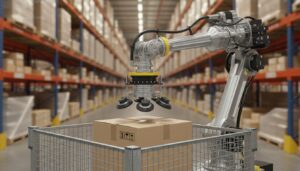

The global logistics sector is currently navigating a precarious intersection between urgent labor shortages and aggressive decarbonization mandates. While automation and alternative fuels often dominate the headlines, a silent revolution is occurring at the foundational level of the supply chain: the standardization of Returnable Transport Items (RTI).
Japan’s Ministry of Land, Infrastructure, Transport and Tourism (MLIT) recently showcased a strategic initiative that serves as a microcosm for this global shift. By pivoting from manual “floor loading” to standardized, data-driven palletization, major players like Denso and Japan Pallet Rental (JPR) are rewriting the rules of cross-border trade.
This article explores how Japan’s push for RTI utilization offers a replicable blueprint for innovation leaders worldwide, transforming the humble pallet from a disposable cost center into a strategic asset for resilience and sustainability.
As discussed in our previous analysis of Hacobu 2025 Report: Regulatory Pressure Drives Global DX, regulatory environments are increasingly forcing companies to digitize. The RTI movement is the physical manifestation of this digital transformation.
Why It Matters: The End of “Floor Loading”
For decades, the logic of international shipping, particularly from manufacturing hubs in Asia to Western markets, was dictated by volume efficiency. “Floor loading”—stacking boxes manually from floor to ceiling inside a container—allowed shippers to maximize space utilization. However, this method incurs a massive “time tax” at the destination: manual devanning (unloading).
In an era of labor abundance, this trade-off was acceptable. Today, with the “2024 Problem” in Japan and similar labor crises in the US and Europe, manual devanning has become a bottleneck that breaks supply chains.
The Double Crisis
- Labor Shortage: Manual unloading of a 40ft container takes hours of intense physical labor, a resource that is becoming scarce and expensive.
- Scope 3 Emissions: Disposable packaging and inefficient turnaround times contribute significantly to indirect supply chain emissions.
Japan’s MLIT has identified RTI not merely as a tool for convenience, but as a critical infrastructure requirement to sustain the flow of goods. This aligns with significant state investment in efficiency, as noted in Japan’s 2026 Logistics Budget: A Global Efficiency Blueprint.
Global Trend: The Race for Standardization
While Japan is accelerating its RTI initiatives, it is essential to contextualize this within the global landscape. The shift toward circular packaging and standardized pooling is happening at different speeds and with different drivers across major markets.
Regional Approaches to RTI and Pooling
The following table outlines how different regions are currently approaching the standardization of transport items.
| Feature | Europe (EU) | United States (US) | Asia (Japan/China) |
|---|---|---|---|
| Primary Driver | Sustainability & Circular Economy (EU Green Deal) | Warehouse Velocity & Automation Compatibility | Labor Shortage & Cost Reduction |
| Standardization Level | High (EPAL/EUR-pallets are ubiquitous) | Moderate (GMA pallets exist but quality varies) | Mixed (Rapidly shifting from loose load to T11/T12) |
| Pooling Model | Mature open pooling systems | Closed loops & rental pools dominant | Emerging cross-border pooling (e.g., JPR) |
| Key Challenge | Cross-border asset recovery | Fragmentation of proprietary systems | Legacy of manual “floor loading” habits |
In the US, the trend is heavily influenced by the need to feed high-speed automated storage and retrieval systems (AS/RS). In Europe, the focus is on reducing packaging waste. Japan’s approach, led by MLIT, bridges these by focusing on Cross-Border Consistency—ensuring that a pallet loaded in Shanghai can be seamlessly inducted into an automated warehouse in Tokyo or Osaka without repalletizing.
Case Study: The Japanese Model in Action
The MLIT showcase highlighted four specific companies that are pioneering this shift. Among them, Denso and Japan Pallet Rental (JPR) stand out for their scale and data-centric approaches.
1. Denso: Centralized Control of 5 Million Units
Denso, a global tier-one automotive supplier, operates one of the most complex supply chains in the world. Their shift to RTI was not just about buying plastic containers; it was about building a global tracking infrastructure.
The Challenge
With 62 global logistics nodes, Denso faced a fragmentation where different regions used different packaging standards, leading to loss, breakage, and repacking costs.
The Solution
Denso implemented a centralized management system for 5 million RTI units.
- Standardization: They unified container sizes to fit modularly onto standard pallets.
- Data Visibility: By integrating RFID and QR codes, Denso can track the lifecycle of each RTI unit.
- Operational Shift: They moved from a “local optimization” model (where each plant manages its own boxes) to a “global loop,” treating RTIs as shared company assets.
The Result
This centralization drastically reduced the procurement of disposable packaging and minimized “dwelling” inventory. The data gathered from RTI movements now informs their production planning, effectively turning transport items into IoT sensors.
2. JPR & Nippon Express: The Cross-Border Breakthrough
Japan Pallet Rental (JPR) partnered with Nippon Express (NX) to tackle the specific inefficiency of the China-Japan trade route. This case is a prime example of shipper-logistics provider collaboration, a necessity emphasized in Japan’s New Logistics Law: Defining Shipper Responsibility.
The “Floor Loading” Trap
Previously, goods imported from China were floor-loaded to maximize container fill rates. Upon arrival in Japan, trucks would wait for hours while workers manually offloaded boxes onto domestic pallets.
The RTI Intervention
JPR introduced a consistent through-transit palletization system. Goods are palletized in China on JPR rental pallets, loaded into containers, and delivered directly to Japanese distribution centers.
Quantifiable Impact
- Time Savings: Devanning time per 40ft container was reduced by 2 hours. This massive reduction frees up truck drivers and dock workers, directly addressing the labor crunch.
- Sustainability: By eliminating disposable wooden pallets and shrink wrap in favor of durable, returnable units, JPR achieved an annual CO2 reduction of approximately 170 tons.
3. Toyo Unyu & The “S-RACK” Innovation
While pallets handle standard boxes, irregular cargo remains a challenge. Toyo Unyu is addressing this with the development of the “S-RACK,” a specialized RTI for difficult-to-handle international cargo.
- Launch Target: First half of 2026.
- Concept: A collapsible, stackable rack system designed for consistent international transport. This allows irregular items to be handled with the speed of standard palletized goods, expanding the RTI revolution beyond simple cardboard boxes.
4. Enabling Automation: The XYZ Robotics Connection
Standardization is the prerequisite for automation. The MLIT showcase highlighted how these RTI initiatives are enabling the deployment of advanced robotics, such as XYZ Robotics’ “Rocky One.”
- The Synergy: Robots cannot easily unload chaotic, floor-loaded containers. However, once cargo is standardized on RTIs (like the JPR model), the “Rocky One” system can automate the devanning process entirely.
- Future State: The combination of JPR’s standardized pallets and XYZ’s robotics creates a “touchless” inbound process, effectively solving the labor shortage at the dock door.
Key Takeaways for Global Leaders
The initiatives by MLIT, Denso, and JPR offer critical lessons for global strategy executives. The shift to RTI is not a procurement decision; it is a strategic supply chain overhaul.
1. Standardization Precedes Automation
You cannot automate a mess. Before investing in expensive robotics or AS/RS, companies must invest in the standardization of the physical units (RTIs) that flow through the system. The “Rocky One” robot is useless without the JPR pallet.
2. Treat RTIs as Data Assets
Denso’s success proves that an RTI is not just a box; it is a data point. Smart RTIs provide visibility into dwell times, route inefficiencies, and inventory accuracy. The future of logistics is the “Physical Internet,” where the container communicates its status to the network.
3. Sustainability is a Byproduct of Efficiency
JPR did not reduce 170 tons of CO2 by buying carbon offsets. They did it by optimizing operations. The most sustainable supply chain is usually the most efficient one. Reducing devanning time reduces truck idling; reusing pallets reduces waste.
4. Cross-Border Collaboration is Mandatory
The success of the China-Japan route relied on the shipper (in China) agreeing to palletize for the benefit of the receiver (in Japan). This requires a shift in procurement contracts (Incoterms) and a redefinition of “Shipper Responsibility,” moving away from purely cost-based freight decisions to total-landed-cost optimization.
Future Outlook: The Rise of Consistent Transport
Looking toward 2030, we expect the “Japanese Model” of state-backed RTI standardization to gain traction globally.
The launch of Toyo Unyu’s S-RACK in 2026 suggests a future where even complex, heavy machinery parts move through the global supply chain as seamlessly as e-commerce parcels. Furthermore, as labor shortages in manufacturing hubs like Vietnam and India intensify, the economic argument for floor loading will evaporate.
The Strategic Imperative:
For global companies, the question is no longer “Should we palletize?” but “How do we standardize our pallets to be data-compatible globally?”
Leaders who anticipate this trend will build supply chains that are not only faster and greener but also resilient enough to withstand the next global disruption. The era of manual logistics is ending; the era of the smart, returnable asset has begun.
See also: Japan’s 2026 Logistics Budget: A Global Efficiency Blueprint