
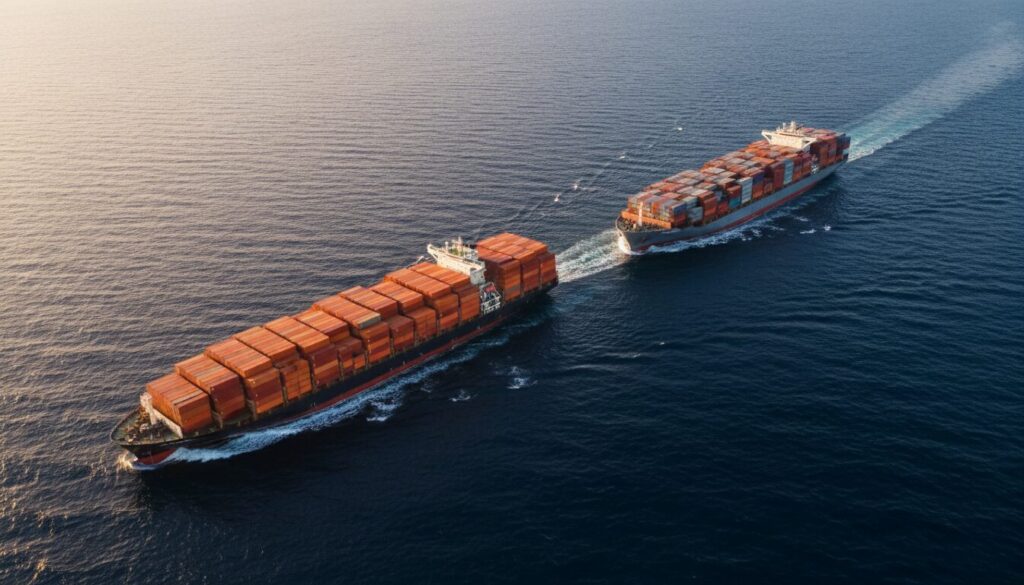
The landscape of global container shipping is undergoing a seismic shift. In a move that redefines the hierarchy of ocean freight, Hapag-Lloyd has announced the acquisition of Israeli carrier Zim for $4.2 billion.
Targeting a closure in late 2026, this deal is not merely about accumulating capacity; it is a calculated strategic maneuver designed to fortify the Gemini Alliance and challenge the dominance of the Mediterranean Shipping Company (MSC). By absorbing Zim’s agile, asset-light operations, Hapag-Lloyd is positioning itself to secure its standing as a top-tier global logistics provider.
For strategy executives and innovation leaders in the US, Europe, and Asia, this acquisition offers a masterclass in market consolidation, alliance leverage, and fleet optimization.
Why It Matters: The Strategic Tectonics
The acquisition of Zim by Hapag-Lloyd represents more than a merger of two corporate entities; it is a restructuring of the global supply chain grid. Currently, the industry is transitioning from a period of hyper-fragmentation to one of “Super-Alliances.”
As discussed in our detailed report, Hapag-Lloyd Buys Zim in $4.2B Deal, this move cements Hapag-Lloyd’s position as the world’s fifth-largest carrier. However, the true significance lies in the Volume Shift.
The Disruption of Vessel Sharing Agreements (VSAs)
Zim has historically operated as a “global niche” carrier, relying heavily on a strategic Vessel Sharing Agreement (VSA) with MSC, particularly on trade lanes between Asia and the US East Coast. This acquisition disrupts that status quo.
- MSC Impact: MSC loses a key partner on specific transpacific routes, forcing the Swiss-Italian giant to re-evaluate its standalone network strategy.
- Gemini Alliance Boost: The “Gemini Cooperation”—the operational alliance between Maersk and Hapag-Lloyd—gains Zim’s volumes. This injection of volume is critical for Gemini’s hub-and-spoke model, ensuring high utilization rates for their massive motherships.
Supply Chain Resilience
For logistics managers, this consolidation implies a change in service optionality. While the number of independent major carriers shrinks, the resilience of the remaining networks potentially increases. The combined entity will manage over 400 vessels with a capacity exceeding 3 million TEUs (Twenty-foot Equivalent Units), creating a denser network that can better absorb shocks—a crucial factor following the disruptions analyzed in 2025 AI vs Risk: The Good, Bad, and Ugly.
Global Trend: The Era of “Agile Scale”
What is happening in the major economic zones (US, China, Europe) that precipitated this deal? We are witnessing a trend where scale alone is no longer sufficient; carriers need “Agile Scale.”
United States: The Transpacific Battleground
In the US, the demand for fast, reliable transpacific services has grown. Zim has built a strong reputation with its “Zimex” fast services, catering to e-commerce giants and time-sensitive cargo owners.
- Trend: Shippers are moving away from “slow steaming” economy services toward premium, guaranteed-delivery options.
- Relevance: Hapag-Lloyd acquires this premium service DNA, allowing it to compete more aggressively for high-value US imports from Asia.
Europe: Regulatory and Green Pressures
European carriers are under immense pressure to decarbonize while maintaining profitability. The EU Emissions Trading System (ETS) makes operating older, inefficient vessels costly.
- Trend: Consolidation allows for faster fleet renewal.
- Relevance: By combining balance sheets, the new entity can accelerate investment in dual-fuel methanol or LNG vessels, crucial for meeting EU 2030 targets.
China and Intra-Asia: The New Manufacturing Hubs
As manufacturing diversifies from China to Vietnam, India, and Thailand (China+1 strategy), carriers need extensive feeder networks.
- Trend: The Intra-Asia trade is the fastest-growing volume trade in the world.
- Relevance: Zim has a robust Intra-Asia network that complements Hapag-Lloyd’s deep-sea focus. This acquisition allows Hapag-Lloyd to capture cargo at the source (e.g., Haiphong or Chennai) and control it all the way to Hamburg or Los Angeles.
Case Study: Hapag-Lloyd Acquires Zim ($4.2B)
This section dissects the specifics of the deal, illustrating how Hapag-Lloyd is executing this strategic pivot. For background on the initial negotiations, see Hapag-Lloyd in talks to acquire Zim for $3.5bn: Global Study.
The Deal Mechanics
- Valuation: $4.2 Billion (Enterprise Value).
- Structure: 100% acquisition of Zim shares.
- Closing Timeline: Late 2026 (Subject to regulatory approval).
- Post-Merger Goal: 18 million TEU annual volume by 2027.
Market Share Transformation
The acquisition significantly alters Hapag-Lloyd’s global footprint. By absorbing Zim, Hapag-Lloyd creates a comfortable buffer between itself and the 6th ranked carrier (ONE), while closing the gap on COSCO.
| Metric | Hapag-Lloyd (Pre-Deal) | Zim (Pre-Deal) | Combined Entity (Post-Deal) |
|---|---|---|---|
| Global Market Share | 7.0% | ~1.8% | 8.8% |
| Global Ranking | 5th | 10th | Solidified 5th |
| Fleet Size | ~260 Vessels | ~140 Vessels | 400+ Vessels |
| Fleet Capacity | ~2.1M TEU | ~700k TEU | 3M+ TEU |
| Primary Alliance | Gemini Cooperation | Independent / MSC VSA | Gemini Cooperation |
Strategic Shift: The Asset-Light Hybrid Model
Perhaps the most innovative aspect of this case study is the shift in fleet philosophy.
Traditionally, Hapag-Lloyd has preferred owning vessels to control costs and quality. Zim, conversely, is famous for its “asset-light” model, chartering the vast majority of its fleet. This allows Zim to scale down quickly during market downturns but exposes them to high charter rates during booms.
The Innovation: The acquisition shifts Hapag-Lloyd’s chartered vessel ratio from 39% to 52%.
Why is this smart?
- Flexibility: In a volatile global economy, having 52% of the fleet on charter allows the combined entity to shed capacity rapidly if demand plummets (e.g., a recession in 2027).
- Capital Efficiency: Instead of tying up billions in steel (ships), capital can be deployed into digitalization, terminal acquisitions, and inland logistics infrastructure.
- Risk Diversification: It creates a hybrid model that balances the stability of ownership with the agility of chartering.
Operational Synergies: The Gemini Effect
The immediate operational impact will be felt within the Gemini Alliance.
- Network Optimization: Zim’s vessels will be integrated into the Gemini “Hub and Spoke” network. Zim’s smaller, faster vessels are perfect for the “shuttle” services Maersk and Hapag-Lloyd are implementing to connect major hubs (like Tanger Med or Singapore) to regional ports.
- Volume Injection: Gemini has set a target of 90%+ schedule reliability. To achieve this, they limit port calls on mainliners. Zim’s volume ensures that these streamlined mainliners run full, maximizing the profitability of the high-reliability strategy.
Key Takeaways: Lessons for the Logistics Industry
The Hapag-Lloyd/Zim deal offers critical lessons for executives across the supply chain spectrum, not just in ocean freight.
1. Strategic Alliances Drive M&A
In the current logistics era, you are who you partner with. Hapag-Lloyd’s acquisition was likely driven by the need to bring value to the Gemini partnership.
- Lesson: Evaluate your M&A targets not just on their standalone EBITDA, but on how they strengthen your ecosystem or alliance.
2. The Rise of the Hybrid Fleet Model
The move to a 52% chartered fleet suggests that total control (ownership) is giving way to flexibility.
- Lesson: In volatile markets, fixed assets can become liabilities. Explore “asset-right” models rather than just “asset-heavy” or “asset-light.”
3. Niche is Valuable, but Scale is Survival
Zim was profitable because it was niche. However, in a market dominated by giants like MSC and CMA CGM, niche players face existential risks during rate wars.
- Lesson: Mid-sized companies must either dominate a specific vertical aggressively or seek shelter within a larger platform to survive long-term consolidation.
4. Geopolitics is a Supply Chain Variable
Acquiring an Israeli carrier involves navigating complex geopolitical waters. Hapag-Lloyd’s willingness to proceed suggests that the strategic value outweighs the geopolitical risk.
- Lesson: Supply chain resilience strategies must account for geopolitical sensitivities, ensuring that the combined network can bypass conflict zones if necessary.
Future Outlook: The Road to 2027
As the deal moves toward its targeted close in late 2026, the industry will be watching several key indicators.
Regulatory Hurdles
The $4.2 billion deal will face intense scrutiny from the US Federal Maritime Commission (FMC), the European Commission, and arguably most importantly, China’s Ministry of Commerce. Regulators are increasingly wary of consolidation that reduces shipper choice. Hapag-Lloyd will need to prove that this merger creates efficiency rather than a monopoly.
Integration of IT Systems
Zim is known for its advanced digital interface and customer-centric IT. Hapag-Lloyd has its own legacy systems. The success of the “18M TEU by 2027” target depends heavily on how quickly these two digital ecosystems can merge. If Hapag-Lloyd can adopt Zim’s digital agility, it could gain a significant competitive advantage in customer experience.
The MSC Response
With Zim leaving the MSC orbit, MSC will have excess capacity on some loops and gaps in others. Expect MSC to respond aggressively, potentially by ordering new tonnage or lowering rates to fight for market share on the Transpacific, creating a volatile pricing environment for shippers in 2026-2027.
Conclusion
The Hapag-Lloyd acquisition of Zim is a defining moment for Logistics 4.0. It signals that the future belongs to those who can combine the scale of a super-carrier with the agility of a niche player. For supply chain leaders, the message is clear: flexibility is the ultimate currency in the next decade of global trade.
See also: