
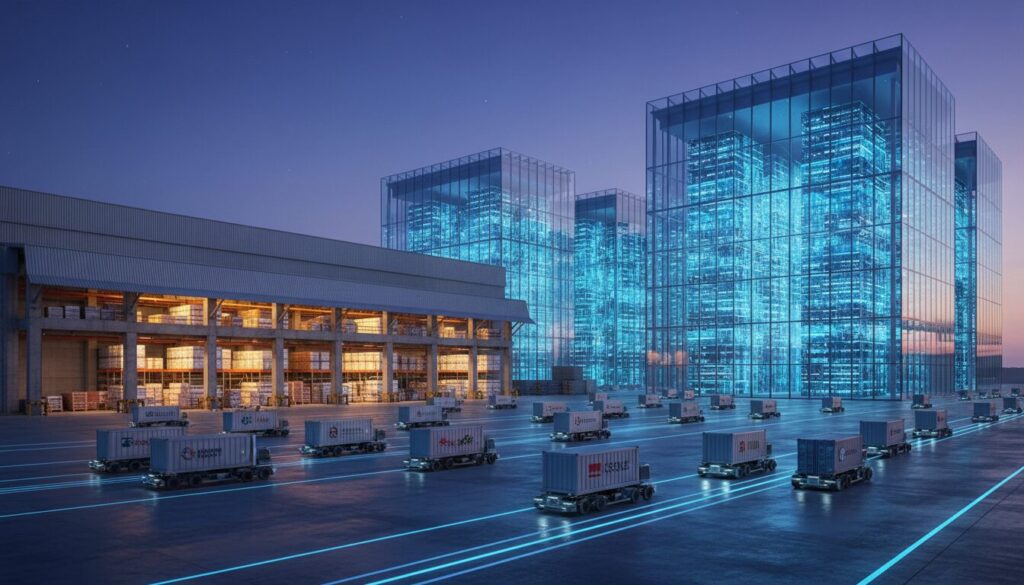
The global supply chain is currently undergoing a tectonic shift, moving from a focus on purely physical infrastructure—ports, roads, and warehouses—to digital infrastructure. At the center of this transformation is a massive redistribution of computing power. While Silicon Valley designs the models and Taiwan manufactures the chips, a new contender is emerging to host the compute at scale.
India is targeting over $200 billion in AI infrastructure investment by 2028 to establish itself as a global computing hub. This is not merely a government aspiration; it is a movement backed by $70 billion in existing pledges from Big Tech giants like Amazon, Google, and Microsoft.
For logistics strategy executives and innovation leaders, this development signals a critical pivot. As we discussed in Winning the AI Capex Race: Amazon’s Logistics Strategy, capital expenditure in AI is reshaping how global networks operate. India’s aggressive entry into this race offers a case study in how sovereign AI ambitions can alter the economics of global supply chains.
Why It Matters: The Shift to “Compute in India”
For decades, the global narrative on India has focused on “Make in India”—an attempt to rival China’s manufacturing dominance. However, the $200 billion target for AI infrastructure represents a strategic pivot toward “Compute in India.”
This matters to the global logistics industry for three primary reasons:
1. The Cost of Intelligence
Logistics optimization relies heavily on AI—from dynamic routing to predictive maintenance and demand forecasting. Currently, the cost of training and running these models (inference) is high, driven by expensive compute resources in the US and Europe. India’s plan focuses on democratizing access to GPU capacity, aiming to lower the unit cost of intelligence.
2. Supply Chain Resilience (China + 1)
As companies diversify their physical supply chains away from China (the “China + 1” strategy), digital supply chains must follow. Data residency laws and latency requirements necessitate that computing power be located near the manufacturing hubs. India’s infrastructure push ensures that as physical factories move to South Asia, the digital “brain” managing them is locally available.
3. Sovereign AI and Data Sovereignty
The IndiaAI Mission aims to scale shared compute capacity from 38,000 to over 58,000 GPUs. This creates a sovereign AI stack that allows global logistics companies operating in the region to process data locally, navigating increasingly complex cross-border data transfer regulations without sacrificing speed.
Global Trend: The Race for AI Supremacy
To understand the magnitude of India’s $200 billion bid, we must contextualize it within the global landscape. The US, China, and Europe are all pursuing distinct strategies regarding AI infrastructure, each impacting global logistics differently.
The following table compares the strategic focus of major regions and their implications for logistics networks.
| Region | Strategic Focus | Key Advantage | Logistics Implication |
|---|---|---|---|
| United States | Innovation & Model Design | Dominance in IP and generative AI model creation. | Source of advanced WMS/TMS algorithms; high cost of compute. |
| China | Hardware Integration | Integration of AI into robotics and physical automation. | Leader in automated ports and warehousing hardware. |
| Europe (EU) | Regulation & Sustainability | Green AI and ethical governance (GDPR/AI Act). | Focus on carbon tracking and compliant supply chains; slower deployment. |
| India | Infrastructure & Scale | Low-cost deployment, massive talent pool, sovereign compute. | Hub for back-office optimization, low-cost predictive analytics, and regional data processing. |
While the US leads in inventing the technology, India is positioning itself as the most efficient place to run the technology. For a global logistics firm, this suggests a future operating model where high-level strategy is designed in the US/EU, but the heavy computational lifting—processing millions of daily tracking events—occurs in Indian data centers.
Case Study: Amazon Web Services (AWS) and the Indian Cloud
The most tangible evidence of this trend is the commitment from hyperscalers. While the government targets $200 billion, private sector validation is already visible. A prime example is Amazon (AWS), which is central to India’s AI infrastructure expansion.
The Investment Landscape
Amazon has committed to investing $12.7 billion (₹1,05,600 crore) in cloud infrastructure in India by 2030. This is part of the broader $70 billion pledged by Big Tech (including Google and Microsoft) to expand Indian operations.
Strategic Deployment for Logistics
This investment is not just about storage; it is about bringing high-performance computing (HPC) closer to the point of action.
- Regional Zones: AWS has expanded its Asia Pacific (Hyderabad) Region and Mumbai Region. For logistics, this dual-region setup provides high availability and disaster recovery essential for supply chain continuity.
- Latency Reduction: By hosting AI models locally, logistics companies in South Asia reduce latency for real-time applications. For instance, an automated sorting facility in Maharashtra can process video feeds for quality control in milliseconds using local compute, rather than sending data to Singapore or Europe.
- Deep Tech Integration: The infrastructure supports the deployment of “Deep Tech” applications. This aligns with the Indian government’s newly approved ₹100 billion ($1.1 billion) venture fund, which targets high-risk areas including robotics and automation.
See also: India’s $1.1B Tech Fund: Logistics Impact Alert
The Ripple Effect
Amazon’s investment serves as a cornerstone. It signals to other technology providers that the power grid, connectivity, and regulatory environment in India are maturing enough to support hyperscale AI. For logistics providers, this means the ecosystem of tools available in India—from route optimization SaaS to warehouse robotics software—will become more robust and cost-effective.
Key Takeaways for Logistics Leaders
The ambition for India to attract over $200B in AI infrastructure investment by 2028 is not just a macroeconomic statistic; it is a roadmap for future supply chain strategy.
1. Digital Infrastructure is the New Port
Just as logistics leaders track the capacity of the Port of Rotterdam or Shanghai, they must now track GPU capacity. The scaling to 58,000+ GPUs under the IndiaAI Mission creates a “digital port” where data can be processed. Companies should evaluate their cloud strategy to ensure they are utilizing these emerging, lower-cost compute hubs.
2. Policy Incentives favor Long-Term Innovation
The Indian government has introduced policy shifts including 20-year startup status eligibility and long-term tax relief for export-oriented cloud services.
- Actionable Insight: Logistics firms should look to partner with Indian “Deep Tech” startups for R&D. The extended startup status allows these companies to take longer-term risks on complex problems like autonomous last-mile delivery in chaotic traffic environments, which can then be exported to other emerging markets.
3. The Democratization of Predictive Logistics
Currently, advanced digital twins and heavy AI modeling are the domain of Tier-1 logistics giants due to cost. As the $200 billion investment drives down the cost of compute in the region, mid-tier logistics providers will gain access to enterprise-grade AI tools.
- Scenario: A mid-sized freight forwarder in Southeast Asia could use Indian-hosted AI infrastructure to run complex weather and geopolitical risk simulations for routing, a capability previously too expensive to maintain.
4. Talent Arbitrage 2.0
India has long been a hub for IT services. The new wave of investment shifts the focus from “coding” to “AI engineering.” With the infrastructure to train models locally, the talent pool for supply chain data science will deepen significantly. Global firms should consider establishing “AI Centers of Excellence” in India not just for cost savings, but for access to specialized talent working on the cutting edge of GPU-accelerated logistics.
Future Outlook: 2028 and Beyond
If India succeeds in attracting the targeted $200 billion, by 2028 it will likely host a significant percentage of the world’s non-Chinese AI compute capacity.
The Rise of “Intelligence Exports”
We anticipate a shift where India begins to export “Intelligence” as a service. Logistics control towers in Europe or the US might rely on AI agents hosted in India to perform 24/7 autonomous dispatching and brokerage.
Infrastructure Challenges Remain
Despite the capital influx, challenges in power stability and cooling water availability for data centers remain. Logistics companies must assess the resilience of these digital nodes just as they would physical infrastructure.
Conclusion
The $200 billion bid is a clear signal: the geography of the digital supply chain is expanding. For innovation leaders, the “India Stack” for AI offers a new frontier for efficiency, resilience, and technological arbitrage. As the physical supply chain diversifies, the digital supply chain is anchoring itself in South Asia, creating a new axis of influence in global logistics.