
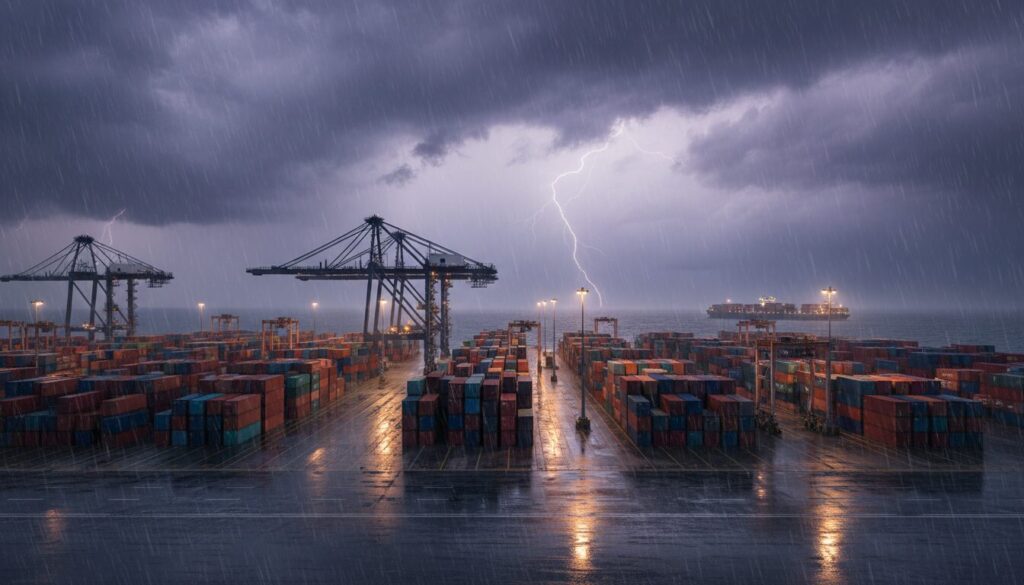
The expectation that 2026 would bring a “new normal” to global trade has been shattered. Instead of stabilization, supply chain executives are facing a phenomenon analysts are calling “policy whiplash.”
The geopolitical landscape has shifted from traditional protectionism—which, while costly, was predictable—to a volatile environment driven by national security imperatives and judicial uncertainty. As the U.S. gears up for the critical USMCA (United States-Mexico-Canada Agreement) review in July 2026, and with the Supreme Court poised to rule on the constitutionality of executive tariff powers, the era of stable sourcing is effectively over.
For innovation leaders and logistics strategists, the message is clear: There is no end in sight for trade turbulence in 2026. This article explores the mechanics of this turbulence, analyzes the global response, and examines how forward-thinking companies are re-engineering their networks to survive the storm.
Why It Matters: The High Cost of “Resilience”
The narrative that tariffs are paid by foreign exporters has been mathematically dismantled. Recent research from the New York Federal Reserve indicates that 90% of the economic burden from recent trade levies is borne by domestic companies and consumers. This cost transfer creates intense margin compression for retailers and manufacturers alike.
However, the financial cost is secondary to the operational chaos. We are witnessing a transition from economic efficiency to a “National Security Resilience” model. In this model, trade lanes are not determined by the lowest cost, but by political alignment.
The Three Pillars of 2026 Turbulence
- The USMCA Cliff: The scheduled review of the USMCA in July 2026 is not a formality. With political pressure mounting to reduce the U.S. trade deficit with Mexico, there is a legitimate risk of “sunset” clauses being triggered or radical renegotiations that could dismantle nearshoring investments overnight.
- Judicial Whiplash: A pending Supreme Court ruling challenges the scope of executive power in levying tariffs under national security grounds (Section 232). A ruling against the administration could invalidate current tariffs, triggering billions in Treasury refunds—a chaotic “win” that would destabilize market pricing instantly. Conversely, affirming these powers could embolden even more aggressive, unpredictable levies.
- The “Liberation Day” Effect: Logistics teams are now dealing with “Liberation Day” style announcements—sudden, zero-notice regulatory changes that strand cargo at sea or force immediate rerouting.
As discussed in our analysis of the Aritzia Case Study: Tariffs & De Minimis End, even agile fashion retailers are struggling to maintain margins as trade borders tighten.
Global Trend: The Fracture of the “World Factory”
The response to this turbulence is not uniform. The global logistics map is fracturing into distinct blocs, each requiring a unique supply chain strategy.
United States: The Fortress Economy
The U.S. strategy has pivoted fully to protectionism wrapped in security language. The focus is on “friend-shoring,” but the definition of “friend” is fluid. The immediate impact is a surge in transpacific costs as companies rush to beat potential new levies.
See also: Transpacific Ocean Rates Spike to Start 2026
Europe: The Regulatory Superpower
Caught between U.S. protectionism and Chinese industrial overcapacity, the EU is using regulation as its primary trade barrier. The Carbon Border Adjustment Mechanism (CBAM) is fully active in 2026, forcing importers to pay for the embedded carbon in their goods. This creates a “Green Tariff” wall that complicates sourcing from developing nations with dirty energy grids.
China: The Global South Pivot
Facing restricted access to Western markets, Chinese manufacturers are aggressively pivoting to the “Global South” (Latin America, Africa, Southeast Asia). They are also embedding themselves into the supply chains of U.S. partners (like Mexico and Vietnam), prompting Washington to scrutinize “country of origin” labeling more deeply than ever before.
Comparative Analysis of Regional Trade Pressures
The following table outlines the distinct pressures executives must navigate in the three major economic zones in 2026.
| Feature | United States | European Union | China |
|---|---|---|---|
| Primary Policy Tool | Section 301/232 Tariffs & Executive Orders | CBAM (Carbon Tax) & Supply Chain Due Diligence | Export Controls & State Subsidies |
| Logistics Impact | High volatility; sudden port entry rejections. | High administrative burden; rigid reporting. | Route diversification; bypassing Western ports. |
| Strategic Goal | National Security & Re-industrialization | Sustainability & “Strategic Autonomy” | Export dominance via non-aligned markets. |
| Top Risk for Firms | USMCA Dissolution (July 2026) | Non-compliance fines (ESG) | Tech decoupling & sanction exposure. |
Case Study: Schneider Electric’s “Multi-Local” Triumph
While many companies are scrambling to react, Schneider Electric stands out as a success story in navigating the 2026 trade turbulence. The French multinational, a leader in digital automation and energy management, foresaw the fragmentation of global trade years ago and adopted a “Multi-Local” strategy.
The Challenge
Schneider Electric faced the same headwinds as everyone else:
- U.S. tariffs on steel and aluminum (critical for their hardware).
- European carbon regulations.
- Volatile shipping rates across the Pacific.
The Innovation: Shortening the Chain
Instead of relying on a centralized “World Factory” model (e.g., making everything in China for global export), Schneider moved to a regionalized production model. Their goal was to produce 80% of products within the same region where they are sold.
Strategy Execution
- Regional Hubs: They established self-sufficient hubs in North America (Mexico/USA), Europe, India, and China. Each hub has its own procurement, R&D, and manufacturing capabilities.
- The Mexico Pivot: Anticipating U.S. trade barriers, Schneider expanded its footprint in Mexico significantly. However, unlike competitors who treat Mexico merely as a cheap assembly point for Asian components, Schneider worked to localize the sub-tier supply chain, reducing “Rules of Origin” risks under the USMCA.
- Digital Twin Integration: They utilized their own EcoStruxure™ software to create digital twins of their supply chain. This allowed them to simulate tariff scenarios. When a new tariff is announced, they can instantly calculate the cost impact of shifting production from their China hub to their India or Mexico hub.
The Results
By 2026, while competitors struggled with the 90% tariff burden pass-through, Schneider Electric maintained stable pricing and lead times.
- Resilience: When transpacific rates spiked in early 2026, Schneider’s North American operations were largely insulated because their supply lines were continental, not intercontinental.
- Compliance: Their localized sourcing in Europe simplified CBAM compliance, as they weren’t importing heavy-carbon steel from distant markets.
This approach aligns perfectly with the insights in our report on Mexico Nearshoring: 3 Ways to Evaluate Regional Labor ROI, proving that regional labor strategies are about risk mitigation, not just labor arbitrage.
Key Takeaways for Logistics Leaders
The “No End in Sight” forecast for trade turbulence requires a fundamental shift in logistics management. The era of the “Lowest Landed Cost” is dead; 2026 is the era of “Lowest Risk Landed Cost.”
1. Diversification is Not Enough; You Need Regionalization
Simply having a backup factory in Vietnam is no longer sufficient if the raw materials still come from China. The U.S. government is actively closing these loopholes.
- Action: Audit your Bill of Materials (BOM) down to Tier 3. Ensure that your “China+1” strategy isn’t just a transshipment hub, but a true value-add manufacturing location.
2. Prepare for the USMCA Review
The July 2026 review could destabilize North American freight. Companies relying heavily on cross-border trucking between Mexico and the U.S. must have contingency plans.
- Action: Secure bonded warehousing capacity on both sides of the border now. If tariffs snap back, you need a place to hold inventory while re-evaluating pricing.
3. Embrace the 4PL Model for Visibility
Managing these geopolitical complexities requires data visibility that traditional 3PLs often lack. As trade barriers rise, the ability to orchestrate logistics data becomes a competitive advantage.
- Action: Move from transactional logistics to strategic oversight.
- See also: Gartner Debuts 4PL Magic Quadrant: Tariffs Reshape Logistics
4. Legal Resilience is Operational Resilience
With the Supreme Court and international tribunals becoming major players in logistics (as seen in port disputes), legal teams must be integrated into supply chain planning.
Future Outlook: The “Sunset” Risk
Looking beyond 2026, the greatest danger is the potential dissolution of established trade frameworks. If the U.S. opts to withdraw from or drastically alter the USMCA, or if the Supreme Court invalidates the Section 232 tariff structure, the resulting chaos will dwarf the supply chain disruptions of the early 2020s.
We are moving toward a world of “Transactional Sovereignty,” where trade rules are rewritten not over decades, but over weeks. For innovation leaders, the priority is no longer just “Just-in-Time” or “Just-in-Case,” but “Just-in-Region.”
There is no end in sight for trade turbulence in 2026. The companies that will thrive are those that stop waiting for the storm to pass and start building windproof supply chains today.