
The global manufacturing landscape is undergoing a tectonic shift. For decades, the dominant strategy was to outsource non-core competencies—specifically logistics—to Third-Party Logistics (3PL) providers. The logic was simple: focus on making the product, let someone else move the parts. However, in an era defined by supply chain volatility, labor shortages, and the demand for hyper-customization, this barrier between “making” and “moving” has become a bottleneck.
A compelling counter-trend is emerging: Logistics Insourcing powered by Robotics.
A prime example of this strategic pivot comes from Japan’s medical technology sector. Sysmex RA, a subsidiary of the global healthcare giant Sysmex Corporation, has integrated Rapyuta Robotics’ PA-AMR (Picking Assist Autonomous Mobile Robot) into its new factory in Shiojiri, Nagano. By bringing logistics back in-house and automating it, Sysmex RA is not just cutting costs—they are synchronizing their manufacturing heartbeat with their supply chain.
For innovation leaders and strategy executives in the US, EU, and Asia, this case study offers a blueprint for the future of the smart factory. It illustrates how decoupling from rigid outsourcing models and deploying flexible automation can solve the dual challenges of labor scarcity and production complexity.
Why It Matters: The Convergence of Manufacturing and Logistics
Historically, factory logistics (intralogistics) and manufacturing operations were treated as separate silos. Logistics ensured parts arrived at the receiving dock, and manufacturing took over from there. Today, that distinction is vanishing.
In high-mix, low-volume industries like medical device manufacturing, the flow of components to the assembly line must be as precise as the assembly itself. Relying on external partners for on-site logistics often leads to communication lags and a lack of agility. If production schedules change instantly due to a rush order, an outsourced team may not be able to pivot as quickly as an integrated, in-house team supported by autonomous software.
The Global Context: Resilience over Cost
The Sysmex RA case is symptomatic of a broader global trend where resilience is prioritized over pure cost reduction.
- Supply Chain Visibility: Insourcing allows for real-time data integration between Warehouse Management Systems (WMS) and Manufacturing Execution Systems (MES).
- Labor Optimization: In aging societies (Japan, Germany) and labor-tight markets (US), finding staff for low-value transport tasks is impossible.
- Quality Control: In MedTech, traceability is paramount. Handling logistics in-house ensures stricter adherence to quality protocols.
As discussed in IFR Names Top 5 Global Robotics Trends of 2026 for Logistics, the integration of autonomy is no longer optional; it is a critical survival mechanism for modern supply chains.
Global Trend: How US, Europe, and Asia approach Intralogistics
While the Sysmex case is specific to Japan, the pressures driving this decision are universal. However, the adoption patterns vary across major industrial regions.
United States: Reshoring and Brownfield Modernization
In the US, the “Reshoring” wave driven by the Inflation Reduction Act has led to a surge in new factory construction. However, labor costs in the US are prohibitively high. American manufacturers are aggressively adopting AMRs not just to replace workers, but to make the few available workers more efficient. The trend here is heavily focused on flexibility—robots that can be deployed in existing (brownfield) warehouses without laying down magnetic tape or modifying infrastructure.
Europe: Industry 4.0 and Human-Robot Collaboration
Led by Germany, Europe focuses on “Industry 4.0,” where cyber-physical systems communicate. The European approach prioritizes safety and collaboration (Cobots). The goal is to keep the human in the loop for complex tasks while offloading the “heavy lifting” to AMRs. The focus is on high-value manufacturing (automotive, aerospace, medical).
Asia (China & Japan): Speed vs. Labor Shortage
- China: The focus is often on speed and scale. China leads in the production of AGVs and AMRs, often deploying them in massive “dark factories” where human involvement is minimized to near zero.
- Japan: Japan faces a unique demographic crisis—a shrinking workforce. The Sysmex RA case reflects the Japanese philosophy of “Jidoka” (automation with a human touch). It isn’t about eliminating people; it’s about maximizing the value of the limited staff available.
Comparative Analysis: Logistics Automation Strategies
| Feature | Outsourced Manual Logistics (Traditional) | Integrated In-House AMR Logistics (Modern) |
|---|---|---|
| Control | Low; reliant on partner SLAs | High; direct control over workflows |
| Agility | Slow response to production shifts | Real-time synchronization with assembly |
| Labor Usage | High % of walking/pushing carts | Staff focused on assembly/picking |
| Data Visibility | Fragmented (Siloed systems) | Unified (End-to-end traceability) |
| Scalability | Linear (add more people) | Flexible (add more robots) |
Case Study: Sysmex RA & Rapyuta Robotics
To understand the practical application of these trends, we examine the deployment at Sysmex RA’s new Shiojiri factory.
The Challenge: Volatility and Labor Scarcity
Sysmex RA produces hemostasis analyzers—critical medical devices. Previously, their logistics operations (receiving parts, storage, supplying the line) were outsourced. This created several friction points:
- Lead Times: Changes in production plans took time to filter down to the external logistics team.
- Labor Waste: Highly skilled workers often had to interrupt assembly to fetch parts if the logistics flow lagged.
- Physical Strain: Workers walked kilometers daily pushing heavy carts.
The Solution: Strategic Insourcing with PA-AMR
Sysmex RA decided to bring logistics in-house for the new plant. However, they did not want to simply hire a new internal team of movers. They partnered with Rapyuta Robotics, a pioneer in cloud robotics, to deploy PA-AMRs (Picking Assist Autonomous Mobile Robots).
See also: AI Robotics Shift: From Hardware to Cognitive Swarms for more on the software intelligence behind these systems.
How It Works
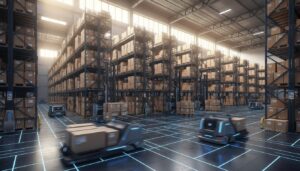
The Rapyuta PA-AMR is not a simple transport vehicle; it is a collaborative picking assistant.
- Collaborative Picking: The AMRs navigate to the storage shelf location autonomously. The human worker meets the robot there, picks the item, scans it, and places it on the robot.
- Autonomous Transport: Once the picking batch is complete, the robot autonomously drives the parts to the assembly area or packing station. The worker stays in the aisles to continue picking with the next robot.
- Replenishment: The system handles not just outbound picking for assembly but also the replenishment of storage from the receiving dock.
The Results: Redirecting Labor to Value
The impact of this deployment was immediate and multifaceted:
- Elimination of Transport Walking: The most non-value-added activity—walking a cart from the warehouse to the assembly line—was eliminated for humans.
- Focus on High-Value Tasks: The labor hours saved were not used to fire staff. Instead, personnel were retrained and reallocated to assembly and inspection processes. This directly increased the plant’s production capacity without hiring new assembly workers.
- Digital Synchronization: By insourcing, Sysmex now has a digital pulse on every part in the facility, allowing for leaner inventory levels and faster reaction to demand spikes.
Key Takeaways for Logistics Leaders
The Sysmex RA case provides three critical lessons for global executives considering their supply chain strategies.
1. Insourcing is a Viable Strategy for Resilience
The pendulum is swinging back from extreme outsourcing. For critical manufacturing components, owning the logistics process provides the agility required to survive market volatility. However, insourcing is only viable if it is automated; otherwise, the labor costs are prohibitive.
2. The Rise of the “Factory Team”
The future is not “lights out” automation for high-mix sectors like MedTech. It is about Human-Robot interaction. The Rapyuta AMRs handle the “legs” (transport), while humans handle the “hands and eyes” (picking and assembly). This distinction is vital for maintaining quality in regulated industries.
For deeper insight into this dynamic, refer to Collaborative Robots: The Rise of Human-Robot Factory Teams.
3. Software Defines the Hardware
The success of the Sysmex deployment wasn’t just about the robot hardware. It was Rapyuta’s cloud robotics platform that allowed for seamless integration with Sysmex’s internal systems. When selecting automation partners, prioritize their software stack and integration capabilities over pure hardware specs.
Future Outlook: The Smart Factory Ecosystem
The Sysmex RA integration of Rapyuta Robotics is just the beginning. As we look toward 2030, we can expect this model to evolve further:
- Predictive Logistics: Instead of reacting to assembly line requests, AI will predict part consumption based on real-time machine data and dispatch AMRs before the line even realizes it needs parts.
- Interoperability: We will see mixed fleets—forklift AGVs working alongside picking AMRs from different vendors—communicating via standard protocols like VDA 5050.
- Sustainability: Reducing human movement and optimizing robot paths contributes to lower energy consumption and a smaller carbon footprint for the facility.
Conclusion
The decision by Sysmex RA to insource logistics using Rapyuta Robotics is a microcosm of a global trend. It challenges the assumption that logistics should always be outsourced and demonstrates that with the right technology, logistics can become a core competitive advantage. For manufacturers in the US, Europe, and Asia, the message is clear: To secure your supply chain, you may need to bring it home—and let the robots do the heavy lifting.