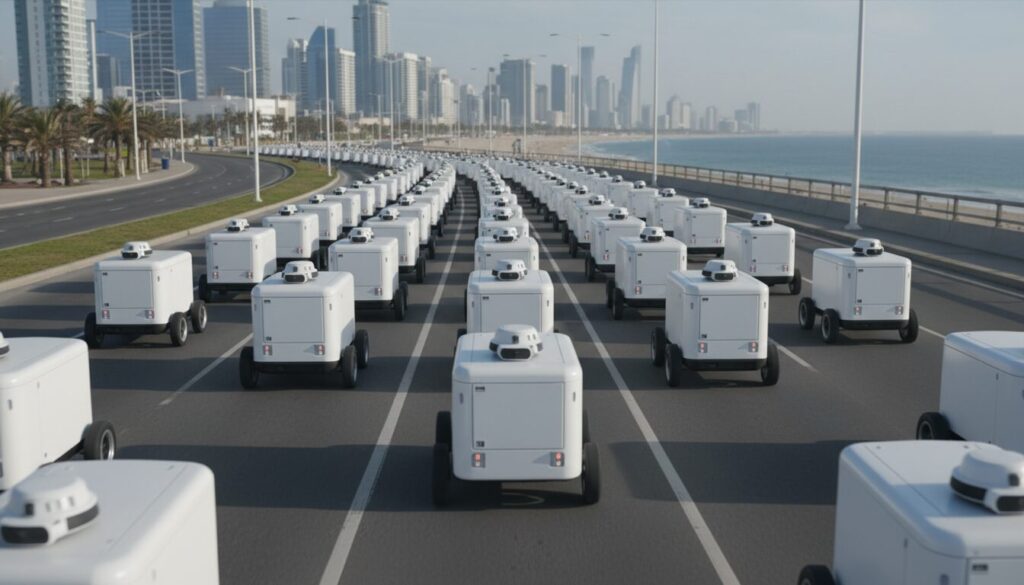
During the Lunar New Year (Spring Festival), traditionally a time when China’s logistics networks strain under the dual pressure of skyrocketing demand and a vacationing workforce, a different scene played out in the streets of Qingdao. Instead of overwhelmed couriers, a fleet of over 1,200 autonomous delivery vehicles (ADVs) quietly navigated the coastal city, ensuring that the supply chain remained unbroken.
For global innovation leaders and supply chain executives, the footage coming out of Qingdao represents a pivotal moment. It signals the end of the “experimental pilot” phase of autonomous delivery and the beginning of massive, industrial-scale deployment.
We are witnessing a fundamental shift in last-mile logic. This is no longer about testing if a robot can deliver a package; it is a demonstration of how a city runs when 1,200 of them operate simultaneously. This article explores the mechanics of Qingdao’s success, the technology behind Neolix’s deployment, and what US and European markets can learn from this case study in “human-less logistics.”
1. Why It Matters: The Global Context
The logistics industry faces a synchronized global crisis: the “Labor Cliff.” From the “2024 Problem” in Japan, where overtime regulations are slashing driver availability, to the chronic shortage of long-haul drivers in the US and Europe, human capital is becoming the most volatile variable in the supply chain equation.
For years, the industry response has been hardware-focused: bigger trucks, electric vans, and faster sorting machines. However, the Qingdao deployment proves that the solution lies in Autonomous Mobility as a Service (MaaS).
This shift mirrors the broader trends we have analyzed recently. As companies move away from pure hardware competition, the value is migrating toward software intelligence and fleet coordination.
The significance of the Qingdao case is not the technology itself—autonomous driving has existed for years—but the density of deployment. Deploying 1,200 units in a single urban environment creates a “network effect” that drastically lowers the unit cost of delivery, finally offering a viable alternative to human couriers for heavy-duty last-mile tasks.
2. Global Trend: The State of Autonomy
While Qingdao is currently the densest autonomous delivery zone, it is essential to contextualize this within the global landscape. The approach to autonomous logistics varies significantly between the US, Europe, and China.
Comparative Analysis: Global Autonomous Delivery Strategies
| Feature | United States | Europe | China (Qingdao Model) |
|---|---|---|---|
| Primary Players | Nuro, Waymo (via Uber), Zoox | Starship, Goggo Network | Neolix, Meituan, JD.com |
| Vehicle Form Factor | Mixed: Sidewalk bots & Custom Pods (Nuro) | Predominantly Sidewalk Robots (<50kg) | Light Commercial Vehicles (1-ton capacity) |
| Regulatory Environment | Fragmented (State-by-State); High Liability focus | Stringent privacy (GDPR) & safety norms | Centralized support; “Sandboxing” large zones |
| Tech Focus | L4/L5 with heavy Lidar/HD Map reliance | Vision-based, low speed, safety-first | AI Vision-Action Models (Mapless navigation) |
| Primary Use Case | Grocery/Food Delivery (B2C) | Parcel/Food (B2C) | B2B Industrial, Pharma, Retail Restock |
The Divergence
In the US, companies like Nuro have focused heavily on custom-built vehicles for suburban grocery delivery. However, regulatory hurdles and high production costs have slowed scaling. In Europe, the focus has often been on smaller “cooler-sized” robots (like Starship) that share sidewalks with pedestrians.
China’s strategy, exemplified by Neolix in Qingdao, bridges the gap. By utilizing public roads (not sidewalks) and deploying vehicles with a 1-ton payload, they are not just replacing the pizza delivery boy; they are replacing the urban cargo van.
This consolidation of sensors and movement toward “Physical AI” is a trend we are seeing globally, but China is executing it at speed.
3. Case Study: Neolix in Qingdao
The deployment in Qingdao involves a strategic partnership between Neolix (the vehicle manufacturer and operator), Didi (the ride-hailing giant providing the user interface), and the local government.
The Hardware: Beyond the “Sidewalk Bot”
The vehicles roaming Qingdao are vastly different from the small roving coolers seen on US college campuses. These are industrial-grade logistics tools.
- Payload: 1,000 kg (1 Ton)
- Cargo Volume: 6 cubic meters (comparable to a small cargo van)
- Range: 200 km per charge
- Uptime: 24/7 operations enabled by a 2-hour fast-charge capability/battery swapping.
This capacity allows the fleet to service diverse sectors. In Qingdao, these vehicles are not limited to delivering fast food. They are actively transporting:
- Pharmaceuticals: Secure transport between hospitals and clinics.
- Auto Parts: Just-in-Time delivery to repair shops.
- Construction Materials: Last-mile transport to active sites.
- Retail Replenishment: Restocking convenience stores overnight.
The “Vision-Action” AI Model
One of the most critical innovations allowing this scale is the move away from expensive High-Definition (HD) Maps. Traditionally, autonomous vehicles rely on pre-scanned, centimeter-perfect maps of the city. Maintaining these maps is costly and creates a bottleneck for expansion.
Neolix utilizes a proprietary “Vision-Action” AI model.
- Concept: Similar to how humans navigate, the AI uses real-time computer vision to interpret the environment rather than matching sensor data to a pre-downloaded map.
- Benefit: This drastically reduces the computational load and the operational cost of entering new neighborhoods. It allows the fleet to adapt instantly to road construction or layout changes without waiting for a map update.
This mirrors the capex strategies we see in major tech giants, where investment is pouring into AI models that can generalize the physical world.
Seamless UX Integration
Technology means nothing if users cannot access it. The Qingdao deployment leverages the ubiquity of Didi (China’s Uber) and WeChat.
Users—whether a hospital administrator or a construction foreman—summon the vehicle via the Didi app. When the vehicle arrives, they unlock the specific cargo bay using their smartphone. This integration into an existing “Super App” removes the friction of downloading a proprietary logistics app, streamlining the adoption curve.
4. Key Takeaways for Logistics Leaders
For executives in the US and Europe, the Qingdao case study offers actionable insights for future supply chain strategies.
1. Capacity is Key to Profitability
Small sidewalk robots struggle with unit economics because they carry low-value, low-volume goods. The Neolix model (1-ton capacity) suggests that the “sweet spot” for autonomous delivery profitability is replacing the human-driven cargo van, not the bicycle courier. Leaders should evaluate autonomous solutions that can handle B2B industrial loads.
2. Mapless Autonomy is the Future
Reliance on HD Maps is a scalability trap. Investment should be directed toward vision-based perception systems that allow vehicles to navigate “unseen” environments. This reduces the cost of entry into new markets and increases fleet resilience.
3. The Ecosystem Play
Neolix provided the hardware, but Didi provided the network. Logistics companies should not attempt to build the entire stack alone. Partnerships with ride-hailing platforms or major e-commerce apps are essential to ensure high utilization rates of the assets.
4. Supply Chain Resilience
During the Spring Festival, human labor availability drops to near zero. Autonomous fleets provide a “base load” of logistics capability that is immune to holidays, pandemics, or labor strikes. Building a hybrid fleet (human + autonomous) is the ultimate hedge against disruption.
5. Future Outlook: The Convergence of Form Factors
As impressive as the 1,200-vehicle fleet is, it represents only the “Middle Mile” and “Street-Level Last Mile.” The vehicle can reach the curb, but it cannot climb stairs or enter a warehouse to pick items off a shelf.
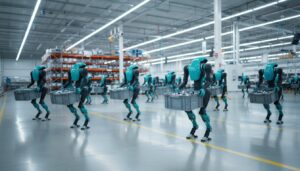
The next phase of innovation will be the convergence of these road-based ADVs with Humanoid Robots.
Imagine a future where a Neolix vehicle pulls up to an office building, and a humanoid robot steps out of the back to carry the package up the elevator. This is not science fiction; given the surge in humanoid production in China, it is the logical next step in supply chain integration.
Conclusion
The deployment of 1,200 autonomous vehicles in Qingdao is a wake-up call. It demonstrates that “human-less logistics” has graduated from R&D labs to city streets. By combining high-capacity hardware, mapless AI navigation, and consumer-grade software integration, Qingdao provides a blueprint for the future of urban logistics.
For global strategists, the question is no longer if this technology will scale, but how quickly they can adapt their own supply chains to compete in this automated reality.