
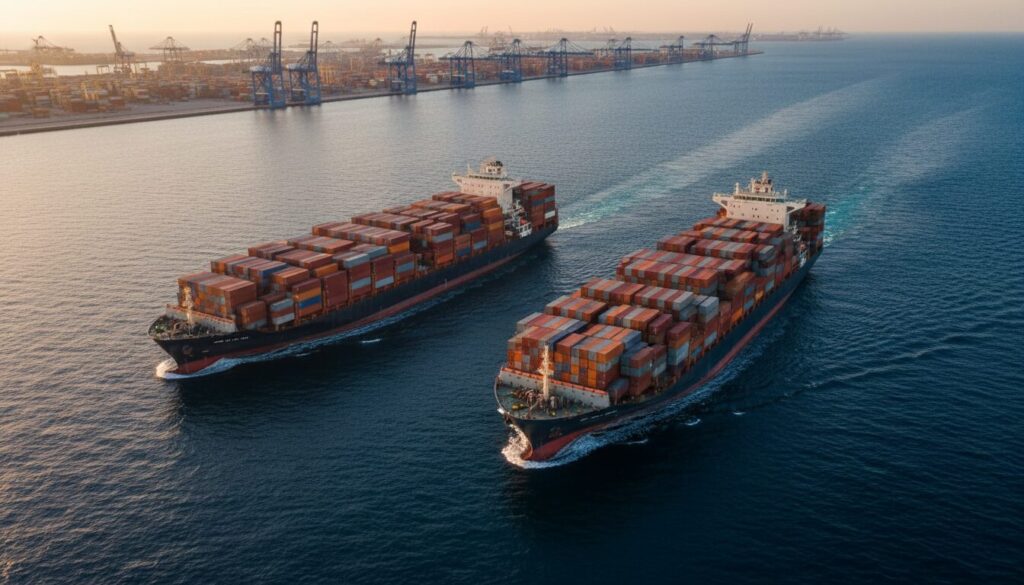
The global shipping landscape is undergoing its most significant transformation since the consolidation wave of the mid-2010s. In a move that redefines the hierarchy of ocean freight, Hapag-Lloyd has confirmed an agreement to acquire Israeli carrier Zim Integrated Shipping Services for $4.2 billion.
This transaction represents more than just a merger of fleets; it is a strategic maneuver designed to navigate the post-pandemic freight slump, secure a dominant position in Asian trade lanes, and innovate around complex geopolitical barriers.
As discussed in our previous analysis, Hapag-Lloyd in talks to acquire Zim for $3.5bn: Global Study, the market had anticipated a significant move. However, the finalized deal structure—valued higher than the initial rumors—reveals a sophisticated approach to asset-light logistics and national security compliance.
Why It Matters: The Era of Strategic Fortification
For strategy executives and innovation leaders, this acquisition signals the end of “growth at all costs” and the beginning of “strategic fortification.” The container shipping industry has moved past the volatile boom of 2021-2022 and is settling into a period of normalized rates and overcapacity management.
The acquisition matters globally for three primary reasons:
- Consolidation of the Trans-Pacific Trade: Zim has historically held a strong, nimble position in the Trans-Pacific trade (Asia to US). Hapag-Lloyd, traditionally stronger in the Atlantic and Europe-Asia lanes, effectively buys immediate market share in the critical China-US corridor.
- Hybridization of Fleet Models: The deal combines Hapag-Lloyd’s asset-heavy ownership model with Zim’s asset-light chartering model, creating a hybrid operational structure capable of flexing with market demand.
- Geopolitical M&A Templates: The involvement of FIMI Funds to satisfy Israeli security concerns sets a precedent for how global companies can acquire assets in nations with strict protectionist policies.
Global Trend: Diverging Strategies in Major Markets
The Hapag-Lloyd and Zim deal does not exist in a vacuum. It is a reaction to diverging strategies across the world’s three major logistics hubs: Europe, Asia, and the United States.
Europe: The Split Between Integration and Scale
European carriers are currently split into two camps regarding strategy:
- Vertical Integration (Maersk/CMA CGM): These carriers are buying warehouses, last-mile delivery firms, and air cargo fleets to become end-to-end integrators.
- Pure-Play Scale (MSC): Mediterranean Shipping Company (MSC) has focused on massive fleet expansion, operating largely independently of alliances.
Hapag-Lloyd has chosen a “Smart Scale” third path. By acquiring Zim, they are not diversifying away from shipping (like Maersk) nor just building new ships (like MSC). Instead, they are acquiring an innovative operating model—Zim’s digital-first, asset-light approach.
Asia: The Push for Regional Dominance
In China and Southeast Asia, carriers like COSCO and ONE are consolidating regional influence. The post-pandemic reality has seen a shift in manufacturing from China to Vietnam, India, and Mexico (nearshoring).
- The Trend: Intra-Asia trade is growing faster than long-haul routes.
- The Deal’s Impact: Zim has an aggressive Intra-Asia network. Hapag-Lloyd’s acquisition is a direct play to capture the logistics volume generated by the “China Plus One” sourcing strategy.
United States: Regulatory Scrutiny
The US Federal Maritime Commission (FMC) has been aggressive in monitoring carrier alliances. A full takeover of Zim by Hapag-Lloyd will face intense scrutiny in Washington. However, because Zim is a niche player (ranking approx. 10th globally) compared to the giants, the deal is more likely to pass than a merger between top-tier carriers, provided service levels to US exporters are maintained.
Case Study: Analyzing the $4.2B Transaction
This deal is a masterclass in financial structuring and operational synergy. Let’s break down the specifics of the transaction to understand why Hapag-Lloyd was willing to pay a 58% premium over Zim’s share price.
The Deal Structure
The final purchase price of $4.2 billion ($35 per share) reflects a valuation that looks beyond current depressed freight rates and focuses on future network value.
Financial and Operational Comparison
| Metric | Hapag-Lloyd (Acquirer) | Zim (Target) | Synergistic Outcome |
|---|---|---|---|
| Primary Model | Asset-Heavy (Owns ships) | Asset-Light (Charters ships) | Flexibility: Ability to drop charters during downturns while retaining owned assets for base load. |
| Core Strength | Atlantic / Europe-Asia | Trans-Pacific / Intra-Asia | Global Coverage: Complete encirclement of major East-West trade lanes. |
| Fleet Size | ~260 Vessels | 145 Vessels (130 Container) | Scale: Approx. 400+ vessels, solidifying a Top 5 global position. |
| Tech Focus | Traditional / Stability | Digital / Agile | Innovation: Hapag-Lloyd gains Zim’s proprietary AI-driven allocation systems. |
The “Golden Share” Solution: FIMI Opportunity Funds
The most innovative aspect of this case study is how Hapag-Lloyd navigated Israeli national security requirements. Zim holds a “Golden Share” owned by the State of Israel, which grants the government veto power over ownership changes to ensure the fleet remains available during national emergencies.
The Solution:
To bypass this hurdle, the deal involves a complex carve-out structure involving FIMI Opportunity Funds, the leading private equity firm in Israel.
- Commercial Assets: Hapag-Lloyd acquires 100% of Zim’s commercial operations and the majority of the fleet.
- Strategic Security Assets: FIMI Opportunity Funds will co-manage a specialized fleet of 16 vessels. These ships are contractually obligated to prioritize Israeli supply chain security during conflicts.
- Governance: The Israeli government retains its veto rights strictly over this sub-segment of the fleet, while Hapag-Lloyd gains commercial control over the global network.
This structure allows Hapag-Lloyd to own the profitability of Zim without compromising the sovereignty required by the Israeli government. This is a crucial lesson for Strategy Executives looking at cross-border M&A in sensitive sectors like semiconductors, energy, or logistics.
The Asset-Light Advantage
Zim operates 145 vessels, but owns very few. They lease them. In a high-rate environment, this is expensive. In a low-rate environment (like the current slump), it allows the carrier to return ships to owners and reduce costs immediately.
Hapag-Lloyd is betting that by integrating Zim’s chartered fleet, they can:
- Renew leases when rates are low.
- Terminate leases when demand drops, protecting their own balance sheet.
- Use Zim’s agile network to enter and exit niche markets faster than competitors with owned heavy assets.
Key Takeaways for the Logistics Industry
The Hapag-Lloyd/Zim deal offers critical lessons for leaders across the supply chain.
1. Hybrid Operating Models are the Future
The binary choice between “owning assets” (CAPEX heavy) and “3PL/Forwarding” (OPEX heavy) is fading. The most resilient companies will be hybrids. Hapag-Lloyd’s move proves that legacy carriers need the agility of asset-light competitors to survive market volatility.
2. Geopolitics is a Design Constraint, Not a Blocker
The collaboration with FIMI Funds demonstrates that national security interests do not have to kill M&A deals. By carving out specific assets (the 16 security vessels) to satisfy local governments, global deals can proceed.
- Lesson: When acquiring strategic assets, propose a “sovereignty carve-out” early in the negotiation.
3. Premium on Digital Agility
Zim traded at a premium not just because of its ships, but because of its tech stack. Zim is known for having one of the best user interfaces and digital booking systems in the industry.
- Lesson: In logistics M&A, you are buying the software and the customer interface as much as the physical trucks or ships.
Future Outlook
Looking ahead to the projected completion in late 2026, the industry faces several scenarios.
Regulatory Hurdles
While the deal is announced, it is not guaranteed. The European Commission and the US Department of Justice will scrutinize the concentration of power on the Trans-Atlantic and Trans-Pacific routes. We expect Hapag-Lloyd may be forced to divest certain service loops to gain approval.
Integration Challenges
Merging a German legacy carrier with an Israeli digital-first disruptor poses immense cultural and operational challenges.
- Risk: If Hapag-Lloyd imposes rigid bureaucratic structures on Zim, the agility that made Zim valuable could be lost.
- Opportunity: If Hapag-Lloyd adopts Zim’s digital culture, it could modernize the entire fleet.
The “Mid-Size” Squeeze
This deal puts immense pressure on remaining mid-size carriers like Yang Ming (Taiwan) and HMM (Korea). With Hapag-Lloyd growing larger, the gap between the “Super Carriers” and the rest widens. We predict further M&A activity in Asia as mid-sized players seek partners to survive.
Conclusion
The Hapag-Lloyd acquisition of Zim is more than a $4.2 billion check; it is a strategic bet on a hybrid, resilient, and digitally integrated future. For global supply chain leaders, it serves as a reminder that in a slumping market, the boldest moves—fortification through acquisition—often yield the highest long-term returns.
See also: Hapag-Lloyd in talks to acquire Zim for $3.5bn: Global Study