
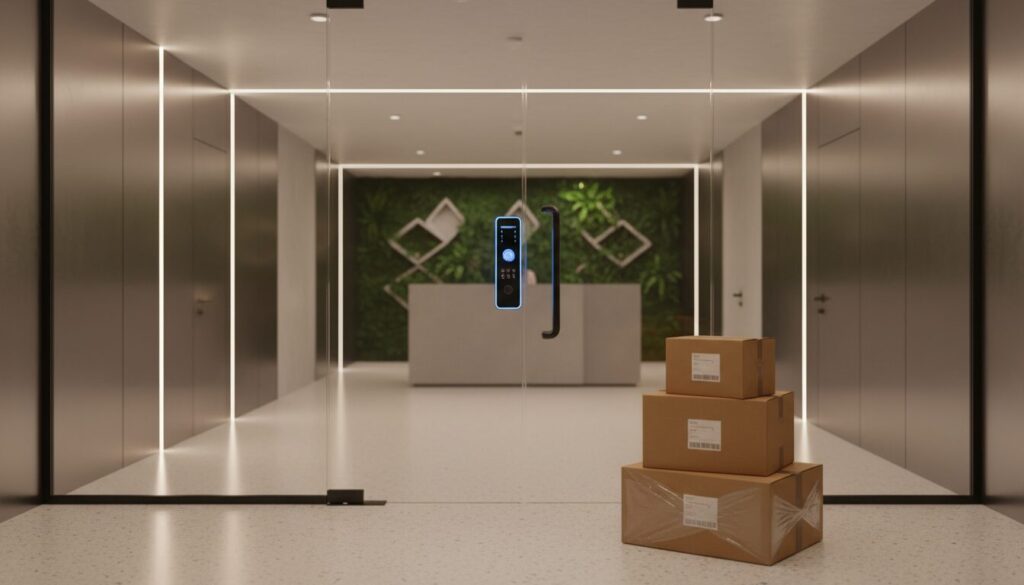
The “last mile” remains the most expensive and inefficient segment of the global supply chain, accounting for up to 53% of total shipping costs. As e-commerce volumes continue to surge post-pandemic, the friction point has shifted from the warehouse to the apartment lobby.
In a move that signals a major shift in PropTech and LogiTech convergence, Relo Partners, a major Japanese property management firm managing over 120,000 rental units, has announced a strategic partnership with Linough to implement “Smart Oki-hai” (Smart Doorstep Delivery). This initiative targets auto-lock apartments in Japan’s densest urban hubs—Tokyo, Osaka, and Fukuoka—using digital keys to allow couriers secure access to lobbies without resident interaction.
For global strategy executives, this is not just a local news update; it is a case study in solving the “redelivery crisis” through software rather than capital-intensive hardware.
Why It Matters: The Global Cost of “Not Home”
The inability to deliver a package on the first attempt is a multi-billion dollar drain on the global economy. The friction is particularly acute in secured multi-family residential buildings (MDU), where auto-lock security systems inadvertently act as barriers to efficient logistics.
The “2024 Logistics Problem” Context
Japan is currently facing the “2024 Logistics Problem,” a severe labor shortage triggered by new overtime regulations for truck drivers. This regulatory shift has forced the industry to innovate or face collapse. The Relo Partners initiative is a direct response to this, aiming to eliminate the time couriers waste buzzing intercoms or rescheduling deliveries.
As discussed in Japan’s 2026 Logistics Budget: A Global Efficiency Blueprint, the Japanese government is actively funding initiatives that secure supply chains against these labor shortages. However, private sector solutions like the Relo-Linough partnership demonstrate how businesses are moving faster than regulation to solve operational bottlenecks.
The Sustainability Angle
Beyond efficiency, redeliveries are a carbon disaster. In Japan alone, redeliveries account for significant unnecessary CO2 emissions. By enabling secure doorstep delivery (known as Oki-hai), logistics companies can significantly lower their carbon footprint, aligning with global ESG mandates.
Global Trend: Access Control as the New Frontier
While Relo Partners is pioneering this specific model in Japan, the race to control the “digital threshold” is global. However, the approaches differ significantly based on infrastructure and housing culture.
Comparative Analysis: Approaches to Secure Entry
The following table contrasts the Japanese model against US, Chinese, and European approaches to the last-mile access problem.
| Region | Primary Strategy | Key Players / Examples | CapEx Requirement | Scalability Friction |
|---|---|---|---|---|
| Japan (Relo/Linough) | Digital Retrofit | Linough, Bitkey | Low / Zero | Low (Software-based integration with existing locks) |
| United States | In-Home / Smart Lock | Amazon Key, Latch | High | High (Requires hardware installation per unit or resident opt-in) |
| China | Smart Lockers (Hive) | Cainiao, Hive Box | Medium | Medium (Space constraints in dense cities; saturation) |
| Europe | PUDO / Packstations | DHL, InPost | Medium | Medium (Requires consumer behavior change to pick up items) |
The US and European Disconnect
In the United States, companies like Amazon have pushed for “In-Garage” or “In-Home” delivery (Amazon Key). While effective, these solutions often require the homeowner to purchase specific hardware (smart garage openers) and overcome significant privacy hesitation.
In Europe, the focus has largely been on PUDO (Pick Up, Drop Off) networks and smart lockers (e.g., DHL Packstations). While efficient for carriers, they transfer the “last few meters” of labor to the consumer.
The Relo Partners case represents a “Middle Way”: it retains the convenience of doorstep delivery without requiring tenants to install hardware or sacrifice privacy inside their actual units. It simply bridges the gap between the street and the front door.
Case Study: Relo Partners x Linough
This partnership is notable not just for the technology, but for the business model. It addresses the classic “principal-agent problem” in rental property management: owners do not want to pay for upgrades that primarily benefit tenants or courier companies.
The Mechanics of “Smart Oki-hai”
Linough’s system works by retrofitting existing auto-lock systems in apartment lobbies with a device that communicates with a courier’s verified smartphone app.
- Authorization: The courier (from approved partners like Amazon, Yamato Transport, or Sagawa Express) arrives at the building.
- Digital Handshake: The courier uses their handheld terminal or smartphone to request entry.
- Verification: The system verifies the courier’s identity and the existence of a package for that building in real-time.
- Access: The lobby door unlocks automatically. The system records exactly who entered and when.
- Delivery: The courier places the package in front of the tenant’s door (or in a designated secure area) and leaves.
The “Zero Cost” Innovation
The most disruptive element of this rollout is the financial structure. Relo Partners is implementing this at zero cost to apartment owners and management companies.
Usually, upgrading a building to be “smart” requires significant capital expenditure (CapEx). By removing the CapEx barrier, Linough and Relo Partners ensure rapid adoption. The monetization likely occurs through efficiencies gained by logistics carriers (who are willing to pay for access to reduce redelivery costs) or future value-add services to tenants.
Scale and Scope
- Portfolio: Relo Partners manages 120,000+ units.
- Geography: Initial rollout in Tokyo, Osaka, and Fukuoka—Japan’s economic spines.
- Target: Reduction of redelivery rates (currently hovering around 11-15% in urban areas) to near zero for participating buildings.
This operational efficiency supports the broader strategies of logistics giants. For instance, Yamato HD’s Harvest Strategy: Logistics Case Study highlights how major carriers are shifting from expansion to “harvesting” profit through efficiency. Secure access systems are the critical infrastructure that enables this “harvest” phase.
Key Takeaways for Innovation Leaders
For strategy executives in the US, EU, and Asia, the Relo Partners case offers three distinct lessons:
1. Retrofit Over Rebuild
In mature markets (NYC, London, Paris, Tokyo), the building stock is old. Waiting for new “smart buildings” to be built is too slow. Solutions that retrofit existing analog infrastructure via software (Digital Transformation) scale faster than hardware-dependent solutions.
2. The “Access as a Service” Model
Logistics companies are realizing that access is a commodity. Relo Partners is essentially tokenizing building access. This creates a new B2B ecosystem where property managers and logistics carriers must collaborate. The value proposition is shifting from “secure the building” to “manage the flow of trusted services.”
3. Solving the CapEx Barrier
The “Zero Cost to Owner” model is critical. If you are selling a logistics solution to real estate owners, remember that their margin for operational improvements is slim. Models that monetize the efficiency gain (paid for by the logistics carrier) rather than the hardware asset (paid for by the building owner) will win.
Future Outlook: Beyond Packages
The implementation of “Smart Oki-hai” by Relo Partners is merely the Trojan Horse for a broader service economy. Once a secure, digital, log-recorded access infrastructure is established, it opens the door (literally) to other verticals.
The Next Wave of Services
- Service Delivery: Housekeeping, pet sitting, and elderly care services can utilize the same digital keys to enter buildings securely.
- Reverse Logistics: Returns pickup from the doorstep, rather than requiring the consumer to visit a post office.
- Autonomous Delivery: As Japan pushes for autonomous delivery robots (UGVs), these digital entry systems will be the API that allows robots to navigate from the street to the elevator.
Conclusion
The partnership between Relo Partners and Linough is a pragmatic, scalable solution to a global logistics crisis. By digitizing the lobby—the final friction point of the last mile—they are unlocking efficiency without demanding capital from property owners. For global logistics leaders, the lesson is clear: the future of delivery isn’t just about faster trucks or drones; it’s about the digital keys that open the doors to our cities.