For logistics leaders and supply chain executives, the last few years have felt like a constant battle against volatility. From the driver shortage crisis to fluctuating fuel surcharges and unpredictable spot market rates, reliance on over-the-road (OTR) trucking alone has become a risky strategy.
You are likely facing a familiar dilemma: How do I lower transportation spend while simultaneously increasing reliability and meeting aggressive sustainability targets?
The answer lies in revisiting a mode of transport often overlooked in the era of rapid e-commerce: Rail.
This article explores the critical role of rail in a future-proof supply chain. We will move beyond the misconceptions of rail being “too slow” and demonstrate how modern intermodal strategies serve as the backbone of a resilient, cost-effective, and environmentally sustainable logistics network.
What is the Role of Rail in a Future-Proof Supply Chain?
To understand the role of rail in a future-proof supply chain, we must first redefine what “future-proof” means in the current logistics landscape. A future-proof supply chain is one that is resilient to shocks, cost-efficient at scale, and compliant with emerging environmental regulations.
Rail freight, specifically intermodal rail, serves as the stabilizer in this equation.
Defining Modern Rail Logistics
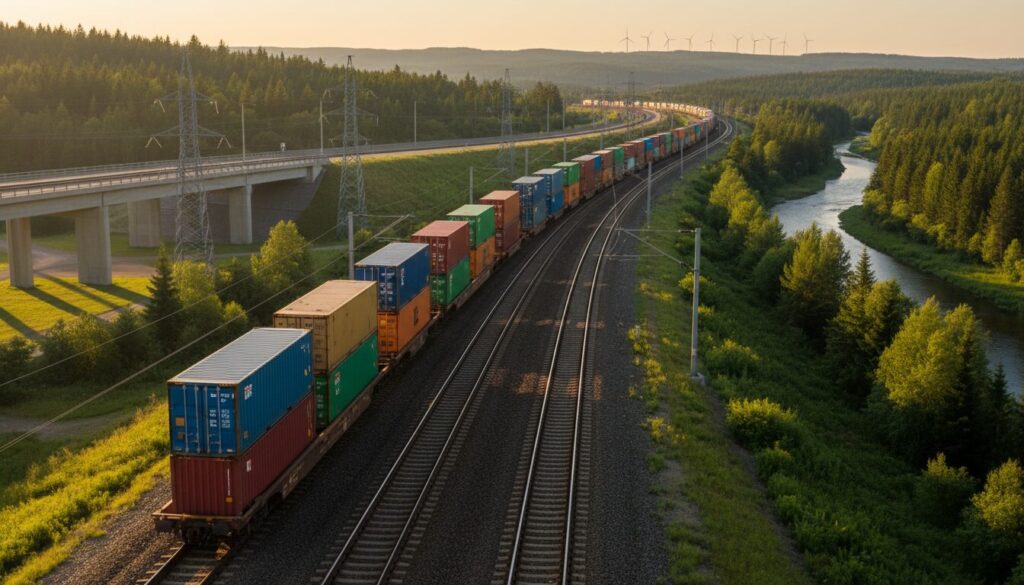
- Intermodal Freight: Moving freight in a container or trailer using multiple modes of transportation (rail, ship, and truck) without handling the freight itself when changing modes.
- Carload/Bulk Freight: Moving massive quantities of raw commodities (grain, coal, chemicals, critical minerals) in dedicated hopper or tank cars.
In a future-proof strategy, rail acts as the “middle mile” workhorse. It handles the long-haul heavy lifting, leaving trucks to handle the precision of the first and last mile. This hybrid approach leverages the best of both worlds: the low cost and high capacity of trains with the flexibility of trucks.
See also: 2026 Trucking Capacity: Why It Tightens & Who Wins
Why Now? The Urgency of Rail Adoption
Why should operations leaders pivot back to rail in 2025 and beyond? The market dynamics are shifting in ways that make exclusive reliance on trucking financially unsustainable and operationally risky.
1. The Capacity Crunch is Returning
As we look toward 2026, the trucking market is signaling a tightening of capacity. With regulations pushing smaller carriers out and driver demographics shifting, the availability of long-haul trucks will likely decrease, driving rates up.
Diversifying into rail now acts as a hedge against these inevitable rate spikes. By locking in rail contracts or establishing intermodal lanes, shippers protect themselves from the volatility of the trucking spot market.
2. Infrastructure Modernization and Digitalization
Historically, rail suffered from a lack of visibility (“black holes” where containers sat for days). However, this is changing rapidly thanks to government and private sector initiatives.
The Department of Transportation (DOT) is currently pivoting from a focus on pure asphalt to digital infrastructure. The Transportation Data Infrastructure (TDI) strategy aims to standardize data exchange, making rail tracking as transparent as parcel tracking.
- Real-time Visibility: GPS sensors on railcars are becoming standard.
- Automated Terminals: reduced dwell times at transition points.
As discussed in our analysis of the DOT’s strategy, the future of infrastructure is code, not just concrete. This digital leap makes rail a viable option for time-sensitive supply chains that previously avoided it.
See also: DOT’s TDI Strategy: The Future of Freight Infrastructure
3. The Green Mandate (ESG)
Sustainability is no longer a “nice to have”—it is a regulatory requirement and a customer demand. Rail is, by a wide margin, the most fuel-efficient way to move freight over land.
- Rail moves approximately 40% of U.S. long-distance freight but accounts for only 1.9% of transport-related emissions.
- A single freight train can replace several hundred trucks, drastically reducing highway congestion and carbon footprint.
Quantitative Benefits of Rail Integration
Implementing rail into your supply chain strategy offers measurable advantages. Below is a comparison of key metrics between Over-the-Road (OTR) Trucking and Intermodal Rail.
Rail vs. Trucking Comparison Matrix
| Metric | OTR Trucking | Intermodal Rail | Advantage |
|---|---|---|---|
| Cost | High (Fuel + Driver wages) | Low (Fuel efficient scale) | Rail: 15-40% savings on long hauls |
| Fuel Efficiency | ~6-7 miles per gallon | ~480 miles per ton/gallon | Rail: 4x more efficient |
| Capacity | 1 Trailer per Driver | 200+ Containers per Train | Rail: Massive scalability |
| Transit Time | Fast (Direct routes) | Slower (Terminal transfers) | Truck: Better for 700 miles. |
| 2. Analyze density: Identify heavy freight that maximizes rail weight limits. | |||
| 3. Digitize: Ensure your TMS can handle multi-modal tracking. | |||
| 4. Diversify: Lock in rail capacity before the 2026 trucking crunch hits. |
By integrating rail, you are not stepping back into the past; you are building a fortress of stability for the future. You reduce your exposure to volatile fuel prices, contribute to sustainability goals, and ensure capacity availability in a tightening market.
Ready to future-proof your logistics? Start by assessing your longest trade lanes today and calculating the cost/carbon savings of an intermodal conversion.