
The global race for supply chain dominance has shifted from pure infrastructure to digital capability. India, already a central figure in the “China Plus One” strategy, has just made a decisive move to secure its future as a high-tech manufacturing and logistics hub.
Facing a 17% decline in private capital inflows in 2025, the Indian government has approved a $1.1 billion (₹100 billion) state-backed venture capital fund. Unlike previous initiatives focused on consumer internet companies, this fund specifically targets deep-tech, AI, and advanced manufacturing—sectors that are foundational to modern logistics.
For supply chain executives, this is not merely financial news; it is a signal that the technological backbone of sourcing from South Asia is about to get a significant upgrade. With the recent tariff adjustments between the US and India, as discussed in our Trump: US-India Tariff Deal Case Study, this influx of capital into deep-tech creates a synergistic effect that could redefine operational efficiency in the region.
The Facts: Breaking Down the $1.1B Injection
To understand the implications, we must first look at the structure of this initiative. The Indian government is employing a “fund of funds” model, designed to de-risk investments for private venture capitalists and catalyze growth in high-risk, high-reward sectors.
Key Components of the Initiative
The following table outlines the core elements of the approved fund and regulatory changes:
| Component | Detail | Strategic Intent |
|---|---|---|
| Total Corpus | $1.1 Billion (₹100 Billion) | Bridge the funding gap caused by the 2025 private capital slowdown. |
| Target Sectors | Deep-tech, AI, Space-tech, Advanced Manufacturing | Move beyond software services into “hard tech” and industrial innovation. |
| Structure | Fund of Funds | Government capital anchors private funds, encouraging 3x-4x total investment leverage. |
| Startup Definition | Extended to 20 years (from 10) | Acknowledges that deep-tech (hardware/biotech) has longer gestation periods. |
| Revenue Cap | Raised to $33M (₹2.5 Billion) | Allows growing firms to retain tax/regulatory benefits longer. |
The Scale of the Ecosystem
The context of this investment is crucial. India’s startup ecosystem has exploded from fewer than 500 firms in 2016 to over 200,000 today. However, the recent 17% drop in funding threatened to stall momentum in capital-intensive sectors like robotics and industrial automation. This intervention is a stabilization mechanism designed to keep the R&D engines running.
Industry Impact: What This Means for Logistics
The injection of over a billion dollars into “deep-tech” and “advanced manufacturing” will ripple through the logistics sector in three distinct ways: smarter infrastructure, automated warehousing, and high-value freight.
1. Acceleration of “LogTech” and Visibility
“Deep-tech” in a logistics context refers to the heavy lifting of algorithms and hardware that goes beyond simple tracking apps.
- AI-Driven Predictive Analytics: With state backing, startups focusing on AI can tackle complex supply chain modeling. We expect to see a surge in Indian platforms offering predictive freight matching and risk sensing, directly competing with established Western providers.
- Space-Tech and Remote Tracking: The fund explicitly mentions space technology. For logistics, this translates to affordable, low-orbit satellite tracking systems. This is critical for monitoring freight in India’s vast rural interior or across the Indian Ocean, improving visibility where cellular networks fail.
2. The Rise of Indigenous Warehouse Automation
Until now, much of the advanced robotics used in Indian warehouses was imported. This fund changes the equation by supporting domestic manufacturing startups.
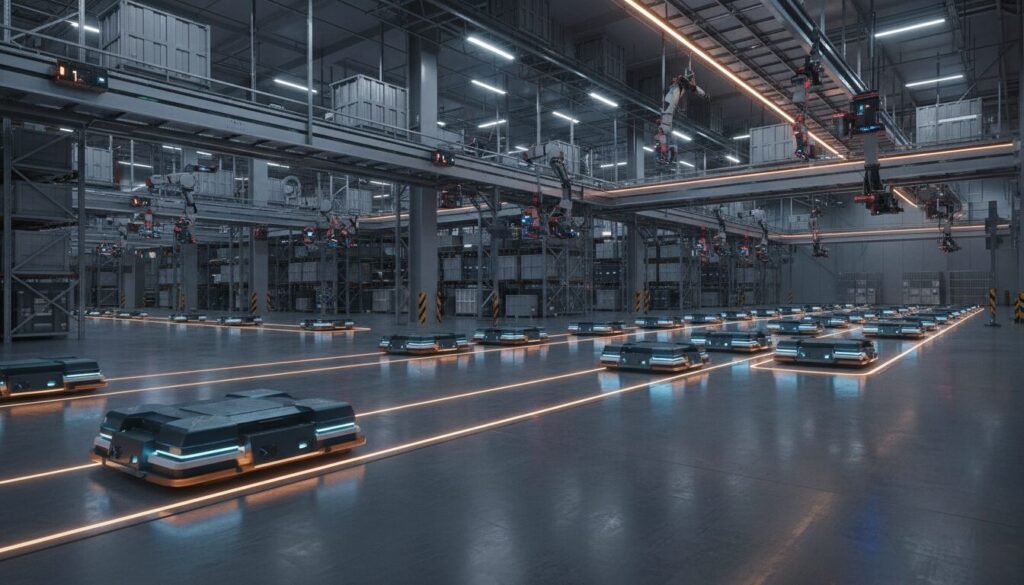
- Cost-Effective Robotics: We anticipate a new wave of localized Autonomous Mobile Robots (AMRs) and automated sorting systems. These will likely be priced competitively for the Asian market, allowing mid-sized 3PLs to automate faster than their global peers.
- Manufacturing Logistics: As the fund supports advanced manufacturing (e.g., semiconductors, EVs), the logistics requirements for these industries are extremely high-precision. Logistics providers will need to upgrade their capabilities to handle sensitive, high-value components, driving a shift from “bulk moving” to “precision logistics.”
3. Strengthening the Supply Chain “Hardware”
The extension of startup status to 20 years is a tacit admission that building hardware takes time.
- Electric Vehicles (EVs) for Last Mile: Deep-tech funding often flows into battery chemistry and EV drivetrains. Expect accelerated deployment of indigenous commercial EVs for logistics, helping shippers meet Scope 3 emission targets when sourcing from India.
- Drone Delivery Networks: With regulatory easing and funding, drone logistics for medical and remote deliveries—already piloted in India—will likely move toward commercial scalability.
LogiShift View: The “So What?” for Global Supply Chains
At LogiShift, we analyze the intersection of policy and operation. This move by India is not just about saving startups; it is about industrial sovereignty.
The Convergence of Policy and Tech
The timing is impeccable. As analyzed in our recent Trump: US-India Tariff Deal Case Study, trade barriers are lowering, making India a more attractive export hub. However, a hub is only as good as its efficiency.
By funding deep-tech, India is attempting to skip the “low-cost labor” phase of logistics and jump straight to “tech-enabled efficiency.” The government realizes that to compete with China’s deeply integrated supply chain ecosystem, they cannot just offer land and labor; they must offer technological resilience.
Prediction: The “Indo-Stack” for Logistics
We predict the emergence of a “Digital Public Infrastructure” for logistics, similar to India’s payment stack (UPI). With this new funding:
- Lower Implementation Costs: Global shippers operating in India will see the cost of technology adoption drop as domestic alternatives to expensive Western SaaS and hardware emerge.
- Integration Challenges: While innovation will spike, fragmentation may initially increase. Shippers will need to ensure their ERPs can communicate with a new generation of Indian LogTech tools.
Takeaway: Strategic Moves for Executives
The $1.1B fund is a green light for innovation. Logistics leaders should adjust their strategies immediately to capitalize on this shift.
1. Re-evaluate Your Indian Tech Partners
Do not view Indian vendors solely as service providers. Look for “deep-tech” partners who are leveraging this funding to build proprietary algorithms or hardware. They may offer competitive advantages over legacy providers.
2. Audit Your “China Plus One” Readiness
If you are moving manufacturing to India, assess the local logistics infrastructure. With this funding, expect rapid improvements in Tier 2 and Tier 3 cities. Ensure your logistics partners are upgrading their tech stacks to match this pace.
3. Monitor the “20-Year” Startups
The regulatory change extending startup status to 20 years allows mature startups to pivot and reinvest in R&D without losing benefits. Watch for “scale-ups” in the robotics and AI space that were previously struggling with profitability but now have a runway to innovate.
Summary: The $1.1B fund is a catalyst. It transforms India from a passive participant in the global supply chain into an active developer of logistics technology. For global executives, the message is clear: The Indian supply chain is getting smarter, and your strategy needs to keep up.