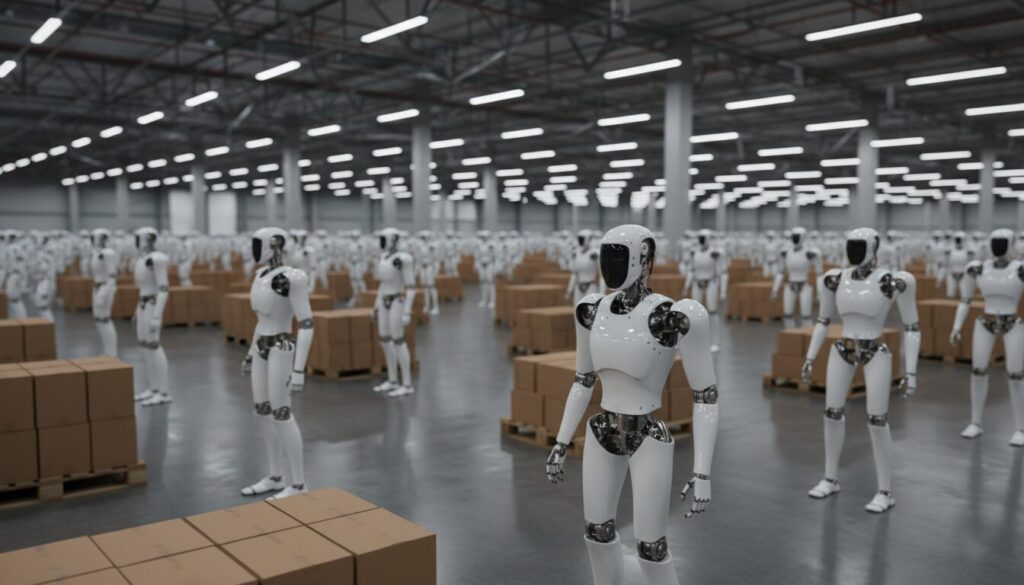
The global robotics landscape has just received a significant jolt. Morgan Stanley has officially doubled its forecast for China’s humanoid robot sales in 2026, revising the figure from 14,000 to 28,000 units. This represents a staggering 133% year-over-year growth projection, signaling that the era of theoretical R&D is ending and the era of mass commercialization is beginning.
For innovation leaders and supply chain executives in the US and Europe, this is not merely a regional statistic. It is a bellwether for the commoditization of high-end automation. With China already accounting for 80% of global humanoid robot installations in 2025 (according to Counterpoint Research), the center of gravity for hardware production has shifted.
This surge is driven by a projected 16% drop in manufacturing costs by 2026, achieved through aggressive supply chain localization and economies of scale. As discussed in our previous analysis of Boston Dynamics’ Atlas Pilot, the shift from pilot programs to commercial necessity is accelerating. However, the data now suggests that while the West may lead in AI “brains,” the East is rapidly cornering the market on the “bodies.”
Why It Matters: The Hardware Commoditization Wave
The revision of sales forecasts by a major financial institution like Morgan Stanley validates a trend that logistics watchers have suspected for massive: the “EV-ification” of humanoid robotics. Just as China leveraged its battery supply chain to dominate the electric vehicle market, it is now applying the same playbook to embodied AI.
The Cost-Volume Loop
The primary barrier to deploying humanoid robots in logistics hubs—such as Amazon fulfillment centers or DHL distinct hubs—has historically been cost. A robot costing $150,000 is a capital expenditure (CapEx) nightmare compared to human labor. However, China’s ability to consolidate the supply chain (motors, sensors, reduction gears) is breaking this barrier.
- Cost Reduction: Raw material costs are projected to fall 16% by 2026.
- Availability: With a forecast of 28,000 units, components will become standardized off-the-shelf parts rather than bespoke engineering marvels.
- Global Viability: As hardware costs plummet, Western software companies may increasingly rely on Chinese hardware platforms to deploy their AI models.
For a deeper dive into how software is evolving alongside this hardware, see our coverage on GigaBrain-0.5M Case Study: World-Model VLA Innovation, which explores the “ChatGPT moment” for robotic control systems.
Global Trend: The Divergence of East and West
While the global goal is identical—solving the labor shortage in logistics and manufacturing—the strategies in China, the US, and Europe are diverging significantly.
China: The “Factory” Model
China is focused on hardware dominance and volume. The strategy is to flood the market with capable, affordable hardware to gather real-world data at scale. The government’s push for “New Productive Forces” has aligned subsidies, manufacturing zones, and regulatory approvals to speed up deployment.
United States: The “Brain” Model
The US approach, led by companies like Tesla (Optimus), Figure AI, and Agility Robotics, prioritizes Embodied AI and reasoning capabilities. The US focuses on robots that can “think” through complex, unstructured environments. However, the hardware is often more expensive and production volumes are currently lower than Chinese counterparts.
Europe: The Specialized Integrator
Europe is carving a niche in high-value industrial integration. Rather than mass-producing general-purpose bots, European firms and adopters are focusing on specific, high-compliance environments like aerospace and automotive assembly. This is perfectly illustrated in the UBTECH & Airbus: Humanoid Robotics Innovation Case Study, where Chinese hardware is integrated into European precision manufacturing.
Strategic Comparison: US vs. China Humanoid Markets
| Feature | United States | China |
|---|---|---|
| Primary Focus | Advanced AI / General Intelligence | Mass Production / Cost Reduction |
| 2026 Volume Strategy | Selective / High-Value Pilots | Scale / Market Saturation (28k units) |
| Supply Chain | Specialized, often fragmented | Highly integrated, localized |
| Key Players | Tesla, Boston Dynamics, Figure | Unitree, Agibot, Fourier Intelligence |
| Logistics Application | Complex decision-making tasks | Repetitive movement / Heavy lifting |
Case Study: The Frontrunners (Unitree & Agibot)
To understand how China plans to hit 28,000 units by 2026, we must look at the companies leading the charge. Two names have emerged as the standard-bearers for this surge: Unitree Robotics and Agibot.
Unitree Robotics: The Speed of Iteration
Unitree is often compared to Boston Dynamics, but with a crucial difference: accessibility. While Boston Dynamics spent decades in R&D, Unitree rapidly commercialized quadrupeds before pivoting to humanoids like the G1 and H1.
- Strategy: Unitree sells high-performance robots at a fraction of the cost of Western competitors (some models under $16,000).
- Impact: By lowering the entry barrier, Unitree allows universities, logistics R&D labs, and smaller warehouses to experiment with humanoids, accelerating the feedback loop for improvements.
Agibot: The Ex-Huawei Effect
Agibot (founded by “Zhihui Jun,” a former Huawei “Genius Youth” recruit) represents the integration of tech-giant methodology into robotics.
- Scale: Agibot is explicitly targeting production scales in the tens of thousands by 2026.
- Ecosystem: They are not just building robots; they are building modular joints and actuators that can be sold to other manufacturers, effectively becoming the “Intel Inside” of the robotics world.
- Logistics Focus: Their prototypes are heavily tested in factory logistics scenarios—moving distinct bins and tending machines—directly targeting the labor gaps in China’s manufacturing heartland.
This rapid scaling creates a massive demand for training data. As noted in our article on Noitom Robotics, the “Data Engine” is the hidden infrastructure that allows these mass-produced robots to actually function usefully in complex environments.
Key Takeaways for Logistics Leaders
The doubling of the sales forecast to 28,000 units is a signal that logistics executives cannot ignore. Here are the strategic implications:
1. The Hardware Price War is Coming
Expect the cost of humanoid robots to drop faster than anticipated. If you are planning a 5-year ROI on automation, factor in that the hardware you buy today might be 20% cheaper (and more capable) in 18 months. Avoid long-term lock-in with hardware that cannot be upgraded.
2. Supply Chain Resilience vs. Dependence
Just as with solar panels and EV batteries, the West faces a dilemma. Utilizing Chinese humanoid hardware offers immediate cost benefits and availability. However, relying on a single geopolitical region for critical labor automation creates supply chain risk.
- Action: Explore dual-sourcing strategies. Look for Western integrators who are hardware-agnostic.
3. Software will be the Differentiator
With hardware becoming commoditized, the value shifts to the software—the “World Models” and VLA (Vision-Language-Action) systems.
- Action: Invest in the digital infrastructure (WMS integration, private 5G, edge computing) required to host these intelligent agents.
4. New Entrants will Disrupt the Market
The market is not settled. Just as Hesai’s founders launched a new venture discussed in the Sharpa Case Study, we will see a wave of startups spinning out of major tech firms, utilizing the cheap supply chain to build specialized logistics bots.
Future Outlook: Beyond 2026
Morgan Stanley’s forecast doesn’t stop at 2026. Long-term projections suggest the Chinese market will reach 262,000 units by 2030 and a massive 2.6 million units by 2035.
If these numbers hold true, humanoid robots will transition from “innovation theater” to standard warehouse equipment—as common as forklifts are today. The supply chain consolidation happening now in China is the foundation for this future.
For global logistics, the message is clear: The hardware is readying for mass production. The question is no longer if humanoids will enter the supply chain, but whose supply chain will build them, and who will write the software that controls them.
For more insights on the intersection of AI and physical logistics, explore our recent coverage on GigaBrain-0.5M and the evolving role of Data Engines in Robotics.