The landscape of global logistics technology is witnessing a pivotal moment. Hai Robotics, a unicorn and pioneer in Autonomous Case-handling Robot (ACR) systems, has officially filed for an initial public offering (IPO) on the Hong Kong Stock Exchange (HKEX).
For innovation leaders and strategy executives, this is not merely a financial headline. It represents a maturation point for the warehouse robotics sector. As the “tote-to-person” picking model moves from novelty to industry standard, Hai Robotics’ transition to the public market signals a shift toward massive global scaling and heightened competition in supply chain automation.
Why It Matters: The Maturation of Logistics Robotics
The filing comes at a time when the logistics industry is transitioning from “pilot purgatory” to full-scale adoption. For years, supply chain leaders have experimented with various Automated Guided Vehicles (AGVs) and Autonomous Mobile Robots (AMRs). The move by Hai Robotics to go public suggests that the technology has proven its ROI and is ready for the intense scrutiny of public markets.
From Experimentation to Mass Scale
As discussed in our analysis of the Manifest 2026 Recap: Robotics Moves to Mass Scale, the era of experimentation is ending. Companies are no longer asking if robots work; they are asking how fast they can deploy them across 50 distribution centers.
Hai Robotics’ IPO filing indicates a need for significant capital to fuel this expansion, particularly in Western markets where labor shortages are acute. It validates the “flexible automation” thesis—that warehouses need systems capable of adapting to fluctuating demand without the rigid infrastructure of traditional heavy automation.
Global Trend: The Tri-Regional Automation Race
To understand the significance of this IPO, one must look at the differing drivers of automation across the three major economic zones: North America, Europe, and Asia-Pacific.
North America: The Labor Crisis Driver
In the US, the primary driver for adoption is the chronic shortage of warehouse labor and rising wages.
- Challenge: High turnover rates in fulfillment centers.
- Solution: Solutions like Hai Robotics allow facilities to operate with fewer humans, reducing dependency on a volatile labor market.
- Trend: US companies are favoring “Brownfield” automation—tech that fits into existing, older buildings rather than requiring new construction.
Europe: Density and Sustainability
In Europe, land scarcity and high energy costs drive the market.
- Challenge: Limited space for warehouse expansion and strict environmental regulations.
- Solution: High-density storage is king here. While grid-based systems like AutoStore are dominant, ACRs are gaining ground by offering vertical utilization (up to 10 meters) without the need for a permanent grid structure.
- Reference: For a deeper look at European high-density innovation, see our case study on Boozt & Cognibotics: Advanced AutoStore Automation.
China: Speed and Supply Chain Resilience
In China, the birthplace of Hai Robotics, the focus is on extreme speed and throughput to handle e-commerce surges (e.g., Singles’ Day).
- Challenge: Massive order volumes and consumer demand for same-day delivery.
- Solution: Robotics firms in China have iterated rapidly, using the domestic market as a testing ground before exporting polished solutions globally.
Comparative Regional Drivers for Robotics Adoption
| Region | Primary Driver | Key Constraint | Preferred Tech Characteristic |
|---|---|---|---|
| North America | Labor Shortage | Wage Inflation | Rapid ROI & Brownfield Fit |
| Europe | Space Optimization | Land Scarcity | High Density & Sustainability |
| Asia (China) | E-commerce Speed | Order Volume Peaks | Throughput & Scalability |
Case Study: Hai Robotics – Defining the ACR Category
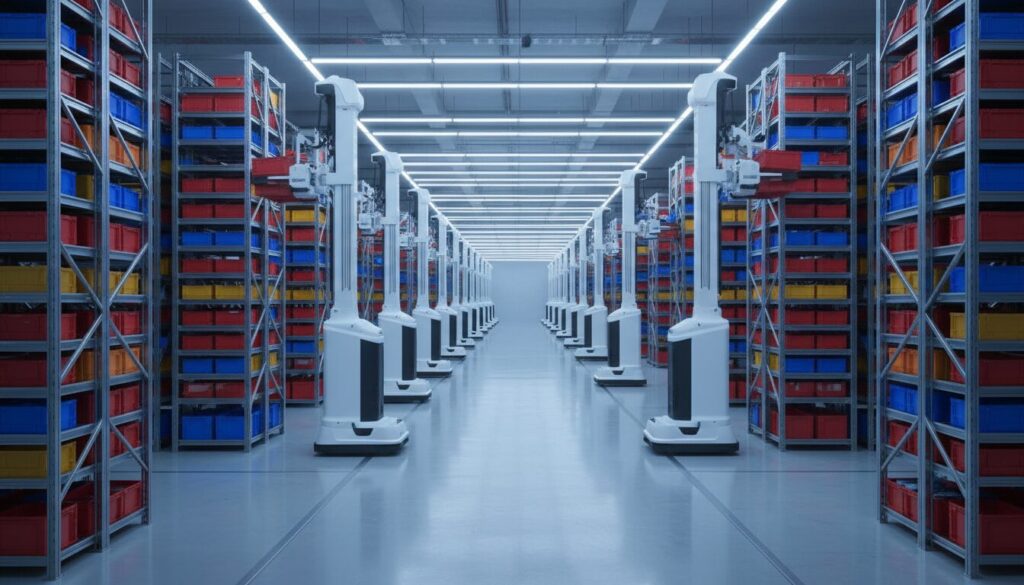
Hai Robotics is widely credited with pioneering the Autonomous Case-handling Robot (ACR) category. Unlike Kiva-style robots (which move whole shelves) or traditional shuttles (which run on fixed tracks), Hai’s “HaiPick” robots roam freely but can reach heights of up to 10 meters to pick specific totes or cartons.
The Financials and Footprint
According to the IPO filing submitted to HKEX:
- Global Reach: The company has deployed over 1,100 projects worldwide.
- Market Presence: They operate in over 30 countries and regions.
- Revenue Growth: The company has demonstrated triple-digit growth in recent years, reflecting the explosive demand for flexible automation.
- Backing: Investors include heavyweights like Sequoia China and Capital Today.
Strategic Deployment: Anta Sports
One of the most defining success stories for Hai Robotics is its collaboration with Anta Sports, a leading global sportswear company.
- The Problem: Anta faced skyrocketing SKU counts and the need to fulfill both B2B (store replenishment) and B2C (e-commerce) orders from a single facility. Traditional shelving was too slow; heavy AS/RS was too rigid.
- The Solution: Anta deployed the HaiPick system.
- The Results:
- Storage Density: Increased by nearly 300% compared to manual shelving by utilizing vertical space.
- Picking Efficiency: Improved by 3-4x compared to manual picking.
- Accuracy: Achieved 99.99% picking accuracy.
Strategic Deployment: DHL Supply Chain
Hai Robotics has also secured partnerships with 3PL giants like DHL Supply Chain. For 3PLs, the contract lengths with clients are often shorter (3-5 years) than the ROI period of heavy automation (7-10 years).
- The Fit: HaiPick robots can be deployed in weeks and, crucially, moved to a different facility if a client contract ends. This “portability of assets” is a game-changer for the 3PL industry, reducing investment risk significantly.
Technology Comparison: Where Does ACR Fit?
Understanding where Hai Robotics sits in the ecosystem is vital for procurement strategy.
| Feature | Traditional AS/RS | Kiva-Style AMR (Shelf-to-Person) | Hai Robotics (ACR) |
|---|---|---|---|
| Flexibility | Low (Fixed steel) | High | High |
| Vertical Reach | Very High (20m+) | Low (2m max) | High (up to 10m) |
| Storage Density | Excellent | Low | Very Good |
| Implementation | 12-24 Months | 3-6 Months | 3-6 Months |
| Granularity | Pallet/Case | Whole Shelf | Individual Tote/Case |
Key Takeaways for Logistics Leaders
The IPO of Hai Robotics serves as a case study for the broader state of supply chain innovation. Here are the actionable lessons for strategy executives:
1. Flexibility is the New Efficiency
The success of the ACR model proves that warehouses value flexibility as much as raw speed. The ability to install a system without bolting racks to the floor—and to expand it by simply adding more robots—allows companies to align capex with growth.
2. The “Middle Ground” is Profitable
For years, the choice was binary: cheap manual carts or expensive AS/RS. Hai Robotics succeeded by creating a middle ground—high density without the heavy infrastructure. Leaders should look for similar “middle ground” technologies in other areas of the supply chain (e.g., mid-mile autonomous trucks).
3. Chinese Innovation Going Global
Hai Robotics represents a wave of “Designed in China, Deployed Globally” tech. These firms are aggressive on pricing and speed. Western competitors must innovate rapidly to compete, while Western buyers can benefit from this competition through lower costs and faster innovation cycles.
Future Outlook
As Hai Robotics prepares to ring the bell in Hong Kong, the ripple effects will be felt across the industry.
Consolidation and Acquisition
With IPO capital, Hai Robotics is likely to invest heavily in R&D, specifically in Generative AI for path planning and anomaly detection. Furthermore, the market is ripe for consolidation. We expect larger players to acquire niche robotics firms to offer end-to-end “hyper-automation” suites.
Integration of Heterogeneous Fleets
The future is not about one type of robot. It is about interoperability. We will see HaiPick robots handing off totes to fast-moving sorters or palletizing arms. The software layer (WES/WCS) that orchestrates these different brands will become the next critical battleground.
Regulatory and Geopolitical Headwinds
As a Chinese firm expanding deeply into US and EU supply chains, data security and geopolitical friction remain risks. Strategy executives must weigh the operational benefits of these technologies against potential regulatory changes regarding data handling and hardware sourcing.
The Hai Robotics IPO is a milestone. It confirms that the warehouse of the future is vertical, flexible, and increasingly autonomous. For logistics leaders, the question is no longer whether to automate, but how to build a robotic portfolio that remains resilient in an unpredictable global market.
See also: