The global supply chain is witnessing a “ChatGPT moment” for physical automation. While Generative AI has revolutionized text and image creation, robotics has largely remained stuck in the era of rigid, hard-coded scripts. Robots could repeat a motion perfectly, but if a box shifted one inch to the left, the operation failed.
That era is ending. With the recent announcement that Visionary Intelligence has unveiled GigaBrain-0.5M, a World-Model-Native Vision-Language-Action (VLA) model, we are seeing the first true implementation of “physical common sense” in industrial logistics.
For strategy executives, this is not just another hardware release. It represents a fundamental shift in how capital is deployed in warehouses—moving from investment in mechanical speed to investment in cognitive adaptability.
As we discussed in AI Robotics Shift: From Hardware to Cognitive Swarms, the industry is pivoting from actuator wars to software dominance. GigaBrain-0.5M is the latest, most potent proof point of this trend.
Why It Matters: The End of “Brittle” Automation
In the current global context, logistics faces a dual crisis: a chronic labor shortage in the US and Europe, and rising supply chain complexity in Asia. Traditional automation (AGVs, basic robotic arms) is “brittle.” It requires structured environments—perfectly aligned pallets, consistent lighting, and standardized packaging.
World-Model-Native VLAs change the equation by introducing Environmental Simulation.
A “World Model” allows an AI to simulate the future consequences of its actions before it executes them. Instead of just recognizing a box (Vision) and moving an arm (Action), GigaBrain-0.5M understands the physics of the box. It predicts: “If I grab this crushed corner, the box will tear.”
Strategic Implications
- CapEx Efficiency: Reduces the need for expensive “perfect” infrastructure (conveyors, guides) to structure the environment for robots.
- Brownfield Deployment: These robots can be deployed in older, unstructured warehouses alongside humans.
- Resilience: The system adapts to SKU changes without retraining, addressing the “high-mix, low-volume” challenge of modern e-commerce.
See also: Winning the AI Capex Race: Amazon’s Logistics Strategy
Global Trend: The Race for “Embodied Intelligence”
The unveiling of GigaBrain-0.5M places Visionary Intelligence at the forefront of a fierce trilateral competition between the US, China, and Europe.
The Regional Breakdown
While the US has led in Large Language Models (LLMs), China is aggressively targeting the intersection of AI and Hardware (Embodied AI). Europe remains a key player in industrial integration.
| Region | Primary Focus | Key Strategy | Representative Players (Context) |
|---|---|---|---|
| United States | End-to-End Learning | Leveraging massive cloud compute (AWS/GCP) to train giant models that control robots directly. | Tesla (Optimus), Google (DeepMind RT-2), Figure AI. |
| China | Hardware-Software Fusion | Rapid iteration of affordable humanoid hardware paired with specialized VLA models like GigaBrain. | Visionary Intelligence, Unitree, Fourier Intelligence. |
| Europe | Industrial Sim2Real | High-fidelity “Digital Twins” (NVIDIA Omniverse/Siemens) to validate safety before deployment. | Siemens, Agility Robotics (EU partnerships), BMW (Spartanburg pilots). |
The Data Bottleneck:
The US strategy often relies on internet-scale data. However, internet text doesn’t teach a robot gravity. This is where companies like Noitom Robotics have stepped in, acting as “data factories” to capture human motion. Now, World Models attempt to bypass physical data gathering by simulating the data.
See also: Noitom Robotics: The Data Engine for Logistics Humanoids
Case Study: Visionary Intelligence & GigaBrain-0.5M
Visionary Intelligence (a leading player in the Asian Embodied AI sector) has released GigaBrain-0.5M, explicitly marketing it as a “World-Model-Native VLA.”
What makes GigaBrain-0.5M unique?
Unlike previous generations of robot brains that were patched together (one model for vision, one for motion planning), GigaBrain-0.5M is a single neural network trained on video prediction.
1. The “World Model” Architecture
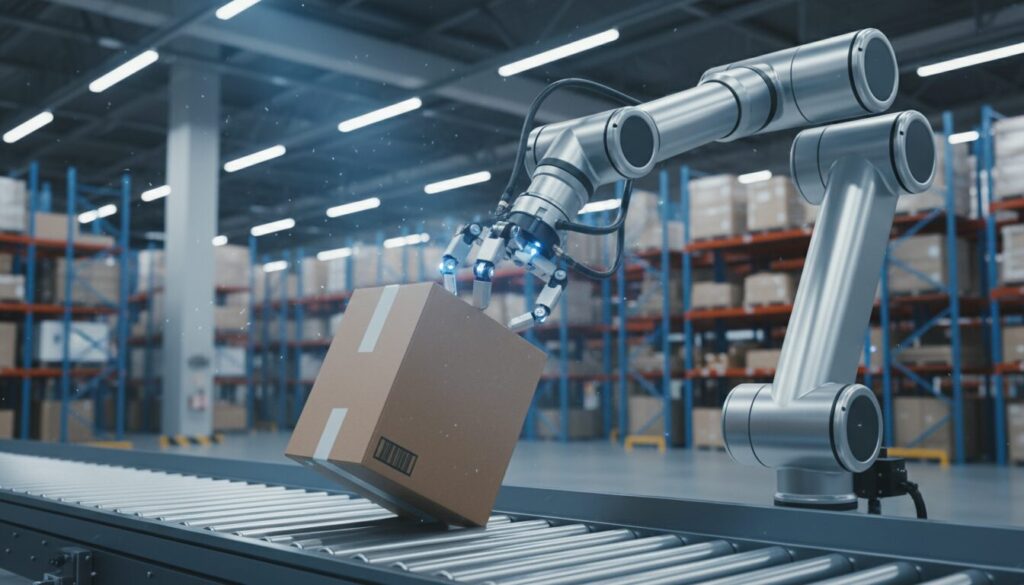
The core innovation is predictive physics. When the robot looks at a stack of packages in a container, GigaBrain generates a short video in its “mind” of what will happen if it pulls the bottom box. If the simulation shows a collapse, it adjusts its strategy before moving a muscle. This reduces error rates in complex de-palletizing tasks by up to 40% compared to traditional computer vision.
2. The “0.5M” Efficiency
The “0.5M” likely refers to a hyper-optimized parameter set or context window designed specifically for low-latency edge computing.
- The Problem: Giant models (like GPT-4) are too slow for robots. A robot cannot wait 500ms for a token to generate when a box is slipping.
- The Solution: GigaBrain-0.5M is distilled to run locally on the robot’s GPU, enabling <20ms reaction times—essential for catching falling objects or navigating busy aisles.
3. Cross-Embodiment
Visionary Intelligence has demonstrated GigaBrain-0.5M controlling multiple form factors:
- Humanoids: For bi-manual manipulation (lifting totes).
- Industrial Arms: For high-speed sorting.
- Mobile Manipulators: For unstructured picking.
This “One Brain, Many Bodies” approach mirrors the strategy we analyzed regarding Destro AI, which seeks to unify disparate robotic fleets under one agentic brain.
See also: Destro AI Impact: Agentic Brain Unifies Warehouse Robotics
Key Takeaways for Logistics Leaders
For innovation leaders observing Visionary Intelligence’s breakthrough, the lessons extend beyond this single company.
1. Shift from “Pre-Programmed” to “Pre-Trained”
We are moving away from writing code (if X, then Y) to deploying Pre-Trained Skills. Just as Trener Robotics uses Acteris to deliver pre-packaged capabilities, GigaBrain-0.5M delivers pre-packaged “physics intuition.”
- Action: Audit your automation roadmap. Are you investing in rigid systems that require constant reprogramming, or adaptive systems that learn?
See also: Trener Robotics Impact: Pre-Trained Skills Change Logistics
2. The Rise of “General Purpose” Robots
Specialized robots (like Kiva systems) are highly efficient but inflexible. World-Model natives enable General Purpose Robots (GPRs).
- Action: Evaluate GPRs for tasks with high variability, such as truck unloading or returns processing, where SKU variance defeats traditional automation.
3. Data is the New Oil, Simulation is the Refinery
The success of GigaBrain relies on its ability to simulate the world. Companies with the best “Digital Twins” of their warehouses will be the first to successfully deploy these advanced robots.
- Action: Invest in high-fidelity digital mapping of your facilities. Your physical warehouse data is the training ground for your future workforce.
Future Outlook: The 2026 Horizon
The unveiling of GigaBrain-0.5M signals that the technology for autonomous physical labor is maturing faster than anticipated.
Short Term (12 Months):
We will see pilot programs of World-Model robots in “semi-structured” environments—loading docks and receiving areas. The focus will be on error recovery (handling dropped boxes without human intervention).
Medium Term (2-3 Years):
As models like GigaBrain scale, the cost of “cognitive” robots will drop below the cost of human labor in developed markets ($15-$20/hour equivalent). This will trigger a massive replacement cycle of legacy “dumb” automation.
Long Term (5 Years+):
The emergence of a global “Robot Skill Marketplace.” A robot in a warehouse in Germany could instantly download the “intuition” for handling a new type of fragile packaging that was learned by a robot in Singapore, powered by shared World Models.
Visionary Intelligence has fired the starting gun. The race is no longer about who has the strongest robot arm, but who has the smartest World Model.