
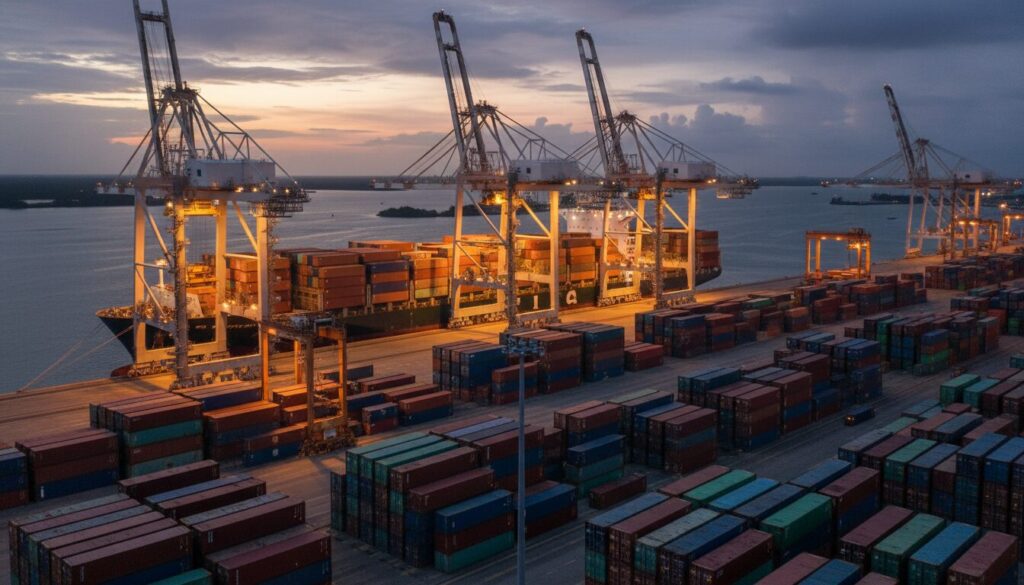
The fragile equilibrium of global trade is currently being tested at one of the world’s most critical maritime chokepoints. In a move that reverberates from Hong Kong to Copenhagen and Washington D.C., CK Hutchison is threatening legal action against Maersk’s APM Terminals and the Panamanian government.
This dispute follows a Panama Supreme Court ruling that declared CK Hutchison’s concessions for the Balboa and Cristobal ports unconstitutional. As APM Terminals offers to step in to prevent operational paralysis, the situation has evolved from a legal contract dispute into a geopolitical flashpoint involving the US, China, and European shipping giants.
For logistics leaders and strategy executives, this is not merely a legal battle; it is a signal of the new era of Geopolitical Supply Chain Risk.
Why It Matters: The Strategic Chokepoint
The Panama Canal is the artery connecting the Atlantic and Pacific oceans, handling approximately 6% of global trade. However, the canal does not operate in a vacuum; it relies on the transshipment hubs at either end to function efficiently.
The Ports in Question
The dispute centers on two specific terminals operated by Panama Ports Company (PPC), a subsidiary of Hong Kong-based CK Hutchison:
- Balboa (Pacific Side): A critical gateway for Asian goods destined for the Americas.
- Cristobal (Atlantic Side): A key hub for distribution into the Caribbean and the US East Coast.
If CK Hutchison follows through on threats to halt operations or drag the transition into prolonged litigation, the resulting congestion could eclipse the disruptions caused by the recent drought-induced draft restrictions.
The Geopolitical Layer
This commercial dispute is inextricably linked to the Sino-American rivalry. For years, Washington has exerted diplomatic pressure on Panama to reduce Chinese influence over critical infrastructure surrounding the canal. The court’s decision to void the contract of a major Chinese conglomerate aligns with US strategic interests, while China has warned of a “heavy price” for this pivot.
For global supply chain strategists, this underscores a vital lesson: Infrastructure is no longer neutral.
Global Trend: The Politicization of Port Infrastructure
We are witnessing a shift from “Efficiency-First” logistics to “Security-First” logistics. Governments in the US and Europe are increasingly scrutinizing foreign direct investment (FDI) in maritime infrastructure, viewing ports not just as commercial assets, but as national security risks.
The Three Power Blocs
The Panama dispute illustrates the collision of three distinct strategic approaches to global logistics infrastructure.
| Feature | China (CK Hutchison) | Europe (APM Terminals / Maersk) | USA (Strategic Influence) |
|---|---|---|---|
| Primary Goal | Belt and Road Initiative (BRI): Securing global trade nodes to ensure export flow and geopolitical leverage. | Vertical Integration: Controlling the entire chain (Sea + Land) to offer end-to-end logistics solutions. | Near-Shoring Security: Preventing adversarial control of critical infrastructure in the Western Hemisphere. |
| Operational Model | Pure-play port operator focusing on volume and efficiency. | Integrated carrier-terminal model. Prioritizing schedule reliability for their own fleet. | Diplomatic pressure and financing alternatives to displace rivals. |
| Current Stance in Panama | Defensive litigation to protect assets and sunk costs. | Opportunistic expansion to secure a key transshipment hub. | Supporting the removal of Chinese operators to secure the “Southern Flank.” |
The “Friend-Shoring” of Ports
The trend is clear: nations are prioritizing operators from allied or neutral nations over those perceived as geopolitical rivals.
- In Europe: The German government recently limited COSCO’s stake in the Port of Hamburg due to security concerns.
- In the US: The Biden administration is investing heavily in port infrastructure to reduce reliance on foreign-owned terminals.
The Panama case represents the aggressive edge of this trend, where existing contracts are challenged constitutionally to force a change in stewardship.
Case Study: The Battle for Balboa and Cristobal
This section analyzes the strategic maneuvering of the two corporate giants involved: CK Hutchison (the incumbent) and APM Terminals (the challenger).
CK Hutchison: The “Sunk Cost” Defense
CK Hutchison’s subsidiary, PPC, has operated these ports since 1997. Their strategy relies on the sanctity of contract law and the threat of massive economic disruption.
Strategic Move 1: The Legal Shield
CK Hutchison is leveraging Investor-State Dispute Settlement (ISDS) mechanisms. They claim that the forced takeover or voiding of their concession violates international investment treaties.
- The Threat: By threatening immediate legal action, they aim to make the ports “toxic assets” for any incoming operator. No company wants to invest billions in a terminal that is tied up in international arbitration for a decade.
Strategic Move 2: The Economic Warning
They are messaging that a forced transition will disrupt trade.
- The Argument: “You cannot replace a 25-year operator overnight without crashing the system.” This appeals to the fear of logistics managers worldwide who remember the chaos of the COVID-19 shipping boom.
APM Terminals (Maersk): The “Integrator” Offense
Maersk’s APM Terminals has positioned itself not just as a replacement, but as a stabilizer. This aligns with A.P. Moller – Maersk’s global strategy to become the “Global Integrator of Container Logistics.”
Strategic Move 1: The Stability Pitch
APM Terminals acted swiftly following the court ruling, offering to step in immediately as a temporary operator.
- Why this is brilliant: It solves Panama’s immediate problem (operational continuity) while giving APM a “foot in the door.” Once they are operating the terminals, they become the de facto logical choice for the long-term concession.
Strategic Move 2: Leveraging Vertical Integration
Unlike CK Hutchison, which is primarily a port operator, Maersk controls the ships and the terminals.
- The Value Proposition: Maersk can promise Panama volume. They can guarantee that their massive fleet will prioritize Balboa and Cristobal, ensuring revenue continuity for the Canal Authority. CK Hutchison cannot guarantee ship calls in the same way, as they rely on third-party carrier alliances.
The Conflict Point
The clash here is between a financial/infrastructure model (CK Hutchison) and a logistics/service model (APM Terminals).
- The Panama Supreme Court provided the opportunity.
- Geopolitics provided the motive.
- APM Terminals provided the means.
Key Takeaways for Logistics Leaders
The situation in Panama is not an isolated incident. It is a blueprint for future infrastructure disputes in Africa, South America, and Southeast Asia. Here are the lessons for strategy executives:
1. Audit Your Transshipment Risks
If your supply chain relies heavily on a single transshipment hub (like Balboa), investigate the operator’s geopolitical standing.
- Actionable Advice: Map your cargo flows against the “Geopolitical Risk Matrix.” If a port is operated by an entity currently in the crosshairs of US-China tensions, develop an alternative routing strategy immediately (e.g., shifting to Cartagena or Manzanillo).
2. The Rise of “Political Force Majeure”
Standard Force Majeure clauses cover acts of God (weather, earthquakes). They rarely cover “Constitutional annulment of concessions due to geopolitical realignment.”
- Actionable Advice: Revisit carrier contracts. Ensure that termination or delay clauses cover disruptions caused by government seizures or port operator disputes.
3. Alignment with “Integrators” Offers Resilience
Carriers that own their terminals (like Maersk/APM or CMA CGM/Terminal Link) may offer higher resilience during these disputes.
- Reasoning: If a port dispute arises, an integrated carrier can prioritize its own vessels at its own terminals, whereas independent port operators are at the mercy of alliance schedules.
4. Legal Innovation in Logistics
CK Hutchison’s use of international arbitration as a defensive moat shows that legal teams are now as important as operations teams.
- Observation: We will see more “Lawfare” in logistics, where legal filings are used to delay competitors or force government settlements.
Future Outlook
The dispute over the Panama Canal ports is unlikely to be resolved quietly.
The Short Term: Volatility
We expect a period of high volatility in Panamanian transshipment pricing. If CK Hutchison initiates a “scorched earth” legal strategy, we may see temporary slowdowns or labor strikes at Balboa and Cristobal as leverage. Shippers should expect delays for cargo transiting the canal that requires transshipment.
The Medium Term: Western Consolidation
It is highly probable that APM Terminals (or a US-backed consortium) will eventually secure the long-term concession. This represents a significant consolidation of Western control over the Panama Canal zone, effectively pushing Chinese operational control out of the Americas’ most vital waterway.
The Long Term: The Bifurcated Supply Chain
This event accelerates the trend toward two distinct global supply chain ecosystems:
- A US/EU-aligned network utilizing “trusted” infrastructure.
- A China/BRI-aligned network utilizing state-owned ports in the Global South.
Innovation leaders must stop planning for a single global market and start planning for a dual-system world. The “CK Hutchison Threatens Legal Action Over Panama Canal Port Dispute” headline is just the opening shot in a much longer struggle for control of the physical internet of trade.