The era of “dumb” industrial robots requiring thousands of lines of custom code is ending. For decades, the barrier to entry for logistics and manufacturing automation hasn’t just been the cost of the arm—it has been the prohibitive cost and complexity of programming it.
Trener Robotics has just secured $32 million in Series A funding to dismantle this barrier. By introducing “pre-trained skills” via their Acteris platform, they are shifting the paradigm from rigid programming to fluid, natural language instruction. For logistics executives, this signals a critical transition: robots are evolving from fixed assets into adaptable teammates capable of learning on the fly.
This analysis explores why Trener’s approach is a turning point for high-mix, low-volume supply chains and how it integrates with the broader shift toward software-defined robotics.
The Facts: Trener Robotics Series A
Trener Robotics is addressing the “integration gap”—the expensive, time-consuming process of coding robots for specific tasks. Their solution, Acteris, allows users to control robots through natural language and pre-trained AI models, effectively democratizing access to advanced automation.
Here is the breakdown of the announcement:
| Category | Details |
|---|---|
| Funding | $32M Series A (Total raised: $38M). |
| Investors | Led by Engine Ventures and IAG Capital Partners. |
| Core Product | Acteris: An AI platform delivering pre-trained skills to robots. |
| Key Innovation | Replaces rigid coding with natural language prompts and ‘agentic’ interfaces. |
| Compatibility | Hardware-agnostic; compatible with ABB, Fanuc, Universal Robots. |
| Market Context | Flexible automation market growing at 14.3% CAGR; driven by labor shortages. |
| Goal | Scale from “one-off” custom integration to repeatable, turnkey skills. |
The capital injection will be used to scale the Acteris platform, allowing manufacturers and logistics centers to deploy robots that arrive with a baseline understanding of physics and task logic, rather than as blank slates.
Industry Impact: The End of “Islands of Automation”
The logistics sector has long struggled with what is known as “islands of automation”—highly efficient robots that are stuck performing a single task in a fixed cage. If the SKU profile changes or the packaging shifts, the robot becomes a paperweight until a systems integrator can reprogram it.
Trener’s model impacts the industry in three distinct ways:
1. Crushing the Integration Bottleneck
Traditionally, the cost of a robot arm represents only a fraction of the total deployment cost. The majority is spent on systems integration (SI)—the custom coding required to make the robot work. By offering pre-trained skills, Acteris reduces the reliance on expensive SIs. This aligns with the trends we analyzed in Democratizing Automation: NEOintralogistics RaaS Case Study, where lowering CapEx and technical barriers is essential for manual warehouses to automate.
2. Enabling High-Mix Logistics
E-commerce fulfillment centers deal with high-mix, low-volume flows. A robot that requires new code for every new product shape is useless. Trener’s AI allows robots to generalize. If a robot knows how to “pick,” it should be able to pick a box, a bottle, or a polybag without explicit reprogramming. This flexibility is the holy grail for 3PLs managing diverse client inventories.
3. Revitalizing Legacy Fleets
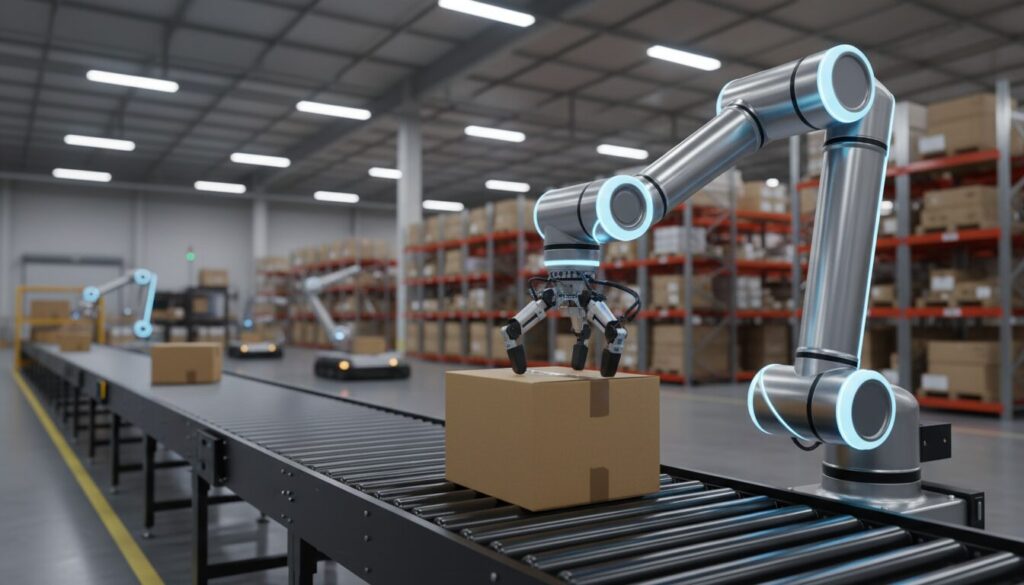
Crucially, Acteris is hardware-agnostic. It works with ABB, Fanuc, and Universal Robots. This means a warehouse does not need to buy futuristic humanoids to benefit from AI; they can upgrade their existing “dumb” arms with a new “brain.” This mirrors the industry-wide pivot we discussed in AI Robotics Shift: From Hardware to Cognitive Swarms, where value is migrating from the actuator to the software stack.
LogiShift View: The Rise of Agentic AI
The terminology used by Trener—specifically “agentic” user interfaces—is significant. It implies that the robot is no longer just a follower of coordinates but an agent capable of decision-making within boundaries.
The “Skill Store” Concept
Trener is effectively building an “App Store” for industrial skills. Instead of writing code to palletize, you download the “Palletize” skill. Instead of coding force-feedback loops for assembly, you download the “Insert” skill.
This creates a distinct divergence in the market:
- Orchestration AI: Platforms that manage fleets and traffic (e.g., WMS integration, path planning). As detailed in Destro AI Impact: Agentic Brain Unifies Warehouse Robotics, this focuses on the macro-optimization of the warehouse.
- Execution AI (Trener): Platforms that manage the individual robot’s hand-eye coordination. This focuses on the micro-physics of manipulation.
The Data Advantage
For these pre-trained skills to work, they require massive amounts of data. Trener’s ability to generalize across different robot brands gives them a unique data feedback loop. Every time a Fanuc arm in Ohio learns to grip a slippery bottle better, the Universal Robot in Germany can potentially benefit from that updated model.
This connects directly to the insights in Noitom Robotics: The Data Engine for Logistics Humanoids, where we identified that the company with the best “data factory” will dominate the robotics landscape. Trener is positioning itself to be the operating system for manipulation, regardless of the hardware.
Critical Analysis: The “So What?” for Executives
Why should a logistics director care about a $32M Series A raise? Because it validates a procurement strategy shift.
If you are currently issuing RFPs for automation, you must ask: “Is this system static or dynamic?”
- Vendor Lock-in is Weakening: Proprietary programming languages (like KAREL for Fanuc or RAPID for ABB) are becoming less relevant for end-users. An abstraction layer like Acteris means your team can manage the robots using natural language or standardized interfaces, reducing dependence on specialized engineers.
- ROI Calculation Changes: The ROI for a robot usually assumes it performs Task A for 5 years. With pre-trained skills, the robot can perform Task A in Q1, Task B in Q2, and assist humans in Q3. The utilization rate of the asset increases dramatically.
- The Human-in-the-Loop: Trener’s emphasis on natural language control suggests a future where warehouse floor supervisors—not just Python developers—can retask robots. This changes the labor profile from “replacing humans” to “empowering operators.”
Takeaway
Trener Robotics is not just selling software; they are selling adaptability. In a supply chain defined by volatility, the ability to retask automation without a six-week integration project is a competitive advantage.
Actionable Advice for Logistics Leaders:
- Audit Your “Graveyard”: Look at the robots in your facility that are currently turned off or underutilized because reprogramming them is too hard. Platforms like Acteris could reactivate this capital.
- Challenge Your Integrators: When quoting new lines, ask integrators how they handle SKU variability. If the answer is “more hard-coding,” look for alternatives that leverage AI-based skill learning.
- Watch the Interfaces: Prioritize systems that offer natural language or intuitive UIs. The future of warehouse labor is collaborating with robots, not coding them.
For a broader look at how humanoid form factors are entering this same space, see our analysis on the Boston Dynamics’ Atlas Pilot. The hardware is evolving, but as Trener demonstrates, the intelligence to run it is the true differentiator.