The cold chain has long been the “final frontier” for warehouse digitalization—a frozen fortress where traditional automation fails, and human labor is both inefficient and hazardous. While standard warehouses have rapidly adopted AGVs and AMR swarms, deep-freeze environments (-20°F / -29°C) have remained stubbornly analog due to battery failure, sensor icing, and the brutal physical toll on workers.
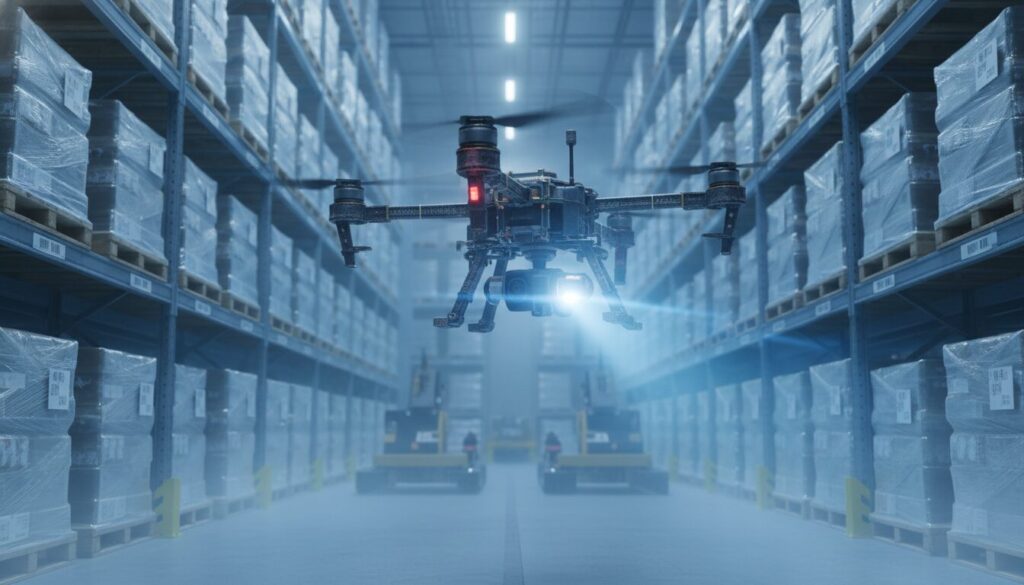
The launch of Corvus One for Cold Chain by Corvus Robotics changes this calculus immediately. By deploying autonomous drones capable of operating in sub-zero temperatures without infrastructure retrofitting, the logistics industry is witnessing the removal of one of its most persistent bottlenecks: the “frozen blind spot” in inventory visibility.
This analysis explores why this technology matters now, its operational impact on the cold chain, and why executives must view this not as a gadget, but as a fundamental shift in inventory management strategy.
The Cold Hard Facts: Corvus One Launch Data
For logistics executives, the significance of this launch lies in the technical specifications that solve historical barriers to entry for freezer automation. The following table summarizes the core components of the announcement.
| Feature Category | Specification / Detail | Operational Benefit |
|---|---|---|
| Operating Environment | Down to -20°F (-29°C) | Eliminates the need for humans to perform inventory counts in hazardous cold. |
| Navigation Tech | Infrastructure-free Localization | No Wi-Fi, beacons, or reflectors required. Operates in “dark” environments without costly facility retrofits. |
| Vision System | Industrial-grade adaptive scanners | Can read frosted, damaged, or low-contrast labels in high-airflow zones where condensation usually blinds sensors. |
| Business Model | Robots-as-a-Service (RaaS) | Includes automated battery swapping and health management, converting CapEx to OpEx. |
| Early Adopter | Kroger (U.S. Retail Giant) | Already deployed in live operations, validating the tech at enterprise scale. |
Industry Impact: Thawing the Data Freeze
The introduction of functional, autonomous drones in cold storage impacts three critical pillars of the supply chain: Labor Safety, Inventory Accuracy (FIFO), and Infrastructure Cost.
1. The End of the “Warming Break” Inefficiency
In deep-freeze environments, safety regulations and human physiology dictate strict limits on work duration. Personnel typically work in short bursts followed by mandatory warming breaks. This results in disjointed workflows and massive idle time.
Corvus One introduces continuous operation. By utilizing an automated battery and device health management system, the drones can run 24/7 without succumb to hypothermia or fatigue. This shift allows warehouse managers to reallocate human labor to value-added tasks in ambient zones, rather than risking injury in the freezer.
This aligns with broader industry trends where automation is no longer about replacing headcount but optimizing it. As discussed in our analysis of Democratizing Automation: NEOintralogistics RaaS Case Study, the shift toward RaaS models allows facilities to deploy automation to handle the “dull, dirty, and dangerous” tasks without the prohibitive upfront capital expenditure that previously blocked smaller players from modernizing.
2. Solving the FIFO Crisis in Perishables
Cold chain logistics is governed by “First-In, First-Out” (FIFO). However, in manual freezer warehouses, strict FIFO compliance is often theoretical. Pallets get buried, labels get frosted over, and manual cycle counts are performed infrequently due to the harsh environment. This leads to spoilage and shrinkage.
The Corvus system’s ability to read frosted labels using adaptive exposure is a game-changer. It provides real-time visibility into what is actually on the shelf versus what the WMS thinks is on the shelf.
Key Insight: Real-time visibility is the only cure for shipping errors. Just as RFID is revolutionizing parcel tracking—see our guide on How to Leverage UPS RFID Expansion—autonomous scanning brings that same level of granularity to the pallet level in the freezer.
3. Infrastructure Independence
Perhaps the most disruptive aspect of the Corvus One is its independence from Wi-Fi and localization markers. Cold storage facilities are often essentially giant Faraday cages—thick metal boxes where Wi-Fi signals die. Installing wireless infrastructure inside a freezer is notoriously expensive and maintenance-heavy.
By removing the requirement for facility modifications, Corvus allows 3PLs and cold storage operators to deploy automation into existing, aging brownfield sites immediately.
LogiShift View: The “Dark Freezer” Arrives
The “So What?” for this announcement goes beyond the hardware. It signals a pivot in how we design cold storage.
The Shift from Hardware to Cognitive Autonomy
The Corvus One operates without external markers, relying on onboard intelligence to map and navigate. This reflects a macro trend we identified in AI Robotics Shift: From Hardware to Cognitive Swarms. The value is no longer just in the mechanical actuator (the drone flying); the value is in the cognitive software that allows the machine to understand a chaotic, unmapped, sub-zero environment.
The Financial Implication: “Freezer Tax” Reduction
Logistics operators have long accepted a “Freezer Tax”—the assumption that cold chain operations will always be 20-30% more expensive and 50% less efficient than ambient operations.
Corvus Robotics is effectively attacking this tax. By automating the inventory count:
- Slotting optimization improves: Drones identify empty slots faster than humans, maximizing cubic utilization (critical when refrigeration costs are high).
- Write-offs decrease: accurate expiration date tracking prevents food waste.
We predict that within 24 months, autonomous inventory in cold chain will move from a “competitive advantage” to a “standard requirement” for 3PL contracts involving high-value perishables (pharma, premium proteins).
Takeaway: Strategic Next Steps for Executives
The launch of Corvus One for Cold Chain is a signal that the technological barriers protecting the “old way” of managing cold storage have fallen. Here is how leaders should respond.
1. Audit Your “Frozen Visibility Gap”
Do not rely on WMS data alone. Conduct a physical audit of your freezer inventory accuracy versus your WMS data. If the variance exceeds 3%, manual counting is failing you.
2. Evaluate RaaS for Hazardous Zones
If you have delayed automation due to CapEx concerns, the RaaS model offered here requires a re-evaluation. The ROI calculation should include:
- Labor savings (direct hours).
- Liability reduction (insurance/injury claims).
- Energy savings (less door opening/closing for human ingress/egress).
3. Plan for Scale, Not Just Pilots
The Kroger deployment proves enterprise readiness. When piloting technologies like this, ensure your backend systems are ready to ingest the massive amount of data these drones produce. As outlined in Automation — A Strategic Growth Enabler, successful scaling requires cleaning your data and preparing your operational processes before the robots arrive.
Conclusion: The cold chain is thawing digitally. With solutions like Corvus One, the excuse that “it’s too cold for robots” is no longer valid. The question is now: is your operation agile enough to adopt them?