Introduction: The Hidden Drag on High-Tech Efficiency
You have invested millions in state-of-the-art automated storage and retrieval systems (AS/RS), robotic palletizers, and high-speed conveyors. Your digital transformation roadmap is clear, and the ROI calculations looked pristine on paper. Yet, your Operations Managers are reporting frequent, unexplained stoppages. The throughput isn’t hitting the targets.
Why?
The answer often lies in a physical variable that gets overlooked during the software and hardware design phase: Material Stability.
In the manual era, a warehouse worker could instinctively adjust their grip on a bulging box or re-stack a slightly leaning pallet. Robots, however, lack this intuition. They rely on predictability. When the physical characteristics of your inventory—packaging integrity, stacking logic, and load containment—fail to match the strict tolerances of your machines, the entire system grinds to a halt.
This article explores why material stability is becoming a bottleneck in automated industrial systems and provides actionable strategies to align your physical inventory with your digital capabilities. By solving this, you unlock the true efficiency your automation promised.
What Is Material Stability in Automation?
To understand the bottleneck, we must first define what “Material Stability” means in the context of modern logistics 4.0.
It is not merely about whether a product is broken. It is about the geometric and structural consistency of the load as it interacts with automated handling equipment.
The Three Pillars of Material Stability
-
Unit Load Integrity
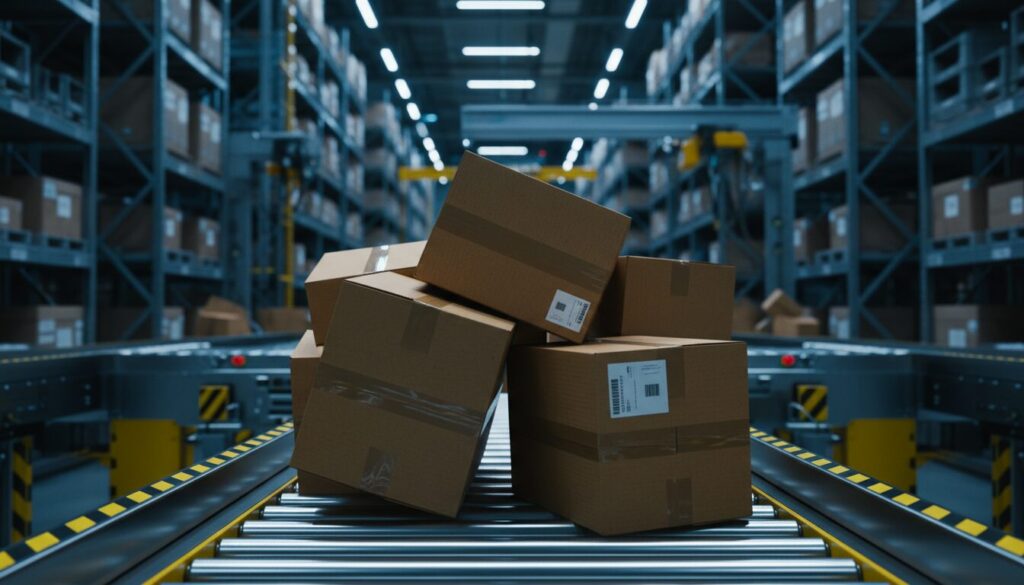
This refers to how well a single item (a carton, a tote, or a bag) maintains its shape. A cardboard box that bulges by even 5mm due to humidity or overpacking can trigger a dimension sensor fault on a conveyor, stopping the line.
-
Stacking interaction
This concerns how units interact when stacked on a pallet or in a mixed-case palletizing robot. If the friction between layers is insufficient, or the interlocking pattern is weak, the motion of an Automatic Guided Vehicle (AGV) can cause the load to shift or topple.
-
Dynamic Stability
This is the ability of the material to remain stable while in motion. Automated systems accelerate and decelerate much faster than forklifts. A load that is stable at rest may become a projectile during an emergency stop of a high-speed shuttle.
The Human vs. Machine Gap
- Humans: Adaptive. We can tilt a box, squeeze it, or use two hands to stabilize a wobbly stack.
- Machines: Binary. A robotic arm expects a surface to be exactly at coordinates X, Y, Z. If the box has collapsed by 10mm, the vacuum gripper fails, leading to a “pick error” that requires human intervention to reset.
Why Now? The Convergence of Trends Creating the Bottleneck
If boxes have always been cardboard, why is material stability becoming a bottleneck in automated industrial systems now? The urgency is driven by four converging global market trends.
1. The Explosion of SKU Complexity (The “E-commerce Effect”)
In the past, warehouses moved full pallets of identical goods (homogenous loads). Today, the demand is for mixed-case pallets and single-unit picking.
- The Challenge: Robots are now required to build pallets using boxes of varying sizes, weights, and rigidities (e.g., placing a heavy case of soda next to a fragile box of chips).
- The Result: Without advanced stability logic, these mixed pallets are structurally weaker and prone to collapse inside the automation grid.
2. Sustainability and “Lightweighting”
Companies are under immense pressure to reduce packaging waste and carbon footprints. This has led to “lightweighting”—using thinner cardboard and less plastic wrap.
While good for the planet, this creates a structural deficit. Thinner corrugate crushes easily under the clamp pressure of a robotic arm or the weight of a stack in an AS/RS, causing system jams that were rare a decade ago.
3. Increased Automation Speeds
Modern sorters and shuttles move at breakneck speeds to meet “Same Day Delivery” promises.
- Physics: Higher acceleration equals higher G-forces exerted on the load.
- Consequence: A packaging standard that was stable on a slow conveyor is unstable on a high-speed loop sorter.
4. Labor Shortages
The primary reason for automation is the lack of available labor. However, when unstable materials cause machine stoppages, you need more skilled technicians to clear jams and reset robots. Unstable materials negate the labor-saving benefits of automation.
Quantitative and Qualitative Benefits of Stability
Addressing material stability is not just a maintenance task; it is a strategic value driver. Aligning your packaging specifications with your automation constraints yields measurable gains.
Comparison: Unstable vs. Stable Operations
The following table outlines the impact of material stability on key operational metrics.
| Metric | With Material Issues (The Bottleneck) | With Optimized Stability (The Solution) |
|---|---|---|
| OEE (Overall Equipment Effectiveness) | Low ( 85%). Continuous, predictable run rates. | |
| Recovery Time | High. Humans must enter “safety zones” to fix jams. | Low. Issues are rare and often auto-correctable. |
| Product Damage | Frequent crushing by grippers or topples. | Minimal. Packaging matches machine force. |
| Throughput Capacity | Variable. Unpredictable peaks and valleys. | Consistent. Meets design capacity reliably. |
Strategic Advantages
- Protecting Capital Assets: Loose flaps and collapsing pallets can damage expensive sensors, belts, and robotic end-effectors.
- Data Accuracy: A stable box ensures barcodes are always facing the scanners at the right angle, reducing “no-read” errors.
- Safety: Preventing pallet tip-overs in high-bay warehouses protects staff working at ground level.
Implementation: How to Overcome the Stability Bottleneck
To remove this bottleneck, operations leaders must bridge the gap between Procurement/Packaging Design and Logistics Operations. Here is a step-by-step implementation guide.
Step 1: Audit Your “Non-Conveyables”
Before buying new robots, analyze your current inventory.
- Identify the top 10% of SKUs that cause jams.
- Look for commonalities: Is it a specific supplier? A specific box type?
- Action: Create a “Do Not Automate” list for items that fail stability tests until packaging is improved.
Step 2: Establish Vendor Compliance Guidelines
Your suppliers likely design packaging for shelf appeal or truck transport, not for your robotic arm. You must update your routing guides.
- Specify Corrugate Strength: Mandate Edge Crush Test (ECT) ratings that can withstand your stacking heights.
- Dimension Tolerances: Set strict limits on “bulge.” (e.g., “Maximum width deviation: +/- 0.5 inches”).
- Dunnage Rules: Require internal dunnage (bubble wrap/paper) to prevent box collapse from the inside.
Step 3: Implement Advanced Palletizing Logic
If you utilize robotic palletizers, upgrade the software to prioritize stability over density.
- Interlocking Patterns: Ensure software “bricks” the layers (overlapping) rather than column-stacking, which is prone to tipping.
- Heavy-on-Bottom: Enforce strict logic where heavier/rigid items are placed first, creating a stable base for lighter/fragile items.
Step 4: Invest in Secondary Containment
Sometimes, you cannot change the primary packaging. In these cases, standardize the interface.
- System Totes/Bins: Decant loose or unstable products into rigid, standardized plastic totes. This gives the robot a perfect surface to handle every time.
- Tray Systems: Use captive trays for goods moving through high-speed conveyors to contain potential spills or tumbles.
Step 5: Utilize Load Stability Testing
Don’t wait for a crash to find out a load is unstable.
- Stretch Wrap ROI: Use an automated stretch wrapper with pre-stretch capabilities. Secure the load to the pallet effectively to withstand G-forces.
- Tilt Testing: Conduct physical tilt tests on sample pallets to determine the maximum safe angle for AGV movement.
Conclusion
The question of why material stability is becoming a bottleneck in automated industrial systems is ultimately a question of alignment. We have built 21st-century robots but are often feeding them 20th-century packaging.
As automation speeds increase and labor pools shrink, the margin for error vanishes. A single crushed box is no longer just a damaged product; it is a system-wide failure that erodes your competitive advantage.
Recommended Next Steps
- Conduct a Gemba Walk: Walk your automated lines specifically looking for “micro-stops” caused by packaging.
- Collaborate with Packaging Engineering: Bring your packaging team into the warehouse to see how their designs interact with the robots.
- Review Procurement Contracts: Add “Automation Readiness” clauses to your supplier agreements.
By treating material stability as a core component of your automation strategy—rather than an afterthought—you ensure your facility runs at the speed and efficiency it was designed for.