Introduction
Are your operational costs spiraling out of control while production targets remain unmet? You are not alone.
For many operations leaders and logistics executives, the modern factory floor is a battleground. You are fighting a two-front war: a crippling labor shortage that leaves critical shifts understaffed, and the relentless pressure to increase efficiency without sacrificing quality. Traditional automation—massive, caged robots—is often too expensive and too rigid to solve these dynamic problems.
This is where the paradigm shifts. We are no longer looking at a future of “lights-out” manufacturing where humans are obsolete. Instead, we are witnessing the rise of collaborative robots (cobots) and human-robot teams in modern factories.
This article is your comprehensive guide to understanding this transformation. We will move beyond the buzzwords to explore how human-robot collaboration (HRC) can stabilize your workforce, reduce operational costs, and introduce a level of flexibility your supply chain desperately needs.
The Basics: What is Human-Robot Collaboration?
To understand the rise of collaborative robots and human-robot teams in modern factories, we must first define what distinguishes this technology from the automation of the past.
Defining Collaborative Robots (Cobots)
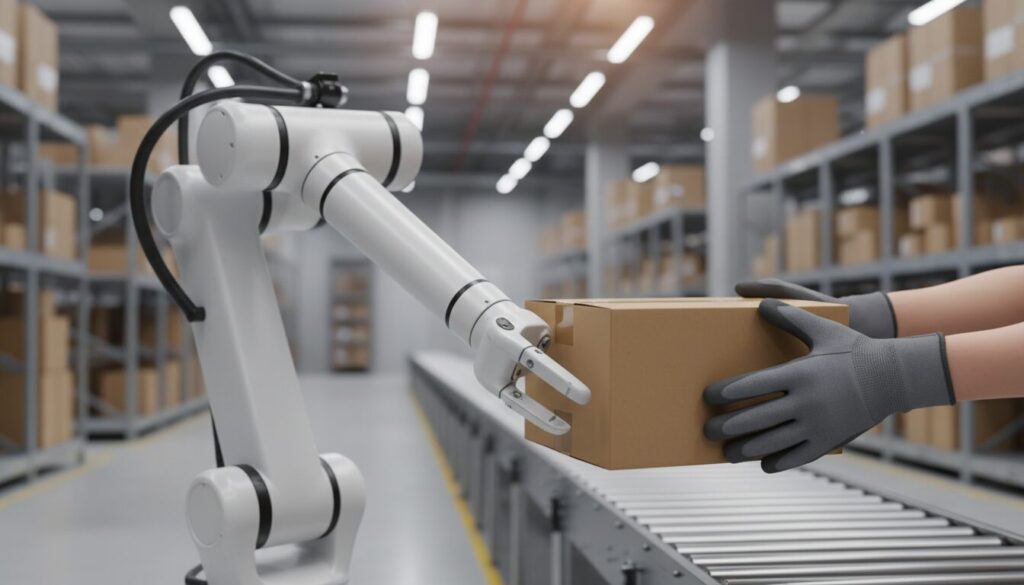
Unlike traditional industrial robots, which are powerful but “blind” machines requiring safety cages to prevent injury to humans, collaborative robots—or cobots—are designed to work safely alongside people.
Cobots are equipped with advanced sensors (torque sensors, vision systems, and capacitive skins) that allow them to detect the presence of a human. If a cobot comes into contact with a worker, it slows down or stops immediately to prevent injury.
The Concept of the Human-Robot Team
The “Human-Robot Team” is not just about placing a robot next to a human; it is about leveraging the unique strengths of both.
- The Robot’s Strength: Endurance, precision, repeatability, and heavy lifting.
- The Human’s Strength: Cognitive decision-making, dexterity, adaptability, and problem-solving.
In a human-robot team, the robot might handle the heavy lifting of a raw material, while the human operator performs the intricate quality check and final assembly. This symbiosis creates a workflow that is more efficient than either working alone.
See also: Zasche Semi-Automated Bin Picking: The Essential Guide
(This guide illustrates a perfect example of semi-automation where human skill meets mechanical assistance.)
Levels of Collaboration
Not all teams work the same way. The International Federation of Robotics (IFR) defines four levels of interaction:
- Coexistence: Human and robot work in the same space but on different tasks without a fence.
- Synchronization: Human and robot work on the same object but at different times.
- Cooperation: Human and robot work on the same object at the same time.
- Collaboration: The robot responds in real-time to the human’s movement and actions.
Why Now? The Drivers Behind the Rise
Why is the rise of collaborative robots and human-robot teams in modern factories happening now? It is not just because the technology exists; it is because the market demands it.
1. The Global Labor Crisis
The “Silver Tsunami” (an aging workforce) and a general disinterest among younger generations in manual manufacturing jobs have created a massive skills gap. Factories cannot find enough people to run fully manual lines.
Cobots act as a force multiplier. Instead of needing three people for a heavy palletizing task, you might need one human supervising a cobot. This allows you to reallocate your scarce human talent to higher-value tasks that require critical thinking.
2. The Shift from Mass Production to Mass Customization
The era of producing one million identical widgets is fading. Modern consumers demand customization. Traditional automation is notoriously difficult to reprogram for small batches.
Cobots, however, are agile. They can be reprogrammed in minutes—often by the operators themselves—to switch from Product A to Product B. This flexibility is essential for “High-Mix, Low-Volume” production environments.
3. Technological Evolution: From Hardware to Intelligence
Robots are getting smarter. We are moving away from purely mechanical advancements toward software-driven intelligence.
As discussed in our analysis of industry trends, the focus is shifting from simple actuators to “Cognitive Swarms” where robots can communicate and adapt.
See also: AI Robotics Shift: From Hardware to Cognitive Swarms
Furthermore, the integration of Physical AI allows robots to understand the 3D space of a warehouse or factory, navigating dynamic environments that would baffle older machines.
See also: How Physical AI Will Reshape the Warehouse: 2025 Guide
Benefits of Adopting Human-Robot Teams
Implementing collaborative robotics is not just an operational change; it is a strategic financial decision.
Quantitative Benefits
- ROI Speed: Traditional automation often takes 2-3 years to see a return on investment (ROI). Cobots, due to lower upfront costs and faster deployment, often show ROI in less than 12 months.
- Space Utilization: Cobots do not require massive safety cages. This saves valuable factory floor real estate, allowing you to fit more production lines into existing facilities.
- Error Reduction: Robots do not get tired or distracted. By handing repetitive tasks to cobots, defect rates typically drop significantly.
Qualitative Benefits
- Employee Retention: By removing the “dull, dirty, and dangerous” tasks (the 3Ds) from human workers, job satisfaction increases. Workers become “Robot Operators” rather than manual laborers, which is a more attractive career path.
- Safety Improvement: Reducing the need for humans to lift heavy loads or perform repetitive motions drastically reduces musculoskeletal disorders (MSDs) and workplace injuries.
Comparison: Traditional vs. Collaborative
| Feature | Traditional Industrial Robots | Collaborative Robots (Cobots) |
|---|---|---|
| Safety | Requires cages/fencing | Safe alongside humans (sensors) |
| Footprint | Large, fixed installation | Compact, mobile |
| Programming | Complex code (Experts only) | Drag-and-drop / Hand-guiding |
| Cost | High CAPEX + Setup costs | Lower CAPEX + Low setup costs |
| Application | High-Volume, Low-Mix | High-Mix, Low-Volume |
Implementation Strategies for Success
The rise of collaborative robots and human-robot teams in modern factories offers immense potential, but deployment requires a structured approach.
1. Safety and Compliance First
Even though cobots are designed to be safe, the application must be safe. A cobot holding a sharp knife is still dangerous.
You must adhere to the latest safety standards. The Association for Advancing Automation (A3) recently released updated standards that are critical for modern compliance.
See also: A3 R15.06-2025: Critical Alert for Robot Safety
Key Safety Steps:
- Conduct a thorough Risk Assessment (RA).
- Define the maximum force and speed limits.
- Determine the separation distance required between human and robot.
2. Identify the Right Pilot Project
Do not try to automate your most complex process first. Start with a “quick win.”
- Pick and Place: Moving parts from a bin to a machine.
- Palletizing: Stacking boxes at the end of a line.
- Quality Inspection: Using a cobot with a camera to check parts from different angles.
3. Change Management and Training
The biggest barrier to the rise of collaborative robots and human-robot teams in modern factories is often cultural, not technical. Workers may fear being replaced.
- Transparency: Explain early on that the goal is to assist, not replace.
- Upskilling: Provide training for your staff to become the “managers” of these robots.
Real-World Example:
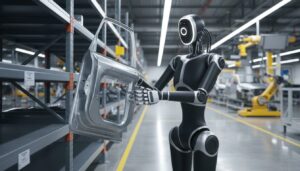
Major aerospace companies are already paving the way. For instance, Airbus has partnered with UBTECH to integrate humanoid robotics into their manufacturing lines, demonstrating how advanced human-robot teams can tackle complex assembly tasks.
See also: UBTECH & Airbus: Humanoid Robotics Innovation Case Study
4. Continuous Optimization
Once deployed, the job isn’t done. Use the data collected by the cobot to analyze bottlenecks. Since cobots are flexible, you can move them to different stations as demand fluctuates.
Conclusion: The Future is Collaborative
The rise of collaborative robots and human-robot teams in modern factories marks a pivotal moment in logistics and manufacturing history. We are moving away from the rigid, capital-intensive automation of the 20th century toward a flexible, intelligent, and human-centric model.
For operations leaders, the message is clear: Adopting human-robot teams is no longer a futuristic experiment; it is a necessary survival strategy.
By integrating cobots, you address the labor shortage, improve safety, and create a production line capable of adapting to the rapid changes of the global market.
Recommended Next Steps
- Audit Your Floor: Walk your factory floor and identify tasks that are repetitive, heavy, or hated by your staff.
- Review Safety: Familiarize yourself with the new A3 R15.06-2025 standards to ensure any future deployment is compliant.
- Start Small: Choose one pilot application to prove the ROI and build team confidence.
The factory of the future is not empty of people—it is powered by teams where humans and robots work hand-in-hand.