The landscape of industrial automation is undergoing a seismic shift. For decades, “automation” meant caged arms welding car chassis or Automatic Guided Vehicles (AGVs) following magnetic tape in warehouses. Today, the definition is changing.
A groundbreaking partnership has emerged that signals the maturation of humanoid robotics: China’s UBTECH Robotics has partnered with European aerospace giant Airbus. They are deploying the ‘Walker S2’ humanoid robot into aircraft manufacturing facilities.
This is not a futuristic demo video; it is an operational Proof of Concept (PoC) aimed at solving critical labor shortages in one of the world’s most high-stakes industries. For innovation leaders and strategy executives in logistics and manufacturing, this collaboration offers a blueprint for how cross-border technology and humanoid robotics will reshape global supply chains.
Why It Matters: Beyond the Hype
The deployment of humanoid robots has historically been viewed with skepticism—great for PR stunts, but questionable for ROI. The UBTECH-Airbus alliance changes this narrative for three critical reasons:
- High-Consequence Environment: Aircraft manufacturing allows zero margin for error. Unlike an e-commerce warehouse where a dropped package is a minor annoyance, a mistake in aviation is catastrophic. Airbus’s willingness to test humanoids implies that the technology has reached a threshold of precision and reliability previously thought unattainable.
- Cross-Border Collaboration: In an era of fragmented global trade and geopolitical technological rivalry, this partnership highlights the pragmatic necessity of innovation. It bridges China’s rapid hardware iteration (UBTECH) with Europe’s industrial heritage (Airbus).
- The Labor Cliff: The aerospace sector, like logistics, faces a severe shortage of skilled labor capable of performing non-repetitive, complex tasks in confined spaces. This partnership proves that major corporations are now betting on embodied AI as the solution.
As discussed in our analysis of the AI Robotics Shift: From Hardware to Cognitive Swarms, the industry is pivoting from simple hardware races to intelligent, cognitive systems capable of adapting to complex environments.
Global Trend: The Race for Humanoid Dominance
To understand the significance of the UBTECH deal, we must view it within the broader context of the “Humanoid Arms Race” occurring across the US, China, and Europe.
The United States: Software-First Approach
The US market is driven by major tech investments focusing on the “brain” of the robot. Companies like Tesla (Optimus), Figure AI, and Agility Robotics are heavily integrated with large language models (LLMs) and vision systems. The focus here is often on general-purpose utility in logistics (totes moving) before high-precision manufacturing.
China: Speed and Scale
China is leveraging its supply chain dominance to iterate hardware faster than any other region. Companies like UBTECH, Fourier Intelligence, and Unitree are driving down the cost of actuators and sensors, aiming for mass production. UBTECH’s projection to produce over 10,000 units by 2026 exemplifies this strategy of scale.
Europe: The Industrial Adopter
Europe acts as the sophisticated testing ground. While generating fewer humanoid startups than the US or China, European heavy industries (Automotive: BMW, Mercedes; Aerospace: Airbus) are the aggressive adopters, integrating these units into legacy production lines to maintain competitiveness.
Comparative Landscape: Global Humanoid Strategies
| Region | Primary Focus | Key Players | Strategic Goal |
|---|---|---|---|
| China | Mass Production & Hardware Cost Reduction | UBTECH, Fourier, Unitree | Dominate hardware market share; Export industrial solutions. |
| US | AI Integration & General Purpose | Tesla, Figure, Agility | Create the “iPhone of Robots”; Solves logistics labor gaps first. |
| EU | Industrial Application & Integration | (Adopters: Airbus, BMW) | Mitigate aging workforce; Sustain high-value manufacturing. |
Case Study: UBTECH x Airbus
This partnership is the definitive case study for 2025 on how to introduce humanoid robotics into heavy industry.
The Technology: Walker S2
The Walker S2 is UBTECH’s industrial-grade humanoid. unlike its predecessors designed for service or education, the S2 is built for the factory floor.
- Mobility: It utilizes bipedal locomotion to navigate stairs, uneven terrain, and confined spaces inside aircraft fuselages—areas where wheeled AMRs cannot go.
- Sensors: Equipped with advanced visual servoing and force-feedback sensors, allowing it to handle delicate components.
The Application: Smart Manufacturing
Airbus is utilizing the Walker S2 for specific, high-precision tasks during the initial PoC phase. These are tasks that are typically ergonomically difficult or dangerous for humans:
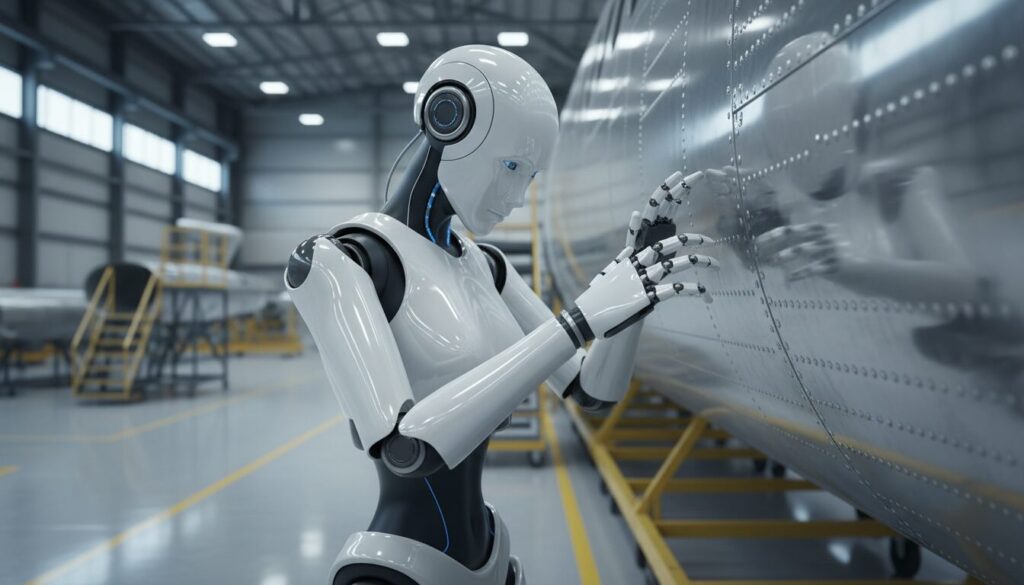
- Intelligent Inspection: Checking rivet quality and fuselage integrity using computer vision.
- High-Precision Handling: Assisting in the installation of interior components where space is limited.
- Chemical Handling: Operating in environments with fumes or materials hazardous to human workers.
Strategic Expansion: The Texas Instruments (TI) Factor
A crucial, often overlooked aspect of UBTECH’s strategy is its partnership with Texas Instruments (TI).
- The Strategy: By integrating TI’s embedded processing and analog chips, UBTECH ensures its robots meet rigorous global industrial standards.
- The Result: This collaboration accelerates UBTECH’s expansion from the Chinese domestic market to global industrial sectors, mitigating potential concerns regarding hardware reliability or supply chain transparency.
Financial Projections
The scale of this ambition is backed by significant financial projections. UBTECH projects a total order value exceeding 1.4 billion yuan (approx. $193M USD) for 2025. This revenue is not consumer-based; it is derived from high-value industrial contracts like the one with Airbus, signaling that the B2B humanoid market is opening up.
For further reading on how physical intelligence is evolving to meet these demands, see our guide: How Physical AI Will Reshape the Warehouse: 2025 Guide.
Key Takeaways for the Logistics Industry
While this case study focuses on aerospace manufacturing, the implications for the global logistics and supply chain industry are direct and profound.
1. The “Brownfield” Advantage
The Walker S2 works in an aircraft factory designed for humans, not robots. It climbs stairs and fits through standard doors.
- Lesson: Logistics leaders do not need to build “lights-out” warehouses from scratch. Humanoids offer a path to automate “Brownfield” sites (existing warehouses with mezzanines and narrow aisles) without changing the infrastructure.
2. High-Value Intralogistics
Airbus isn’t using robots to move cheap boxes; they are handling expensive aircraft parts.
- Lesson: The ROI for humanoids in logistics may not initially be in high-speed sorting, but in high-value intralogistics—moving medical devices, luxury goods, or hazardous materials where precision and handling care outweigh raw speed.
3. Supply Chain Resilience via Autonomy
The labor shortage is a global supply chain risk.
- Lesson: By 2026, incorporating humanoids will be a standard component of Business Continuity Planning (BCP). Companies that start PoCs now will have the data integration layers ready when mass production hits.
4. The Data Engine Requirement
Deploying these robots requires immense amounts of training data. As discussed in our article on Noitom Robotics: The Data Engine for Logistics Humanoids, successful deployment depends on having a robust “Data Factory” to train these embodied AI systems before they enter the facility.
Future Outlook
The UBTECH and Airbus partnership marks the beginning of the “Industrial Humanoid Era.”
We expect the following trajectory over the next 36 months:
- 2025: proliferation of Proof of Concepts (PoCs) in heavy manufacturing and automotive sectors.
- 2026: UBTECH hits its 10,000 unit capacity target; costs per unit begin to drop significantly, making them viable for general logistics 3PLs.
- 2027+: Standardization of “Robot-as-a-Service” (RaaS) models for humanoids, where companies hire a fleet of Walker S2s or similar units for peak seasons.
For strategy executives, the message is clear: The technology has graduated from the lab to the assembly line. The question is no longer if humanoids will enter the supply chain, but how quickly your infrastructure can adapt to manage them.