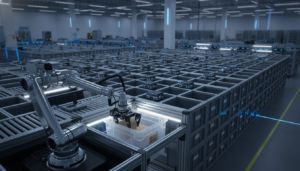
The logistics robotics sector is undergoing its most significant transformation in a decade. For years, the industry’s focus was mechanical: better actuators, lighter materials, and faster motors. Today, that hardware race has largely stabilized. The new battleground—and the primary driver of capital expenditure—is the “brain” behind the machine.
Recent massive capital injections, including Waymo’s staggering $16 billion raise and LimX Dynamics’ $200 million Series B, signal a decisive market shift. Investors and tech leaders are no longer betting on robots that simply repeat programmed tasks; they are funding cognitive humanoids and swarm autonomy.
For logistics executives, this marks the end of “islands of automation.” We are entering an era where edge-based AI allows fleets of robots to collaborate, plan, and execute complex workflows without constant human intervention or centralized cloud dependency. This analysis explores how the pivot from actuators to AI will redefine operational efficiency in the supply chain.
The Facts: The Capital Shift Toward “Thinking” Robots
The current investment landscape provides a clear roadmap of where the technology is heading. The money is flowing away from pure hardware manufacturing and toward companies solving the problems of perception, cognition, and decentralized decision-making.
Key Market Movements
The following table summarizes the critical recent developments driving this trend:
| Entity | Investment / Valuation | Focus Area | Industry Implication |
|---|---|---|---|
| Waymo | Raised $16B ($126B Val.) | Autonomous expansion & Edge AI | Validates the scalability of autonomous networks beyond simple pilots. |
| LimX Dynamics | Raised $200M (Series B) | Cognitive Humanoids | shifts focus to “whole-body motion control” integrated with real-time planning. |
| Swarm Tech | N/A (Trend) | Multi-robot collaboration | Enables robots to make collective decisions at the edge, reducing latency. |
| Hardware | N/A (Trend) | High-precision drive systems | Commodities hardware, allowing fleets to scale cost-effectively. |
The “Swarm” Breakthrough
The most critical technical evolution mentioned in recent reports is the development of multi-robot collaborative autonomy. In traditional setups, robots communicate with a central server (WES/WMS) to receive instructions. This creates latency and a single point of failure.
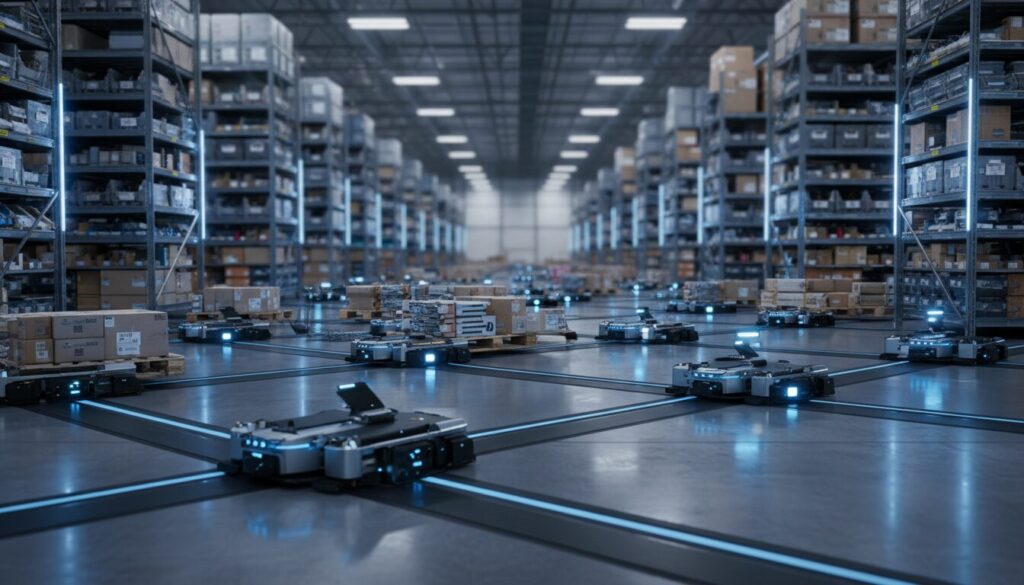
The new generation of AI-integrated systems utilizes “swarm” intelligence. Robots communicate directly with each other at the “edge” (on the device). If one robot identifies a blocked aisle, it instantly informs the fleet, and the swarm collectively re-routes without burdening the central server. This mimics biological systems and is essential for high-volume logistics environments.
Industry Impact: Redefining Logistics Operations
The transition from mechanical capability to cognitive ability impacts every node of the supply chain. The hardware capability—lifting heavy boxes or traversing uneven floors—is now assumed. The differentiator is how the robot handles the unexpected.
1. Warehousing: From Rigid Automation to Fluid Intelligence
In the past, an AGV (Automated Guided Vehicle) required magnetic tape or QR codes to move. If a pallet fell in its path, the robot stopped until a human intervened.
With the integration of cognitive planning and Physical AI, the warehouse floor changes:
- Dynamic Path Planning: Robots equipped with advanced vision systems and edge AI perceive obstacles as semantic data (e.g., “This is a forklift, it will move” vs. “This is a pillar, it will not”).
- Human-Robot Coexistence: Cognitive humanoids can predict human movement, allowing for tighter collaboration in pick-paths without safety cages.
- See also: How Physical AI Will Reshape the Warehouse: 2025 Guide
2. The Rise of the General-Purpose Humanoid
LimX Dynamics’ funding highlights the push for general-purpose humanoids. Unlike specialized robotic arms, these units are designed to operate in environments built for humans (stairs, narrow aisles, shelves).
For logistics managers, this means:
- Retrofit-Free Automation: You no longer need to rebuild your warehouse to suit the robots. Cognitive humanoids can navigate existing brownfield facilities.
- Task Switching: The same robot can unload a truck in the morning and perform cycle counts in the afternoon, driven by software updates rather than hardware changes.
- Data Dependencies: These robots require massive amounts of training data to function. As discussed in Noitom Robotics: The Data Engine for Logistics Humanoids, the ability to simulate and train these “brains” is now just as important as the robot itself.
3. Last-Mile and Yard Management
Waymo’s expansion signals that autonomous systems are maturing enough to handle the unstructured chaos of public roads and shipping yards.
- Edge Decision Making: An autonomous truck in a logistics yard must negotiate right-of-way with manual trucks. This requires split-second edge processing, not cloud-based commands.
- Swarm Yard Operations: A fleet of autonomous yard dogs can coordinate trailer moves autonomously, optimizing dock utilization in real-time.
LogiShift View: The “Brain-Body” Disconnect is Closing
The headlines focus on the dollar amounts, but the real story is the convergence of hardware maturity and software capability. At LogiShift, we see three critical “So What?” implications for the industry.
1. The Commoditization of Mechanics
The mechanical aspect of robotics—actuators, gears, and batteries—is following the trajectory of the smartphone. Hardware is becoming standardized. We have reached a point where high-precision drive systems are reliable enough to scale.
The value proposition has shifted entirely to the software stack. Logistics companies should stop evaluating robots based solely on payload capacity and start evaluating them on “Cognitive adaptability.” How fast can the system map a new facility? How well does it handle edge cases?
2. The Era of “Edge Swarms”
Cloud latency is the enemy of real-time logistics. The move toward edge-based swarm autonomy is a game-changer. It reduces the bandwidth load on warehouse networks and increases resilience. If the Wi-Fi goes down, a true swarm fleet continues to operate via local mesh communication.
This aligns with broader infrastructure trends. Just as Amazon is pouring billions into infrastructure to support AI (see Winning the AI Capex Race: Amazon’s Logistics Strategy), robotic fleets are becoming self-contained infrastructure units.
3. The New Safety Paradigm
As robots become more autonomous and “think” for themselves, traditional safety protocols based on fixed zones become obsolete. The industry must move toward dynamic safety standards.
The recently released safety standards are a direct response to this. Companies deploying cognitive robots must adhere to updated frameworks that account for AI decision-making.
- Critical Reference: A3 R15.06-2025: Critical Alert for Robot Safety
4. Beyond Vision: Tactile Intelligence
While vision (cameras/Lidar) is the primary focus of current autonomous driving and navigation, the next frontier for manipulation (picking/packing) is tactile sensing. As robots move from moving boxes to handling items, innovations in materials will matter.
- Related Insight: Smart Fabric Innovation: Yotlive Case Study in EVs & Robots
Takeaway: Strategic Steps for Logistics Leaders
The shift from actuators to AI is not a future prediction; it is the current investment reality. To stay ahead, executives must adjust their technology roadmaps immediately.
- Evaluate “Brain” over “Brawn”: When issuing RFPs for automation, weight the software’s ability to handle exceptions and unstructured data higher than raw speed or lift capacity.
- Audit Network Infrastructure for Edge Computing: Ensure your facilities can support local mesh networks required for swarm autonomy, reducing reliance on centralized cloud control.
- Prepare for Heterogeneous Fleets: The future is not one brand of robot. It is a swarm of different robots (humanoids, AMRs, arms) collaborating. Invest in middleware and interoperability standards now.
- Update Safety Compliance: Do not apply 2012 safety rules to 2025 AI robots. Review the new A3 standards to mitigate liability as autonomy increases.
The hardware race is over. The cognitive race has begun. The winners will be those who deploy fleets that can think, collaborate, and adapt at the edge.