The numbers are staggering, even for the technology sector. By 2026, Amazon is projected to spend over $200 billion on capital expenditures (capex), with Google following closely at $185 billion and Microsoft at $150 billion. To put this in perspective, Amazon’s projected spend rivals the entire GDP of countries like New Zealand or Greece.
For innovation leaders and strategy executives, the headline is often “Generative AI.” However, for the logistics and supply chain sector, the story is much deeper. While Google and Microsoft are battling for supremacy in search, code, and enterprise software, Amazon is funneling its war chest into a fundamentally different arena: Physical AI.
Amazon and Google are winning the AI capex race — but what’s the prize? For Google, it is the retention of the world’s information flow. For Amazon, the prize is the total automation of the global movement of goods.
This article explores why this unprecedented spending spree is reshaping global logistics and what strategy executives must learn from the “Physical AI” revolution.
Why It Matters: The Shift from Digital to Kinetic
For the past decade, digital transformation meant moving data to the cloud. The next decade is about moving atoms with intelligence. The massive capex injection by Big Tech is not merely about buying Nvidia H100 GPUs; it is about building the infrastructure that powers the future economy.
The logistics industry is currently navigating a “Great De-Coupling.” As discussed in our analysis of the Amazon-UPS De-Coupling: The Singapore Supply Chain Blueprint, volume is vanity, but profit is sanity. Amazon’s investment is designed to lower the unit cost of fulfillment to levels that traditional logistics carriers cannot match without similar automation.
The Three Pillars of the Capex Explosion
- Compute Sovereignty: Reducing reliance on external chip suppliers.
- Energy Resilience: Securing power for data centers and electric fleets.
- Autonomous Execution: Robotics that don’t just “assist” but “act.”
Supply chain leaders are already sensing this shift. According to recent data, 85% of executives are pivoting toward technology to handle disruptions.
Global Trend: The Geopolitical Divide in AI Logistics
While the sheer dollar amount of US Big Tech spending grabs headlines, the application of these funds varies significantly across major global regions. The race is not uniform; it is shaped by regulatory environments and industrial bases.
United States: The Integrated Giants
In the US, the trend is vertical integration. Amazon, Microsoft, and Google are attempting to own the entire stack—from the energy source (nuclear/renewables) to the silicon chips, the data center, and the end-user application.
For logistics specifically, this means the US is moving toward “Logistics-as-a-Service” powered by massive proprietary AI models that optimize routes, inventory, and labor in real-time.
China: Efficiency Under Constraint
Facing export controls on high-end chips, Chinese giants like Alibaba (Cainiao), JD.com, and rising stars like Temu are focusing on process efficiency and collaborative robotics. Instead of relying solely on massive Large Language Models (LLMs) that require banned GPUs, Chinese innovation is flourishing in edge computing and highly efficient automated guided vehicles (AGVs) within warehouses. Their prize is dominance in cross-border e-commerce throughput.
Europe: Sovereign Cloud and Sustainability
Europe remains the regulatory superpower. The focus here is not just raw speed, but “Sustainable AI.” The EU AI Act is forcing companies to be transparent about their algorithms. Consequently, logistics trends in Europe prioritize carbon accounting and supply chain transparency over raw automation speed.
Capex Focus Comparison: Big Tech vs. Global Logistics
| Company / Region | Est. 2026 Capex | Primary Logistics Focus | Strategic Goal |
|---|---|---|---|
| Amazon (USA) | $200B | Robotics, Satellites, Custom Chips | Total Supply Chain Autonomy |
| Google (USA) | $185B | Maps, Routing AI, Cloud Logistics | Data & Search Dominance |
| Microsoft (USA) | $150B | Enterprise ERP, Digital Twins | OS for Global Trade |
| Alibaba/JD (China) | N/A (High) | Cross-border fulfillment, AGVs | Global E-commerce Volume |
| DHL/Maersk (EU) | Moderate | Sustainable Fuel, IoT Tracking | Green Logistics Leadership |
Case Study: Amazon’s “Physical AI” Ecosystem
While Google’s $185 billion is largely directed at preserving its advertising monopoly and winning the cloud war against Microsoft, Amazon’s $200 billion strategy is uniquely physical. They are not just building chatbots; they are building a machine that moves the world.
1. The Custom Silicon Edge (Trainium & Inferentia)
Amazon is aggressively moving away from total reliance on Nvidia. By designing its own AI chips (Trainium for training models and Inferentia for running them), Amazon creates a cost structure for AI that logistics competitors (like UPS or FedEx) cannot replicate. This allows them to run complex optimization algorithms on every package without destroying margins.
2. Robotics Beyond the Kiva
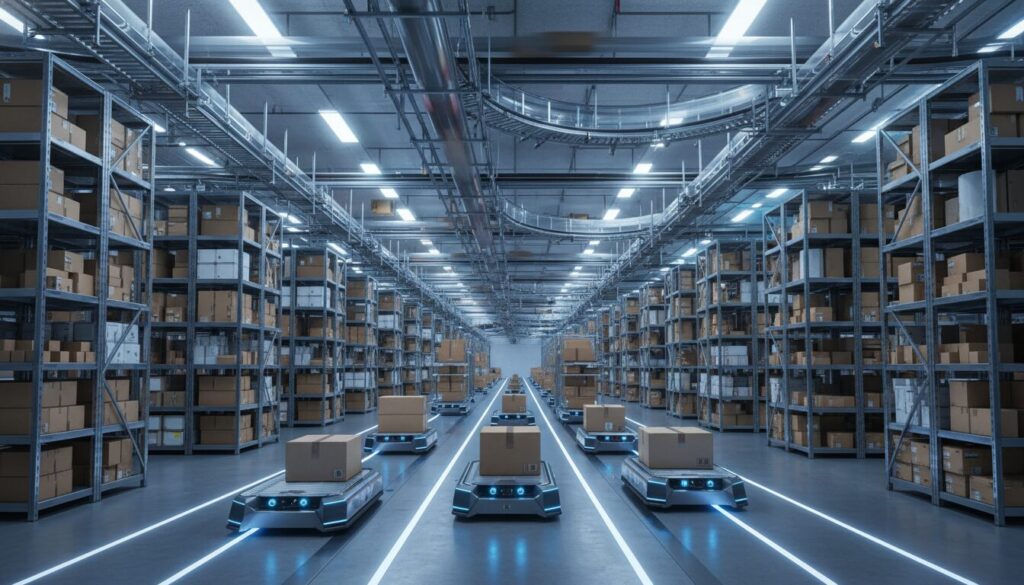
Amazon’s acquisition of Kiva Systems years ago was just the start. The new capital injection fuels the deployment of humanoid robots (like Digits) and fully autonomous arms (Sparrow) that can handle individual items, not just pallets.
This transition is critical. As labor shortages plague the Western world, Amazon is betting that the only way to sustain 2-day or same-day delivery is by removing the biological limit on warehouse throughput.
- For a deeper dive on this technology, read: How Physical AI Will Reshape the Warehouse: 2025 Guide
3. Project Kuiper: Connectivity from the Sky
A largely overlooked part of Amazon’s capex is Project Kuiper—its low earth orbit satellite constellation (competitor to Starlink). Why is a retailer launching thousands of satellites?
- Global Tracking: Real-time visibility of maritime and trucking assets in dead zones.
- Consumer Reach: Connecting the “next billion” consumers in remote areas to the e-commerce grid.
- Defense & Enterprise: Selling high-bandwidth connectivity to logistics partners.
The Contrast: Walmart’s Cross-Border Play
While Amazon builds satellites and chips, Walmart is leveraging its massive physical footprint and vendor relationships to dominate cross-border trade. They are optimizing the “middle mile” and customs brokerage, proving there is more than one way to win.
Key Takeaways: Lessons for the Logistics Industry
If Amazon and Google are winning the AI capex race, what does that mean for the rest of the industry? You cannot out-spend them, but you can out-maneuver them.
1. Energy is the New Bottleneck
The massive data centers required for AI consume electricity at a rate that grids cannot sustain. We are seeing a race for energy assets. Logistics hubs of the future will not just need good roads; they will need proximity to power stations and battery minerals.
- The rush for energy resources is evident in government policy: US Mineral Reserve: An Admission the Future is Electric
2. Physical AI > Generative AI
For logistics, ChatGPT is a productivity tool, but Physical AI (computer vision, robotics, predictive maintenance) is a survival tool. Strategy executives should prioritize investments that touch the physical product over purely digital enhancements.
3. Vertical Integration vs. Horizontal Partnership
Amazon is vertically integrating. Most other logistics companies must horizontally partner. Using Microsoft’s Azure or Google’s Cloud for logistics AI is a valid strategy, but companies must retain ownership of their proprietary data to avoid becoming “dumb pipes” for Big Tech.
Future Outlook: The Prize is the Automated Economy
The prize at the end of this $200 billion tunnel is not just better product recommendations. It is the ability to predict a consumer’s need, manufacture the item (or source it), and deliver it via an autonomous network with minimal human intervention.
Amazon is betting that the company which controls the “brains” (AI chips), the “nervous system” (Satellites/Data Centers), and the “muscle” (Robots/Trucks) of commerce will become the operating system of the global economy.
2026 and Beyond
Investors are currently jittery about the ROI of these massive expenditures. Stocks may fluctuate as Wall Street asks, “Where is the profit?” However, for logistics strategists, the signal is clear: The era of manual supply chains is ending.
The winners of the next decade will be those who can integrate these massive AI capabilities into the messy, unpredictable real world of cross-border trade. Whether you are competing with Amazon or partnering with them, understanding their $200 billion roadmap is the first step to survival.