
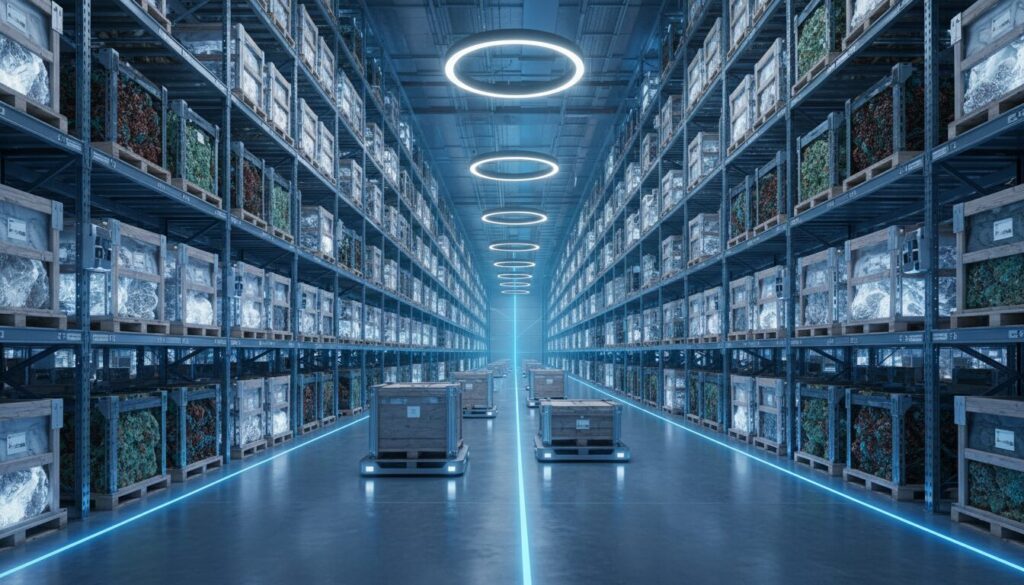
The geopolitical tectonic plates are shifting, and for the first time in a century, the epicenter is not an oil well.
In a move that defies traditional political categorization, the Trump administration has launched “Project Vault,” an $11.7 billion initiative designed to build a national critical mineral reserve. For logistics leaders and strategy executives, this is more than a policy update; it is a signal flare. Despite political rhetoric often favoring traditional energy, Trump’s critical mineral reserve is an admission that the future is electric.
This initiative marks a definitive transition from the petro-politics of the 20th century to the electro-politics of the 21st. The Strategic Petroleum Reserve (SPR), long the safeguard of American industrial might, now has a successor tailored for the era of electric vehicles (EVs), wind turbines, and AI-driven data centers.
For detailed background on the specific funding mechanisms of this initiative, see our coverage here: Project Vault: US $12B Mineral Reserve Strategy Case Study.
Why It Matters: The Shift from Oil to Electrons
For decades, global supply chain resilience was measured in barrels of crude oil. Logistics networks were optimized to mitigate fluctuations in Brent Crude or WTI prices. However, the cornerstone of industrial security has changed.
The modern supply chain runs on Cobalt, Gallium, Lithium, and Rare Earth Elements (REEs). These are the inputs for the dual engines of the future economy: the energy transition and the digital revolution.
The Strategic Pivot
Project Vault allocates $10 billion through the U.S. Export-Import Bank (EXIM) and additional direct funding to stockpile these materials. This mimics the logic of the oil SPR but acknowledges a reality where:
- China dominates processing: Controlling 60-90% of critical mineral refining.
- Demand is inelastic: An EV battery factory cannot substitute Cobalt with plastic; without the mineral, the line stops.
- Data Centers are hungry: The explosion of AI requires massive energy infrastructure, heavily reliant on copper and rare earths for power generation and cooling.
This is a defensive logistics strategy at a sovereign level. It suggests that the US government expects future supply chain disruptions to be mineral-based, not just oil-based.
Global Trend: The Race for Resource Sovereignty
The US is not acting in a vacuum. Project Vault is a counter-move in a high-stakes global chess game involving China and the European Union.
United States: Financializing Resilience
The US approach is capital-intensive. By using the EXIM Bank, the US is essentially underwriting the risk of mining projects. The goal is to create a “floor” for prices, giving domestic and allied miners the confidence to invest without fearing that China will flood the market to crash prices—a tactic used frequently in the past.
China: The Weaponization of Supply
China has moved from merely producing these minerals to actively managing their export as a tool of statecraft. Recent bans on the export of Gallium, Germanium, and Antimony—specifically targeting high-tech sectors—demonstrate this volatility.
For a deeper analysis of how these bans impact neighboring markets, read: China Bans Dual-Use Item Exports to Japan: Global Impact.
Europe: The Regulatory Approach
The EU’s Critical Raw Materials Act (CRMA) focuses on setting domestic extraction and processing benchmarks (e.g., ensuring 10% of extraction and 40% of processing happens within the EU by 2030). Unlike the US “stockpile” approach, the EU focuses on “diversified partnerships” and circular economy regulations to recover minerals from waste.
Comparative Analysis: Global Mineral Strategies
| Feature | United States (Project Vault) | China (Export Control) | European Union (CRMA) |
|---|---|---|---|
| Primary Mechanism | Sovereign Stockpiling & EXIM Financing | Export Quotas & Licensing Bans | Regulatory Benchmarks & Trade Diplomacy |
| Key Objective | Buffer against supply shock | Geopolitical leverage | Strategic autonomy & Sustainability |
| Funding Scale | $11.7 Billion (Direct + Loan) | State-Owned Enterprise Subsidies | Mixed (Member State + Private) |
| Logistics Impact | Creates new domestic warehousing nodes | Forces supply chain rerouting | Increases recycling/reverse logistics demand |
Case Study: MP Materials and the “Mine-to-Magnet” Chain
To understand the logistics implications of Project Vault, we must look at the companies actively rebuilding the supply chain. MP Materials, owner of the Mountain Pass mine in California, serves as the prime example of the “reshoring” effort Project Vault aims to protect.
The Challenge
For years, Mountain Pass was the only scaled rare earth mine in North America. However, the extracted concentrate had to be shipped to China for processing because the US lacked the refining capability. The logistics flow was circular and inefficient: US Mine → Ocean Freight to China → Refining → Ocean Freight to Japan/US (Magnet maker) → US Auto Plant.
The Innovation
MP Materials, supported by Department of Defense contracts and aligned with the goals of Project Vault, executed a strategy to vertically integrate. They built a separation facility at the mine site and a magnet manufacturing facility in Fort Worth, Texas.
The Strategic Partnership: General Motors (GM)
General Motors signed a definitive supply agreement with MP Materials. This deal secures GM’s supply of rare earth magnets (neodymium-iron-boron) for its EV fleet.
Logistics Outcomes:
- Reduced Lead Time: The supply chain length was reduced from global (20,000+ miles round trip) to domestic (California to Texas to GM Assembly).
- Inventory Resilience: By sourcing domestically, GM insulates itself from trans-pacific shipping disruptions and tariffs.
- Regulatory Compliance: The materials qualify for IRA (Inflation Reduction Act) tax credits, a critical competitive factor.
Why Project Vault Matters Here
Without a price floor or a strategic reserve, companies like MP Materials are vulnerable to predatory pricing. If global rare earth prices crash, maintaining a US-based workforce and facility becomes economically difficult. Project Vault acts as a “buyer of last resort,” ensuring that domestic capacity remains viable even during market downturns.
Key Takeaways for Logistics Leaders
The launch of Project Vault and the broader admission that the future is electric carries specific lessons for the logistics industry.
1. The Rise of “Just-in-Case” Inventory
The Just-in-Time (JIT) model is dangerous for critical minerals. Project Vault validates the shift toward Strategic Stockpiling. Manufacturers must now weigh the cost of carry (warehousing inventory) against the cost of a line-down situation caused by a mineral export ban.
- Action: Re-evaluate inventory holding levels for components containing cobalt, lithium, and rare earths.
2. Diversification is No Longer Optional
Reliance on a single source (China) is a single point of failure. The “China Plus One” strategy is evolving into “China Plus Friends.” Companies are moving production to Vietnam, Mexico, and India to bypass tariffs and restrictions.
For insights on how tariff shifts are accelerating this trend, see: Trump: US-India Tariff Deal Case Study.
3. Specialized Logistics Infrastructure
Critical minerals often require specialized handling.
- Hazmat Protocols: Lithium-ion batteries and certain refined chemicals are dangerous goods (DG).
- Security: High-value concentrates are targets for theft.
- Reverse Logistics: As the EU pushes for recycling, the logistics of returning end-of-life batteries to processing centers (Urban Mining) will become a major business vertical.
4. Navigating the Tariff Minefield
The supply chain is being carved up by tariffs. Moving goods between Canada, the US, and China is becoming increasingly complex and costly.
See also: Trump’s 100% Canada Tariff: Supply Chain Case Study.
Future Outlook: The Metal Curtain
Looking toward late 2026 and beyond, we anticipate the formation of a “Metal Curtain”—a bifurcated global market where critical minerals trade within two distinct blocks: a China-centric block and a US/EU-aligned block.
- Price Volatility: Prices will not be determined solely by supply and demand, but by diplomatic relations.
- Investment Surge: We expect a rush of logistics investment into corridor infrastructure (rail and port) linking mines in Africa and South America to processing hubs in the US and Europe, bypassing China.
The Project Vault initiative is an $11.7 billion admission that energy security has changed shape. For supply chain executives, the message is clear: The future is electric, and the logistics of that future must be built today.
For a comprehensive look at the risks defining the next year, read: Top Supply Chain Risks and Trends to Follow in 2026: US & EU.