The beverage industry is currently fighting a war on two fronts: the explosion of Stock Keeping Units (SKUs) driven by consumer demand for variety, and a crippling shortage of warehouse labor willing to perform heavy, repetitive lifting.
For logistics executives, the announcement of “RAPTOR”—a new robotic order picking system developed by NūMove Robotics & Vision in partnership with KPI Solutions—is not just another product launch. It is a signal that the “heavy goods” sector of warehousing is finally catching up to the agility seen in e-commerce.
By introducing a vision-guided, dual-robot system that decouples depalletizing from palletizing, this partnership addresses the specific, high-friction bottlenecks of beverage distribution. This analysis breaks down the RAPTOR system, its operational methodology, and why it represents a critical shift in how wholesalers will handle mixed-case fulfillment in 2025 and beyond.
The Facts: NūMove and KPI Solutions Launch RAPTOR
To understand the magnitude of this release, we must look at the specifications. RAPTOR is designed specifically to replace the most labor-intensive component of beverage warehousing: building mixed-SKU pallets for retail delivery.
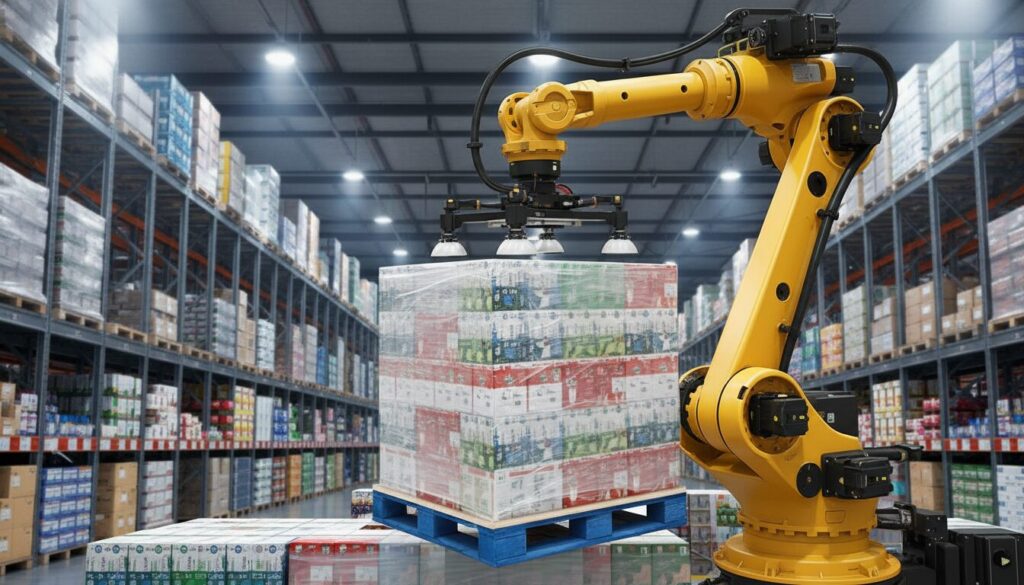
Unlike traditional layer-pickers that require massive floor space and uniform loads, RAPTOR utilizes a compact, vision-guided approach to handle the chaotic reality of beverage distribution—including returnable shells, trays, and closed cases.
RAPTOR System Profile
| Feature | Description |
|---|---|
| Developers | NūMove Robotics & Vision / KPI Solutions |
| System Name | RAPTOR (Robotic Automated Picking) |
| Core Technology | Dual-robot system with 3D Vision Guidance |
| Footprint | 2,500 sq. ft. (Approx. 230 sq. meters) |
| Key Innovation | Decoupled Architecture: Separate depalletizing and palletizing via SKU buffers |
| Handling Capability | Closed cases, trays, returnable shells, diverse formats |
| Target Market | High-volume beverage wholesalers and distributors |
| Status | Currently being deployed across the United States |
The “Decoupling” Mechanism
The critical differentiator of RAPTOR is its architectural decision to decouple the inbound and outbound flows.
In traditional automation, a robot picks an item and places it immediately on the shipping pallet. If the picking robot stalls or encounters a complex grip, the building robot waits. RAPTOR inserts a temporary SKU-specific buffer between the two processes.
- Robot A (Depalletizer): Breaks down source pallets into the buffer.
- Buffer: Holds inventory temporarily to smooth out flow.
- Robot B (Palletizer): Builds the mixed customer pallet from the buffer.
This ensures that a slowdown in one stage does not immediately halt the entire line, maximizing throughput and uptime.
Industry Impact: Solving the Beverage Logistics Paradox
The beverage sector has historically lagged behind e-commerce in automation adoption due to the physical characteristics of the product. Beverages are heavy, fragile, and come in irregular packaging (shrink-wrapped trays vs. solid cardboard). The RAPTOR system impacts the industry by solving the “Beverage Logistics Paradox”: the need for high speed despite heavy, variable payloads.
1. The End of the “Heavy Lift” Crisis
Manual mixed-case picking is one of the leading causes of injury in warehousing. Operators often lift thousands of pounds per shift. By automating this specific task, facilities can redirect labor to higher-value tasks, such as inventory management or quality control.
- Impact: Reduction in Worker’s Comp claims and turnover rates.
- Trend: As discussed in How Physical AI Will Reshape the Warehouse: 2025 Guide, the integration of robotics into physical workflows is no longer optional for handling heavy goods; it is a requirement for operational continuity.
2. Brownfield Site Viability
One of the most surprising statistics regarding RAPTOR is its footprint: 2,500 square feet.
Many beverage distributors operate in older, urban-adjacent facilities where expansion is impossible. Massive ASRS (Automated Storage and Retrieval Systems) are often ruled out due to space constraints.
- Impact: RAPTOR allows legacy warehouses to retrofit automation without building a new facility. It fits into existing aisle structures.
- Strategy: Before implementing such compact systems, savvy operators are using simulation. See also: How PepsiCo Uses Digital Twins to Trial Changes: 4 Steps.
3. Vision Guidance and Circular Economy
The system’s ability to handle returnable shells is significant. As sustainability regulations tighten, the volume of reverse logistics (empty bottles/shells returning to the plant) is increasing. Standard grippers fail on empty, lightweight shells or dirty trays. RAPTOR’s vision guidance adapts to these variances.
- Connection: This relies heavily on advanced recognition capabilities. For a deeper dive into how vision systems are evolving, refer to How AI Is Rewriting the Rules of Quality Inspection: A Guide.
LogiShift View: The “So What?” for Logistics Leaders
Why does this specific partnership matter now? The collaboration between NūMove (Robotics/Vision tech) and KPI Solutions (Integration/Design) highlights a maturation in the market: The shift from “Generic Automation” to “Micro-Vertical Solutions.”
Analysis 1: The Buffer is the Brain
The genius of RAPTOR is not the robot arm; it is the buffer. In logistics, flow is king. By decoupling the depalletizing from the palletizing, KPI Solutions has introduced “Asynchronous Fulfillment” to beverage aisles.
- Insight: This mirrors the strategies seen in lighter e-commerce picking, where goods-to-person systems buffer bins before presenting them to pickers. RAPTOR applies this logic to 50lb beverage cases.
- Comparison: For a look at how this buffering logic works in e-commerce, see Boozt & Cognibotics: Advanced AutoStore Automation. The principle is identical; only the payload differs.
Analysis 2: Complexity Management via Vision
Traditional automation demands uniformity. If a case is dented or a tray is misaligned, the line stops. RAPTOR’s reliance on 3D vision suggests a move toward “Adaptive Automation.”
- Prediction: By 2026, non-vision-guided robotics in the beverage sector will be considered obsolete. The variability of packaging (seasonal SKUs, promo packs) demands eyes, not just coordinates.
Analysis 3: Scalability and the Picking Paradox
Many companies struggle to scale picking operations because adding more manual pickers congests the aisles, actually slowing down throughput. RAPTOR solves this by condensing the picking zone.
- Context: This aligns with the broader industry struggle to scale operations without linear cost increases. For more on solving picking scalability, read How to Scale Picking: The Nowaste & Cognibotics Method.
Takeaway: What You Should Do Next
The launch of RAPTOR is a wake-up call for any distributor handling mixed pallets of heavy goods. The technology is no longer “experimental”; it is being deployed in the US now.
Action Plan for Executives:
- Analyze Your “Touch Count”: Calculate how many times a human operator touches a beverage case from receiving to shipping. If it is more than twice, your labor costs are bleeding your margins.
- Audit Your Floor Space: Do not assume you need a greenfield site to automate. If you have 2,500 sq. ft. of clear space, high-density automation is now an option.
- Review SKU Velocity: Identify your top 20% fast-movers. These are the prime candidates for a decoupled buffer system like RAPTOR.
- Prepare for Vision: Ensure your packaging data (dimensions, weights, visual characteristics) is clean. Vision systems like RAPTOR require accurate master data to function at peak efficiency.
The era of manual beverage palletizing is ending. Systems like RAPTOR are not just replacing hands; they are reorganizing the flow of the warehouse to be faster, safer, and more resilient.