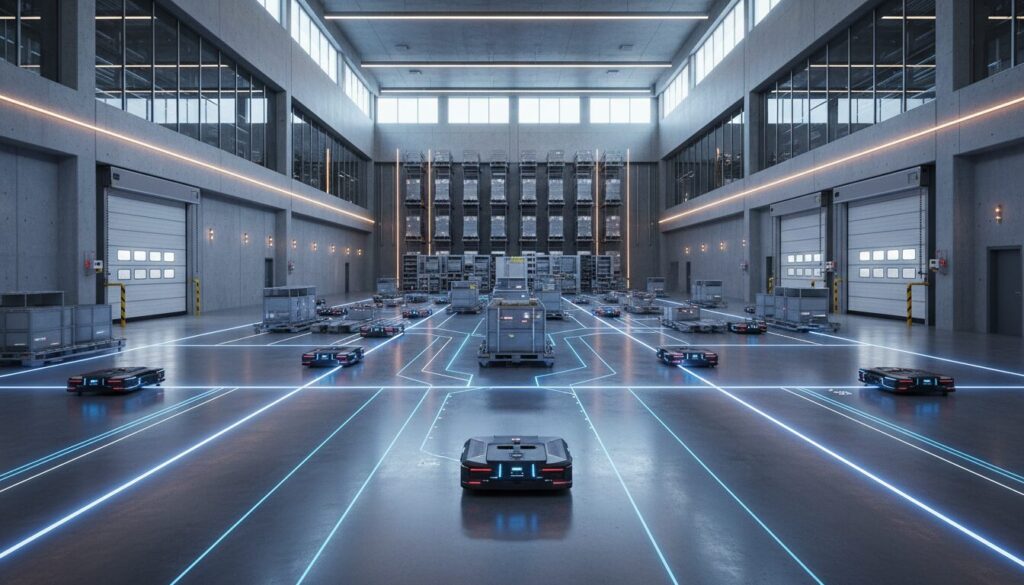
The greatest barrier to global logistics automation today is not the robot itself; it is the environment in which the robot operates. For decades, automation strategies have focused on adapting machines to navigate “dumb” infrastructure—warehouses with erratic Wi-Fi, heavy manual doors, and unmapped obstacles.
This paradigm is shifting. A groundbreaking collaboration between Neura Robotics, a pioneer in cognitive AI, and Drees & Sommer, a global infrastructure consulting giant, marks the beginning of a new era: “Robotics-Ready” Buildings.
For innovation leaders and strategy executives, this partnership signals a move from retrofitting automation to designing Cognitive Infrastructure. As we discussed in our 2025 Guide to Physical AI, the convergence of embodied AI and physical environments is the next frontier. This article analyzes the Neura-Drees & Sommer case study and what it means for the future of global supply chains.
Why It Matters: The Friction of Legacy Infrastructure
In the logistics and facility management sectors, the “Brownfield Problem” is acute. Most existing warehouses, airports, and production sites were designed for humans, not humanoids or AMRs (Autonomous Mobile Robots).
When a robot is deployed in a standard facility today, integrators spend 60-70% of their time mapping the environment and programming “workarounds” for physical barriers. This friction kills ROI and slows deployment.
The partnership between Neura Robotics and Drees & Sommer addresses three critical global pain points:
- The Labor Crisis: By 2030, the global manufacturing and logistics labor shortage is projected to reach 85 million workers (Korn Ferry). The facility management sector (cleaning, maintenance) is particularly hard hit.
- Digital Fragmentation: Buildings have BMS (Building Management Systems) and robots have RMS (Robot Fleet Management), but they rarely communicate effectively.
- Process Resilience: In airports and high-tech production lines, a lack of hygiene or maintenance can shut down operations. Automating these peripheral tasks ensures core logistics processes run smoothly.
By embedding a “digital nervous system” into the building’s architecture, this partnership aims to reverse the dynamic: instead of the robot guessing the environment, the environment guides the robot.
Global Trend: The Race for Smart Infrastructure
The concept of integrating robotics into architectural design is gaining momentum worldwide, though approaches differ by region. The US focuses on proprietary ecosystems, while Europe and Asia lean toward standardization and public-private partnerships.
Regional Approaches to Robotics-Ready Infrastructure
| Region | Primary Focus | Key Players/Examples | Logistics Implication |
|---|---|---|---|
| Europe (DACH) | Interoperability & Standards. Integrating industrial construction with cognitive robotics (e.g., Neura x Drees & Sommer). | Siemens, BMW (iFactory), VDA 5050 Standard. | Focus on creating a unified standard where any robot can work in any building. |
| United States | Proprietary Ecosystems. Tech giants building custom “smart” warehouses optimized for their specific fleets. | Amazon (Proteus), Tesla (Gigafactory), Prologis. | Highly efficient but creates vendor lock-in; less flexible for 3PLs using mixed fleets. |
| China/Asia | Smart City Integration. Government-led initiatives linking logistics hubs directly to smart city grids and 5G networks. | Alibaba (Cainiao), Huawei, JD.com. | High connectivity allows robots to move seamlessly from warehouses to public roads. |
In the US, we see companies like Prologis experimenting with “Smart Warehouse” certifications, but the integration often stops at the power and data level. The European approach, exemplified by this new partnership, goes deeper—into the physical design and cognitive sensors of the walls themselves.
This trend mirrors the data-centric approach discussed in our analysis of Noitom Robotics, where the focus is on creating a data-rich environment (a “Data Factory”) to train and guide embodied AI.
Case Study: Neura Robotics and Drees & Sommer
This strategic partnership is a prime example of Cross-Industry Innovation—merging deep tech (Neura) with traditional infrastructure consulting (Drees & Sommer).
The Players
- Neura Robotics: A German innovator known for “Cognitive Robots” like MAiRA. Unlike traditional cobots, their machines possess AI-driven sensory perception (vision, voice, touch), allowing them to operate safely alongside humans without cages.
- Drees & Sommer: A Europe-based international consulting firm specializing in construction and real estate. They are leaders in sustainable building and digital twin implementation.
The Innovation: The “Digital Nervous System”
The core of their joint value proposition is the creation of a building with a Digital Nervous System.
- Sensorized Environment: Instead of the robot relying solely on its on-board cameras, the building itself is equipped with sensors that track occupancy, dirt levels, and equipment status.
- The Cognitive Interface: The building’s digital twin communicates directly with Neura’s cognitive robots. If a sensor detects a spill in Aisle 4, the building “dispatches” the robot. The robot does not need to patrol randomly; it acts on demand.
- Design for Automation: Drees & Sommer incorporates “robot-friendly” features into the architectural blueprints—wider corridors, automated doors that trigger upon robot approach (without Wi-Fi lag), and docking stations integrated into walls rather than bolted on the floor.
Initial Application: Automated Facility Management
While the long-term goal is broad logistics automation, the initial pilot focuses on a high-need niche: Sanitary and Hygiene Facilities.
- The Problem: High turnover in cleaning staff, inconsistent hygiene standards, and health risks in high-traffic areas (Airports, Hospitals, Factories).
- The Solution: Neura’s robots, guided by the building’s sensors, perform autonomous cleaning and disinfection.
- Why it matters for Logistics: In a logistics hub or airport, “Facility Management” is mission-critical. If bathrooms or breakrooms are unsanitary, labor dissatisfaction rises. If a cleanroom in a chip factory is compromised, production stops.
Expansion Plans
The partnership explicitly targets international airports and production facilities. In an airport context, this goes beyond cleaning; it lays the groundwork for baggage handling robots and security drones to navigate the terminal using the same “Digital Nervous System.”
For production sites, this aligns with the Digital Twin strategies used by major manufacturers. As detailed in our article on how PepsiCo uses Digital Twins, simulating these interactions before construction is vital to eliminating costly errors.
Key Takeaways for Logistics Leaders
For strategy executives observing this case, the lessons extend beyond just buying a cleaning robot. This is about future-proofing real estate assets.
1. The Rise of “Brownfield” Intelligence
You do not always need a new building. Drees & Sommer’s approach involves upgrading existing infrastructure with sensor layers. Logistics leaders should audit their current warehouses: Is your building helping or hindering your automation strategy?
2. Digital Twins as the Operating System
The building’s Digital Twin is no longer just a static 3D model for construction; it is becoming the real-time operating system for the facility. It acts as the “Traffic Controller” for mixed fleets of robots.
3. Shift from CapEx to RaaS Integration
This partnership facilitates new business models. By embedding the infrastructure, companies can plug-and-play robots more easily, lowering the barrier to entry. This mirrors the trend we analyzed in the NEOintralogistics RaaS Case Study, where reducing CapEx barriers democratizes access to advanced automation.
4. Human-Centric Design remains Paramount
“Robotics-ready” does not mean “human-hostile.” Neura’s cognitive robots are designed to work safely around people. The architectural changes (wider paths, better lighting, automated access) actually improve the workplace for human employees as well.
Future Outlook: The Symbiotic Warehouse
The Neura Robotics and Drees & Sommer partnership is a precursor to fully Symbiotic Warehouses.
In the near future (2027-2030), we expect to see:
- Generative AI in Building Management: A facility manager will ask the building, “Optimize energy usage for the night shift robot fleet,” and the BMS will adjust lighting and charging schedules automatically.
- Unified Standards: The VDA 5050 standard (communication between AGVs and control systems) will likely expand to include building infrastructure (Elevators, Doors, HVAC).
- The “Cobot” Building: Buildings will react physically to needs—moving partitions, adjusting dock heights, and redirecting airflow—in concert with the robotic workforce.
Conclusion
The strategic partnership between Neura Robotics and Drees & Sommer proves that the future of logistics automation is not just about smarter robots—it is about smarter spaces. For global supply chain leaders, the question is no longer just “Which robot should I buy?” but “Is my building smart enough to manage it?”
Those who answer this question now by investing in Cognitive Infrastructure will secure a decisive advantage in efficiency, resilience, and labor retention for the coming decade.
See also:
」、25年調達額が1億ドル超え。物流コスト半減、170都市で2000台稼働_hero-300x171.jpg)