
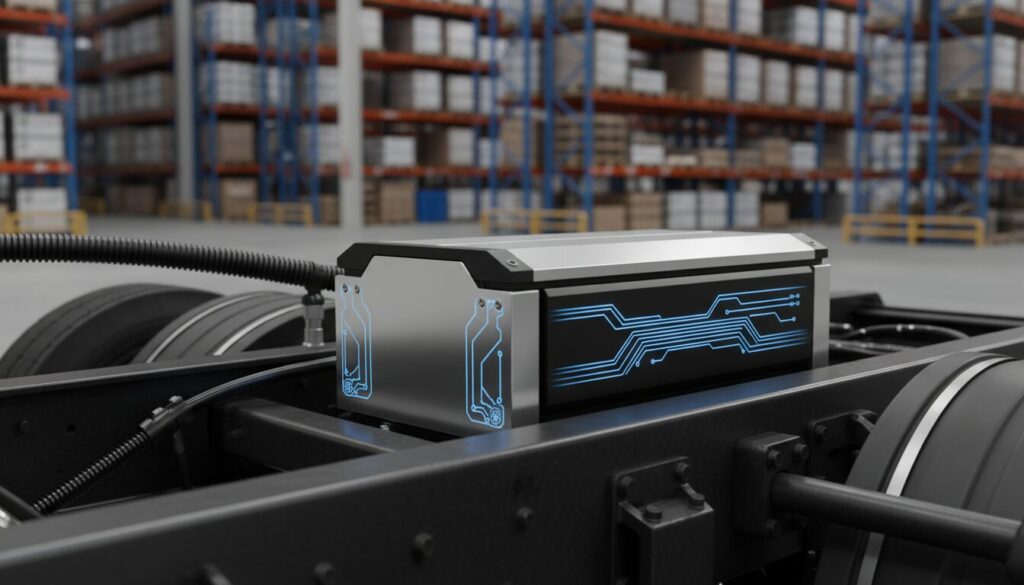
The global logistics industry is currently navigating a “hardware renaissance.” While software and AI often dominate the headlines, a critical revolution is occurring at the chassis level. The traditional lead-acid battery—a heavy, inefficient staple of trucking for over a century—is being usurped by IoT-integrated Lithium Iron Phosphate (LFP) solutions.
This shift is not merely about energy storage; it is about data.
In China, a startup led by a veteran from CATL (Contemporary Amperex Technology Co. Limited), the world’s largest EV battery manufacturer, is transforming the 12-million-strong truck market. By replacing “dumb” lead-acid batteries with smart, connected lithium units, they are unlocking new efficiencies in fuel consumption, predictive maintenance, and fleet longevity.
For innovation leaders and strategy executives in the US, Europe, and Asia, this case study offers a blueprint for how legacy hardware can be converted into a digital transformation (DX) tool.
Why It Matters: The Hidden Cost of “Hotel Loads”
In the context of global supply chain resilience, the humble truck battery is often overlooked. Yet, it represents a significant vulnerability and a massive opportunity for decarbonization.
Long-haul trucks require substantial power not just to start the engine, but to support “hotel loads”—air conditioning, heating, microwaves, and telematics systems used by drivers during mandatory rest periods. Traditionally, heavy-duty trucks rely on lead-acid batteries. Because these batteries have low energy density and degrade quickly if deeply discharged, drivers are forced to idle their engines to keep the cabin comfortable and the electronics running.
The Global Cost of Idling
- Fuel Waste: An idling heavy-duty truck consumes approximately 0.8 to 1.2 gallons of diesel per hour.
- Maintenance: Excessive idling accelerates engine wear, clogging Diesel Particulate Filters (DPF) and shortening engine life.
- Carbon Footprint: Idling contributes significantly to Scope 1 emissions, a key metric for logistics companies targeting Net Zero.
As discussed in our previous analysis, AI Redefines Logistics: The Complete Guide, tracking assets is no longer enough; the industry must optimize the asset’s health and behavior. The shift to IoT-enabled lithium batteries addresses this directly by allowing trucks to run hotel loads on battery power alone—effectively acting as a mild-hybrid system for auxiliary power—while simultaneously streaming health data to the cloud.
Global Trend: The Shift from Lead-Acid to Smart Lithium
While the electrification of powertrains (full EV trucks) grabs headlines, the “smartification” of the existing internal combustion fleet is the immediate, pragmatic trend.
Regional Approaches to On-Board Power
| Region | Primary Tech | Key Drivers | Limitation |
|---|---|---|---|
| North America | APUs (Diesel/Electric) | CARB regulations (anti-idling laws), Driver retention (comfort). | High upfront cost for separate Diesel APUs; Lead-acid weight issues. |
| Europe | Parking Coolers + AGM | High fuel costs, strict noise regulations in rest areas. | AGM batteries still suffer from short lifespans (1-2 years) and lack deep connectivity. |
| China | IoT-Integrated LFP | Cost reduction, massive fleet scale (12M trucks), aggressive DX adoption. | Fragmented market, though consolidating around tech leaders. |
| Global Standard | Target: Connected Energy | Scope 3 reporting, Predictive Maintenance. | Lack of standardized data protocols across battery brands. |
The Lead-Acid Bottleneck
The logistics sector is realizing that lead-acid batteries are a “black box” of failure. They usually fail without warning, leading to:
- Unplanned Downtime: A dead battery is the #1 cause of road service calls.
- Lack of Data: Fleet managers cannot see the voltage drop or health status remotely.
The global trend is moving toward LFP (Lithium Iron Phosphate) chemistry. Unlike the Nickel-Cobalt chemistries used in luxury EVs, LFP is cheaper, safer (highly resistant to thermal runaway), and offers a cycle life 4-5x longer than lead-acid.
Case Study: Power Vance and the “Bu Dian Bao” Revolution
The most compelling example of this trend comes from Power Vance, a Chinese startup founded by a founding member of CATL. Leveraging deep expertise in battery chemistry and supply chain management, Power Vance has introduced a product specifically designed for the rigorous demands of the Chinese logistics market.
The Product: “Bu Dian Bao” (Never Lose Power)
Power Vance’s flagship solution targets the replacement of the standard 24V lead-acid battery packs found in China’s 5 million long-haul heavy trucks.
Key Technical Differentiators:
- CATL Genealogy: Utilizing automotive-grade cells from CATL, the batteries are engineered to withstand the extreme vibration and temperature variances of trucking.
- Standardized 4G IoT Integration: Unlike standard batteries, every unit contains a 4G module. This transforms the battery from a consumable part into a connected IoT node.
- Deep Cycle Capability: The battery is designed to power parking air conditioners for extended periods without the engine running, solving the idling problem.
Operational Impact
The strategic partnership with Kuayue Express, a major logistics player in China, highlights the operational benefits of this technology.
1. Predictive Maintenance vs. Reactive Repair
With lead-acid batteries, a fleet manager knows a battery is dead only when the driver calls to say the truck won’t start.
With Power Vance’s IoT solution, the fleet manager sees:
- Real-time Voltage
- Cell Temperature
- State of Charge (SoC)
- Abnormal discharge patterns
This data allows for predictive replacement. If a battery shows signs of cell imbalance or voltage sag, it can be swapped during scheduled maintenance, eliminating roadside breakdowns.
2. Cost Reduction via “Mild Hybridization”
The product is marketed as reducing usage costs by 40%. This savings comes from two sources:
- Lifespan: The manufacturer offers a 5-year guarantee, compared to the 1–1.5 year average lifespan of lead-acid batteries in heavy-use scenarios.
- Fuel Savings: By enabling the truck to run AC and electronics on lithium power, the engine remains off during rest breaks.
3. Supply Chain Visibility
Because the battery is GPS and 4G enabled, it acts as a secondary tracker for the vehicle. Even if the main telematics unit is tampered with or fails, the battery—essential for vehicle operation—continues to report location and status.
Key Takeaways for Global Logistics Leaders
The Power Vance case study illustrates broader strategic imperatives for logistics executives in the US, EU, and Asia.
1. Hardware as a DX Enabler
Digital Transformation is often associated with software suites (TMS, WMS). However, this case proves that innovating the hardware layer is equally critical. By embedding connectivity into essential components (tires, batteries, brakes), fleets can capture granular data that software alone cannot generate.
2. The Rise of “Brownfield” Smartification
Waiting for fully electric Tesla Semis or Volvo VNR Electrics to replace entire fleets will take decades. The immediate opportunity lies in retrofitting existing internal combustion trucks with smart, electrified components. This “brownfield” approach yields immediate ROI and carbon reduction.
3. Energy Resilience is Supply Chain Resilience
A truck that cannot start is a broken link in the supply chain. Shifting to LFP batteries is not just about fuel saving; it is about reliability. The high cycle life of lithium ensures that trucks are ready to move, reducing the volatility associated with legacy component failure.
See also: AI Redefines Logistics: The Complete Guide for more on how data integration is reshaping fleet management.
Future Outlook: The Battery as a Service Platform
The trajectory of Power Vance suggests a future where truck batteries are no longer sold as parts, but as services.
Subscription Models
With IoT connectivity, manufacturers can remotely disable batteries if payments are missed, or offer “Battery as a Service” (BaaS) models where fleets pay per mile or per kWh used, converting CapEx to OpEx.
V2G (Vehicle to Grid) Potential
While currently focused on powering the truck, future iterations of large capacity truck batteries could interact with the grid. A depot of 500 trucks, all plugged in and managed via IoT, becomes a massive virtual power plant capable of stabilizing local energy grids.
Integration with OEMs
While currently an aftermarket solution, the success of companies like Power Vance will likely force OEMs (Original Equipment Manufacturers) to adopt smart LFP batteries as the factory standard. We expect major truck manufacturers in Europe and the US to transition away from lead-acid entirely by 2030, driven by the data requirements of autonomous and connected logistics.
Conclusion:
The “IoT-Lithiumization” of truck batteries is a microcosm of the wider logistics industry. It combines sustainability (anti-idling), reliability (LFP chemistry), and intelligence (IoT). For strategy executives, the lesson is clear: look for the “dumb” components in your value chain and ask, “What happens if we make this smart?”