
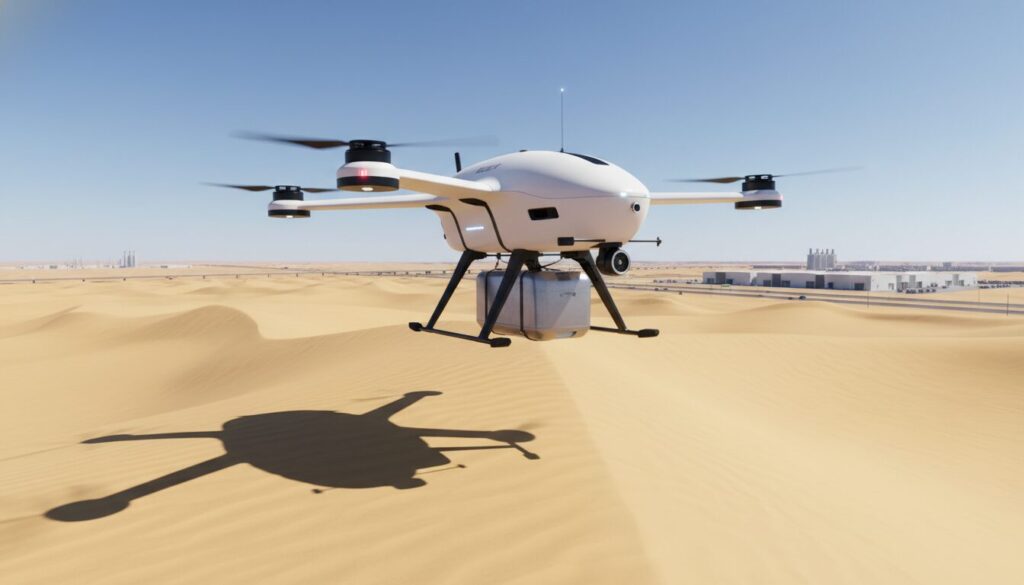
The global logistics landscape is witnessing a pivot from experimental “science projects” to scalable, cross-border infrastructure deployment. In a significant move that underscores the maturation of autonomous delivery technology, Chinese retail giant JD.com’s logistics arm, JD Logistics, has successfully completed its first overseas drone delivery trial in Saudi Arabia.
By reducing a delivery route that typically takes over 60 minutes by ground to just 15 minutes by air, JD Logistics is not merely testing a gadget; they are validating a new model for global supply chain efficiency.
Why It Matters: The Export of “Logistics OS”
For innovation leaders and strategy executives in the US and Europe, this event signifies a critical shift in the competitive landscape. Historically, logistics innovation was viewed through the lens of domestic optimization—Amazon improving Prime delivery in the US, or DHL refining routes in Germany.
However, the JD Logistics case in Saudi Arabia represents the “Overseas 2.0” strategy: the export of mature, proprietary logistics infrastructure (hardware + software) to emerging markets. This aligns with Saudi Arabia’s “Vision 2030,” which aims to transform the Kingdom into a global logistics hub.
The successful trial proves that Chinese digital transformation (DX) solutions, honed in the high-density crucible of Chinese cities, are now robust enough to be exported and adapted to the harsh geographic and climatic conditions of the Middle East.
Global Trend: The State of Aerial Logistics
To understand the significance of the Saudi trial, one must view it against the backdrop of the global drone delivery ecosystem. While the technology is universally available, regulatory frameworks and business models diverge significantly across regions.
United States: Regulatory Caution
In the US, the Federal Aviation Administration (FAA) maintains strict control over Beyond Visual Line of Sight (BVLOS) operations. While giants like Amazon Prime Air and UPS Flight Forward are making progress, scalable commercial rollout remains slow due to safety concerns and air traffic density.
Africa: The Leapfrog Model
Africa has served as the cradle for pragmatic drone logistics. As discussed in our analysis of Zipline’s $600M Funding: Last-Mile Logistics Tipping Point, companies like Zipline have bypassed traditional road infrastructure to deliver medical supplies. This “leapfrog” approach proved that drones are viable where ground infrastructure fails.
China: High-Density Maturity
China represents the most mature commercial market. Companies like JD Logistics, Meituan, and SF Express have already normalized drone delivery in specific zones, accumulating millions of flight hours. The trend now is exporting this maturity.
Comparative Maturity of Global Drone Logistics
| Region | Primary Use Case | Regulatory Environment | Key Challenge | Dominant Model |
|---|---|---|---|---|
| China | E-commerce / Food | Supportive / Government-backed | Ultra-high density urban navigation | B2C & B2B (Hub-to-Hub) |
| Middle East | Infrastructure / B2B | Aggressive / “Sandbox” Approach | Extreme heat / Sandstorms | Infrastructure Leapfrogging |
| US / EU | Medical / Niche Retail | Restrictive / Safety-First | Privacy / Air Traffic Control | B2C (Niche) |
| Africa | Medical / Emergency | Flexible / Pragmatic | Infrastructure for charging/maintenance | B2B (Medical Supply Chain) |
Case Study: JD Logistics in Saudi Arabia
JD Logistics’ recent success offers a blueprint for how technology transfer can function in the logistics sector.
The Challenge
The trial took place in Tanajib, a coastal industrial area in Saudi Arabia. The specific route covered a linear distance of approximately 15 kilometers.
- Ground Reality: By car, this route requires navigating winding coastal roads and industrial checkpoints, taking over 60 minutes.
- The Goal: Demonstrate drastic time reduction and reliability in high-temperature environments.
The Solution: Hybrid “Feilang” Architecture
JD Logistics deployed its proprietary “Feilang” (Flying Wolf) autonomous cargo drones.
- Technology: eVTOL (electric Vertical Take-Off and Landing) fixed-wing drones.
- Payload: Up to 10kg.
- Speed: Cruise speeds significantly faster than multi-rotor drones.
- Range: Capable of long-distance flight (ideal for Middle Mile).
Unlike the typical quadcopters used for short-range food delivery, eVTOLs combine the vertical flexibility of a helicopter with the aerodynamic efficiency of a plane. This allows them to cover the 15km gap efficiently without requiring runways.
The Result
- Time Reduction: 15 minutes (Aerial) vs. 60+ minutes (Ground). A 75% reduction.
- Operational Success: The drones successfully handled the coastal winds and heat, proving the durability of the hardware.
The Partnership Model: JoyExpress
Crucially, JD did not attempt to build a ground network from scratch. They partnered with JoyExpress, a local Saudi logistics provider.
- Role of JD: Provides the high-tech “Middle Mile” (the drone flight between hubs or to a courier meeting point).
- Role of JoyExpress: Manages the “Last Mile” (taking the package from the landing zone to the customer’s doorstep).
This hybrid approach mirrors successful strategies seen in other sectors, such as the autonomous vehicle expansion discussed in our MINIEYE Case Study: 1,000 AVs & The “Overseas 2.0” Strategy, where partnering with local entities facilitates rapid scaling and regulatory navigation.
Key Takeaways for Logistics Executives
1. The “Middle Mile” is the Sweet Spot
The industry obsession with “drone-to-doorstep” (delivering a coffee to a backyard) often obscures the more immediate ROI found in the middle mile. JD’s Saudi trial focused on moving goods between hubs or across difficult terrain (15km) to a local courier.
Lesson: Automate the transport leg that has the highest friction (traffic/distance), not necessarily the final handover.
2. Exporting “Infrastructure as a Service”
JD Logistics is moving beyond being a logistics provider; they are becoming a technology vendor. By exporting the “Feilang” drone system, they are selling the capability to deliver, rather than just the delivery service itself. This creates a stickier, higher-margin relationship with international markets.
3. The “Sandbox” Advantage
The Middle East is rapidly becoming the global laboratory for future logistics. With initiatives like NEOM and Vision 2030, Saudi Arabia offers regulatory sandboxes that allow companies to test technologies that are stalled by red tape in the US or EU.
Strategy: If your innovation faces regulatory hurdles in Western markets, look to the Middle East for proof-of-concept (PoC) validation.
4. Technology Durability is a USP
Operating in Saudi Arabia requires hardware that can withstand extreme heat and sand. JD’s ability to deploy there signals to the world that their technology is “military-grade” regarding durability.
Insight: Stress-testing in harsh environments is a powerful marketing tool for global expansion.
Future Outlook
The success of JD Logistics in Saudi Arabia is likely to accelerate the adoption of aerial logistics in the MENA (Middle East and North Africa) region.
Regulatory Harmonization
As more international players enter the Saudi market, we expect to see the development of a standardized Unmanned Traffic Management (UTM) system in the region, potentially serving as a model for global standards.
Integration with Ground Automation
The next phase will likely involve the integration of aerial drones with ground-based autonomous vehicles. Imagine a “Feilang” drone landing on a MINIEYE-equipped autonomous van, creating a fully unmanned supply chain from warehouse to neighborhood.
The Shift to Heavy-Lift
With the 10kg payload proven, the race is on for heavier lifts. JD and its competitors are already developing heavy-lift drones capable of carrying hundreds of kilograms, which could disrupt traditional trucking for urgent industrial parts—a massive market in the oil-rich Gulf region.
Conclusion:
JD Logistics has moved the needle from “theoretical possibility” to “operational reality.” By cutting delivery times by 75% in a challenging environment, they have laid down a gauntlet for global logistics players: Innovate the middle mile, or get left behind in traffic.