The landscape of autonomous mobility is shifting from a hardware arms race to a battle for platform dominance. In a decisive strategic pivot, Uber has solidified its position not as a vehicle manufacturer, but as the world’s premier autonomous vehicle (AV) aggregator. With a massive $1 billion investment in Waabi—including $750 million upfront—Uber is signaling a new era where software, simulation, and network density outweigh proprietary hardware.
For logistics leaders and strategy executives, this move is more than just a headline; it is a blueprint for the future of supply chain asset management. Uber is literally in the driver’s seat when it comes to AV bets, steering the global industry toward an ecosystem model that values flexibility over ownership.
This article analyzes the global implications of Uber’s partnership with Waabi, the rise of the “Simulation-First” AI model, and what this platform-centric approach means for logistics networks in the US, Europe, and Asia.
Why It Matters: The Shift from Builder to Broker
For years, the “holy grail” of logistics and mobility was vertical integration—companies wanted to build the truck, own the software, and control the network. However, the capital intensity of manufacturing Level 4 (L4) autonomous vehicles has proven prohibitive.
Uber’s latest move confirms a definitive shift in global strategy: the “Super-Aggregator” model. By divesting its own Advanced Technologies Group (ATG) years ago and now backing Waabi, Uber is betting that the winner will not be the company that builds the best robot, but the company that can deploy the most robots across the most efficient network.
The Strategic Value of the “Bet-on-Everything” Ecosystem
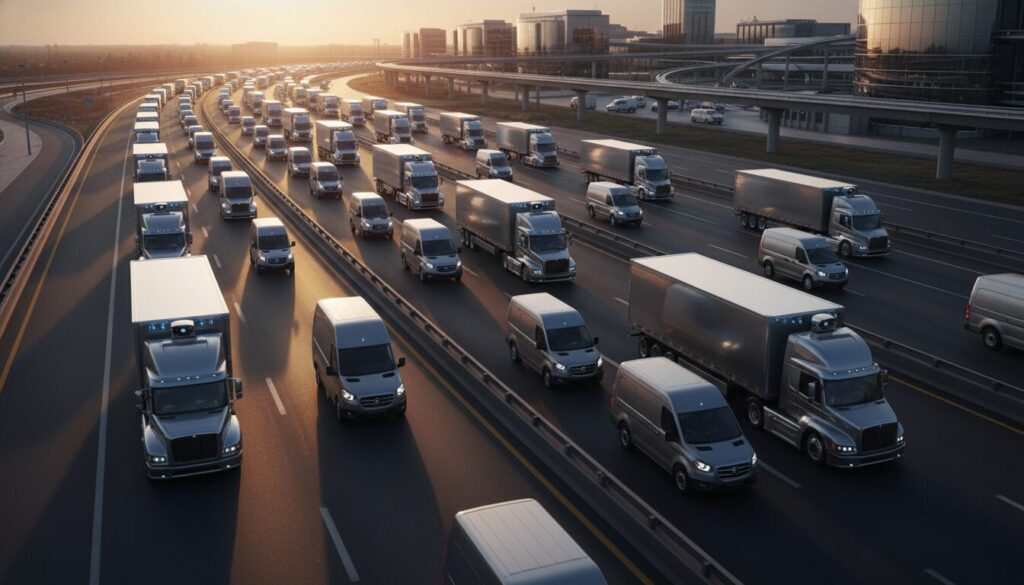
Uber now maintains over 20 autonomous vehicle partnerships worldwide. This diversification strategy mitigates technology risk while maximizing market penetration. For supply chain strategists, this offers a critical lesson in resilience: do not lock your logistics network into a single hardware vendor.
- Risk Mitigation: If one AV developer faces regulatory hurdles (as seen with Cruise), the network remains operational via other partners.
- Scalability: Uber can simultaneously deploy robotaxis in Los Angeles and autonomous freight lanes in Texas without carrying the depreciation costs of the vehicles.
- Data Dominance: Every mile driven by a partner vehicle feeds Uber’s demand prediction algorithms, tightening their grip on market liquidity.
As discussed in our analysis of the Tesla Robotaxi Austin Launch: Autonomous Logistics Impact, the ability to deploy fleets without a human safety driver is the tipping point for unit economics. Uber is positioning itself to capture this margin regardless of whose badge is on the hood.
Global Trend: The “Platformization” of Autonomy
The Uber-Waabi deal is symptomatic of a broader trend occurring across the US, China, and Europe. We are witnessing a bifurcation of the industry: Platform Operators (who own the demand) vs. Technology Providers (who own the AI driver).
United States: The Aggregator Wars
In the US, the market is moving away from “walled gardens.” While Waymo (Alphabet) continues to operate a vertically integrated service, the industry is bending toward Uber’s open model. The partnership with Waabi is designed to challenge the Tesla and Waymo dominance by offering a hardware-agnostic AI driver that can be retrofitted onto various vehicle platforms.
China: The Ecosystem approach
China has long favored this ecosystem approach. Tech giants like Baidu (Apollo Go) and Pony.ai operate as technology providers partnering with traditional OEMs (like Toyota or Geely) to deploy fleets.
For a deeper dive into how Chinese firms are exporting this model, refer to the MINIEYE Case Study: 1,000 AVs & The “Overseas 2.0” Strategy, which details the deployment of autonomous units in the Middle East. Uber’s global reach puts it in direct competition with these Chinese expansion strategies in neutral markets like MENA and Southeast Asia.
Europe: Regulation Driving Partnerships
In Europe, strict regulatory frameworks (such as the EU AI Act) make it difficult for single entities to manage both hardware compliance and operational logistics. This fosters an environment where partnerships are essential. Uber’s “asset-light” approach is particularly well-suited for the EU, allowing it to navigate local labor laws and safety regulations by offloading hardware compliance to partners like Waabi or Aurora.
Comparison of Regional AV Strategies
The following table outlines how the “Platformization” trend manifests differently across key regions:
| Feature | US Strategy (Uber/Waabi Model) | China Strategy (Baidu/Pony.ai) | EU Strategy (OEM Partnerships) |
|---|---|---|---|
| Primary Focus | Robotaxis & Long-haul Trucking | Mixed (Robotaxi + Urban Logistics) | Heavy Trucking & Closed Campus |
| Integration Model | Aggregator (Software separate from Hardware) | Joint Ventures (Tech + OEM) | OEM-led Consortia |
| Reg. Environment | State-by-State (Patchwork) | Centralized & Supportive Zones | Stringent, Safety-First (UNECE) |
| Capital Flow | VC & Public Market driven | Government Subsidies & Tech Giants | Corporate R&D & EU Grants |
Case Study: Uber x Waabi – The Billion Dollar Bet
This partnership is not merely a financial transaction; it is a validation of a specific technological philosophy. Waabi, founded by Raquel Urtasun (formerly the Chief Scientist at Uber ATG), represents a departure from traditional AV development.
The Deal Structure
- Total Investment: $1 Billion approx.
- Upfront Capital: $750 Million (Equity investment).
- Milestone Capital: $250 Million (Contingent on technical deployments).
- Goal: Deployment of 25,000+ autonomous vehicles on the Uber platform.
The Technology: Simulation-First AI
Most AV companies, including Waymo and Cruise, rely heavily on “on-road” miles—physically driving millions of miles to train their systems. This is expensive, slow, and dangerous.
Waabi utilizes a “Generative AI” approach centered on simulation. Their platform, Waabi World, creates hyper-realistic virtual environments where the AI driver can test infinite edge cases (accidents, severe weather, erratic pedestrians) without ever putting a physical tire on the pavement.
Why This Matters for Logistics
- Speed to Market: Simulation allows for rapid iteration. An AI can drive the equivalent of 100 years in a single day of simulation.
- Safety Validation: For logistics carriers hauling high-value or hazardous materials, simulation proves safety capabilities in “black swan” scenarios that rarely happen in real life but are catastrophic when they do.
- Cost Reduction: It eliminates the need for massive fleets of test vehicles burning fuel and requiring maintenance.
From Trucking to Robotaxis
Waabi initially focused on autonomous trucking (long-haul freight). The Uber investment marks a significant expansion into robotaxis. This dual-use application of the “AI Driver” is critical.
Just as we discussed in the PlusAI Listing: 2027 L4 Autonomous Freight article, the convergence of freight and passenger autonomy is accelerating. The same core “AI Driver” that navigates a Class 8 truck on a highway can, with modification, navigate a passenger vehicle. Uber is banking on Waabi to bridge this gap, potentially unifying their Uber Freight and Uber Rides businesses under a single autonomous tech stack.
Key Takeaways for Innovation Leaders
The Uber-Waabi deal offers distinct strategic lessons for the global supply chain and logistics industry.
1. The “Asset-Light” Future is Here
Logistics companies should reconsider the necessity of owning their autonomous fleet. Uber’s model suggests that the future value lies in the network orchestration layer, not the assets themselves. Strategy executives should look for partnerships where they can leverage AV technology without the CAPEX of fleet ownership.
2. Generative AI is a Supply Chain Tool
Waabi’s success validates Generative AI beyond chatbots. In logistics, “Digital Twins” and simulation environments (like Waabi World) will become the standard for testing supply chain resilience. Before routing a fleet through a new region, companies will simulate the logistics flow digitally to predict bottlenecks.
3. Diversification is the Best Policy
Uber did not bet the farm on Waabi; they added Waabi to a portfolio of 20+ partners. Logistics leaders must avoid vendor lock-in with AV providers. A multi-vendor strategy ensures that if one technology stack fails or faces regulatory grounding, the supply chain continues to move.
4. Convergence of Passenger and Freight
The line between moving people and moving goods is blurring. The technology driving a robotaxi is increasingly similar to that driving a delivery van. Companies should look for synergies where the same autonomous platform can serve last-mile delivery during the day and ride-hailing at night (or vice versa) to maximize asset utilization.
Future Outlook: 2027 and Beyond
The infusion of $1 billion into Waabi accelerates the timeline for mass deployment. While Uber has set a goal of 25,000 vehicles, the real metric of success will be the cost per mile.
We anticipate that by 2027-2028, the “Simulation-First” approach will allow Waabi to undercut competitors who are still amortizing billions of dollars spent on physical test fleets. This could trigger a price war in the AV sector, finally bringing the cost of autonomous logistics below that of human-driven transport.
The Aggregator Endgame
Uber’s ultimate goal is to become the operating system for physical movement. By controlling the interface between the customer (shipper or rider) and the varied fleet of autonomous bots (Waabi, Waymo, Aurora, etc.), Uber secures the highest margin position in the value chain.
For the global logistics industry, the message is clear: Uber is literally in the driver’s seat when it comes to AV bets. They have successfully outsourced the risk of hardware development while retaining control over the customer network. As we move toward 2030, the companies that thrive will likely be those that integrate into these open ecosystems rather than trying to build walled gardens of their own.