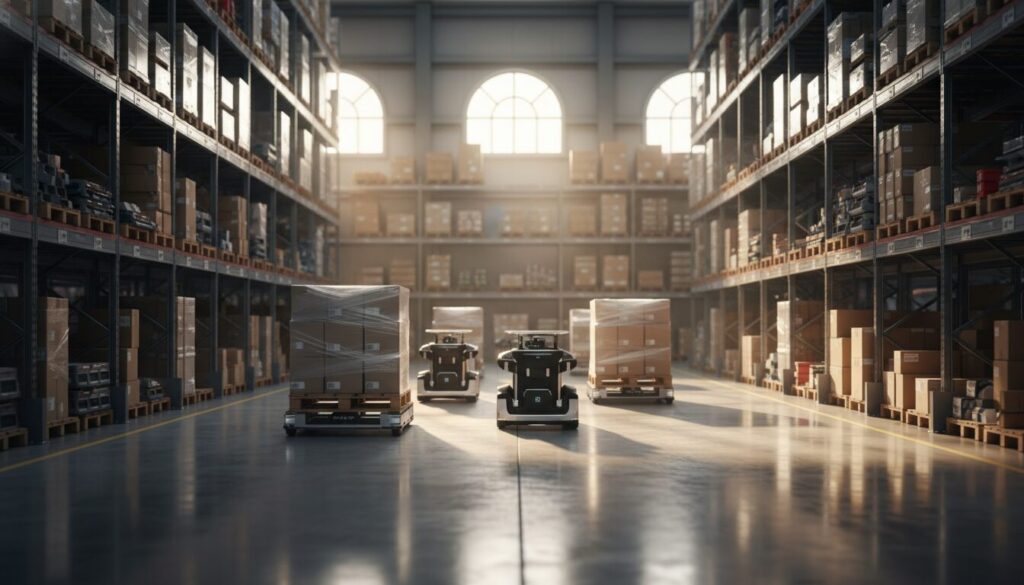
The logistics landscape is currently defined by a stark divide: the hyper-automated giants and the manual majority. While global players like Amazon and DHL leverage proprietary robotics stacks, approximately 80% of global warehouses still rely entirely on manual labor. The barrier has never been the technology itself, but the accessibility of that technology—specifically, the high Capital Expenditure (CapEx) and rigid infrastructure requirements.
In a move that signals a significant shift in how the mid-market approaches logistics, German startup NEOintralogistics has secured €3 million in seed funding. Their mission is to “democratize warehouse automation” through a Robotics-as-a-Service (RaaS) model.
For innovation leaders and strategy executives, this is not just another funding announcement. It is a case study on the maturity of the “Pay-per-Pick” economy and the critical pivot toward brownfield-compatible automation.
Why It Matters: The End of the “All-or-Nothing” Era
Historically, warehouse automation required a binary choice: invest millions in a multi-year project to rebuild a facility (Greenfield) or remain manual. This rigidity has left the vast majority of the supply chain exposed to labor shortages and rising operational costs.
The funding of NEOintralogistics by the Amadeus APEX Technology Fund highlights a global appetite for flexible, low-risk automation. By shifting the financial model from CapEx to Operational Expenditure (OpEx), RaaS platforms allow companies to deploy robotics in weeks rather than years.
As discussed in our analysis of How Physical AI Will Reshape the Warehouse: 2025 Guide, the industry is moving away from static conveyor belts toward intelligent, adaptable agents. NEOintralogistics fits precisely into this trajectory by lowering the barrier to entry for physical AI adoption.
Global Trend: The Race for Mid-Market Automation
To understand the significance of this case study, we must look at how major economic regions are tackling the automation of existing (brownfield) warehouses.
The United States: Speed and OpEx
In the US, the RaaS model has gained traction through companies like Locus Robotics. The primary driver here is the labor crisis; warehouses cannot find enough staff to meet peak demand. American executives favor RaaS because it allows them to scale fleet sizes up or down based on seasonality without owning depreciating assets.
Asia (China): Hardware Dominance
China approaches this through hardware proliferation. Manufacturers like Geek+ and HAI Robotics have driven the cost of hardware down significantly. In Asia, the trend is often focused on high-density storage and manufacturing integration. While RaaS exists, the lower cost of hardware often makes direct purchase more viable than in the West.
Europe: Integration in Complex Environments
Europe represents the most challenging environment: strict labor laws, expensive real estate, and a high density of older, non-standardized warehouses. This is where NEOintralogistics is carving its niche. The European market demands solutions that can navigate narrow, irregular aisles without requiring a facility shutdown.
Table 1: Regional Approaches to Warehouse Automation Barriers
| Region | Primary Driver | Dominant Strategy | Key Hurdle |
|---|---|---|---|
| Europe | Space constraints & Labor laws | Brownfield Retrofitting & RaaS | Integrating robots into non-standard shelving. |
| USA | Labor shortage & ROI Speed | Flexible AMRs (OpEx focus) | Scaling fleet management during peak seasons. |
| China | Manufacturing Scale | Low-cost Hardware adoption | shifting from hardware sales to software services. |
For a deeper look at how established European players are expanding, see: Exotec Expands with Renault in Germany: Automation Scale-Up.
Case Study: NEOintralogistics and the “Pay-per-Pick” Model
NEOintralogistics, a spin-off from the Technical University of Munich, has positioned itself to solve the “80% problem”—the vast market of manual warehouses that cannot afford traditional automation.
The Financial Innovation
The €3 million seed round, led by Amadeus APEX Technology Fund with participation from reputable business angels, is intended to scale their specific flavor of RaaS. Unlike competitors who sell robots and charge a maintenance fee, NEOintralogistics offers a pure performance-based model.
- Model: Pay-per-pick.
- CapEx: Near zero for the client.
- Risk: Shifted from the operator to the technology provider.
This financial engineering is critical. It transforms automation from a risky investment decision into a simple operational expense, comparable to hiring a temporary agency worker.
Operational Agility: The Brownfield Breakthrough
The technical differentiator for NEOintralogistics is its ability to integrate into existing shelving systems. Many “flexible” solutions still require QR codes on floors, specific lighting, or widened aisles.
NEO’s system claims deployment in “weeks, not years.” This rapid deployment capability is essential for supply chain resilience. If a 3PL wins a new contract, they cannot wait 12 months for an AutoStore installation; they need capacity immediately.
Strategic Partnerships
A key lesson for innovation leaders is NEO’s ecosystem approach. Rather than building every component in a silo, they have established strategic partnerships with:
- Magazino (Jungheinrich): Leveraging established hardware expertise.
- GLS: Providing a massive testbed and validation within the parcel logistics sector.
Performance Data
The startup’s pilot programs have yielded data that validates the RaaS thesis:
- Labor Reduction: Up to 70% reduction in manual picking tasks.
- Cost Efficiency: Up to 65% reduction in overall operational costs regarding picking.
- Deployment Speed: Integration into live environments without halting operations.
This mirrors the scaling challenges and successes seen in other robotics startups. For a comparative investment perspective, refer to the Botsync Investment Case Study: Scaling Robotics.
Key Takeaways for Logistics Leaders
The success of NEOintralogistics’ funding round offers several actionable insights for strategy executives planning their 2025-2026 roadmaps.
1. Brownfield is the New Greenfield
Stop waiting for the “perfect” facility. The most valuable technologies today are those that can overlay onto your current imperfect infrastructure. If an automation solution requires you to rebuild your warehouse to suit the robot, it is likely too rigid for the modern volatile market.
2. Shifts in ROI Calculation
The metric is moving from “Return on Investment” (which implies ownership) to “Cost per Unit Processed.” RaaS aligns the cost of automation directly with revenue generation. This is particularly vital for 3PLs operating on razor-thin margins with short-term client contracts.
3. The Democratization Effect
Automation is no longer a competitive advantage reserved for the elite; it is becoming table stakes. Smaller players can now compete with giants on fulfillment speed and cost efficiency by utilizing RaaS.
4. Software Over Hardware
The hardware (the robot) is becoming a commodity. The value lies in the orchestration software—the “brain” that integrates with the WMS and optimizes the flow.
- See also: Master Zero-Touch Automation with Locus Array: 5 Steps for insights on orchestration.
- See also: How to Scale Picking: The Nowaste & Cognibotics Method for alternative picking strategies.
Future Outlook: The Standardized Robot Workforce
The €3 million injection into NEOintralogistics is a microcosm of a macro trend. We are witnessing the standardization of the robotic workforce.
In the near future, we expect to see:
- Interoperability Standards: RaaS fleets from different vendors (e.g., NEOintralogistics and Exotec) communicating within the same facility (VDA 5050 standard).
- Dynamic Leasing: Warehouses “subscribing” to extra robotic capacity during Black Friday and returning the units in January.
- The Rise of the “Dark” SME Warehouse: Small-to-medium enterprises fully automating their stockrooms without owning a single robot.
The trend is clear: Ownership is out; Access is in. For the 80% of warehouses that are still manual, the excuse of “high entry costs” has effectively been removed. The question for logistics leaders is no longer “Can we afford automation?” but “Can we afford to remain manual?”