Introduction: The Paralysis of the Unpredictable Warehouse
In the current logistics landscape, “business as usual” no longer exists. Warehouse managers are constantly battling the “Unpredictable Warehouse”—a chaotic environment defined by fluctuating SKU velocities, sudden e-commerce spikes, and chronic labor shortages.
The traditional approach to managing this volatility has been reactive: throwing more bodies at the problem during peak seasons or manually re-configuring pick paths when order profiles change. This creates a high-stress environment where operational confidence is low, and the risk of error is high.
The Core Pain Points:
- Rigid Workflows: Traditional automation (conveyors) cannot adapt to daily volume changes.
- Labor Dependency: excessive time spent training temporary staff who turnover quickly.
- Decision Fatigue: Floor managers spend hours manually batching orders and managing congestion.
As we discussed in our guide on How Physical AI Will Reshape the Warehouse: 2025 Guide, the future belongs to systems that can think and adapt physically. This is where Operating With Confidence in an Unpredictable Warehouse: Zero-Touch Automation with Locus Array comes into play. It transitions the warehouse from a place of reactive panic to proactive, automated confidence.
Solution: What is Zero-Touch Automation with Locus Array?
“Zero-Touch Automation” in this context does not mean a dark warehouse with no humans. Instead, it refers to the elimination of manual decision-making and manual transport.
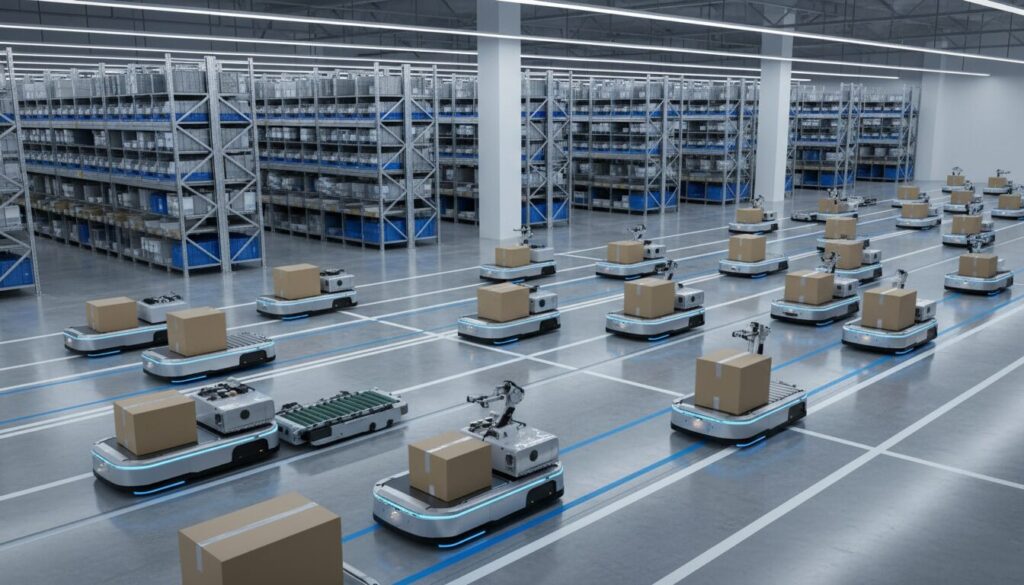
The Locus Array approach utilizes a fleet of Autonomous Mobile Robots (AMRs)—specifically the LocusBots—orchestrated by an intelligent software layer (LocusOne). The “Array” refers to the coordinated mesh of robots that acts as a flexible conveyance system.
Unlike rigid AS/RS systems that require massive infrastructure overhauls, the Locus Array overlays onto your existing floor plan. The “Zero-Touch” aspect is achieved because the system:
- Auto-Batches Orders: No human planner needs to group orders; the AI does it based on pick density.
- Optimizes Pathing: It dynamically re-routes bots to avoid congestion.
- Directs Labor: Humans strictly pick; they do not walk long distances or make routing decisions.
This allows managers to operate with confidence, knowing the system will absorb volatility without manual intervention.
See also: The hidden technology behind fluid robot motion: 2025 Guide
Process: Implementing the Locus Array Strategy
Transforming an unpredictable warehouse into a confident operation requires a structured implementation. Below is a 5-step guide to deploying this technology effectively.
Step 1: The Volatility Audit and Data Integration
Before deploying robots, you must understand the nature of your unpredictability. You cannot automate confidence if you don’t understand your chaos.
Actionable Steps:
- Map SKU Velocity: Identify which SKUs fluctuate the most. The Locus Array works best when high-velocity items are spread out to prevent picker congestion, rather than clustered tightly as in manual picking.
- WMS Handshake: Ensure your Warehouse Management System (WMS) can pass order data in real-time. The “Zero-Touch” goal requires the WMS to drop orders continuously (waving) or via a bucket-less flow, allowing the Locus software to pull work dynamically.
Step 2: Designing the “Zero-Touch” Induction Zone
The most critical failure point in AMR deployment is the induction station—where orders are initialized onto the bots. If humans have to make decisions here, efficiency drops.
Configuration:
- Automated Induction: Set up scan-and-put stations. The associate scans a tote/box, and the Locus Array software tells them exactly which bot (waiting in the queue) to place it on.
- Multi-Bot Queuing: Ensure there is physical space for 3-5 bots to queue per inductor. This ensures the human never waits for a robot.
Step 3: Calibrating Dynamic Zone Picking
To operate with confidence, you must decouple the picker from the order. In manual picking, one human owns one order from start to finish. In the Locus Array model, pickers are assigned to “Zones.”
Implementation Logic:
- Zone Definition: Divide the warehouse into dynamic zones based on current density.
- The Handoff: Robots travel between zones. A picker in Zone A picks three items, then the robot travels autonomously to Zone B.
- Result: The picker stays in their aisle (minimizing walking), and the robot handles the transit. This creates a “Zero-Touch” transport layer.
This method aligns with concepts seen in other high-density scaling solutions. For a comparison on scaling picking density, refer to How to Scale Picking: The Nowaste & Cognibotics Method.
Step 4: Activating Real-Time Heat Mapping
Confidence comes from visibility. The Locus management dashboard provides a “digital twin” view of operations.
Managerial Routine:
- Hourly Review: Check the heat map for robot congestion.
- Zero-Touch adjustments: If a specific aisle is too hot (too many pickers/bots), the software should automatically divert lower-priority picks to other areas to disperse traffic.
- Battery Management: The system automates charging cycles (Opportunity Charging). Managers do not need to schedule downtime; the bots go to chargers during micro-breaks in workflow.
Step 5: The “Gamification” of Associate Adoption
For the system to work in an unpredictable environment, the human element must be compliant. LocusBots feature intuitive screens (often iPads) that display images of the item to be picked.
Training Protocol:
- Language Neutrality: Configure the bots to display tasks in the native language of the picker.
- Gamification: Enable features that show pickers their current pick rate vs. the goal. This provides immediate feedback, reducing the need for manager intervention (Zero-Touch management).
Results: Before vs. After Locus Array
Implementing Operating With Confidence in an Unpredictable Warehouse: Zero-Touch Automation with Locus Array yields measurable shifts in operational metrics.
The following table outlines the transformation from a manual, unpredictable state to an automated, confident state.
| Metric | Before (Manual/Cart Picking) | After (Locus Array Automation) | Impact |
|---|---|---|---|
| Walking Time | 60% of shift spent walking | < 15% of shift spent walking | 45% reduction in wasted motion |
| Training Time | 2-3 Weeks for full proficiency | 15-30 Minutes | Immediate labor flexibility |
| Scalability | Linear (Need 2x volume = Need 2x humans) | Elastic (Add bots, keep humans constant) | High confidence in peaks |
| Error Rate | 1-3% (Fatigue induced) | Near 0% (Scan verification) | Elimination of returns cost |
| Mgmt. Style | Reactive (Firefighting) | Proactive (Dashboard monitoring) | Operational Calm |
Case Context: Scaling Robotics
The transition to this model mirrors the success seen in other scalable robotics deployments. For example, moving out of “pilot purgatory” and into full-scale fleet management is a critical step for ROI, as discussed in the Botsync Investment Case Study: Scaling Robotics. The Locus Array allows you to skip the pilot purgatory by offering an immediate “Results as a Service” model.
Summary: Keys to Success
Operating with confidence in an unpredictable warehouse is not about predicting the future—it is about building a system that can handle any future.
Zero-Touch Automation with Locus Array succeeds because it addresses the three pillars of modern logistics:
- Flexibility: Robots can be added or removed based on seasonality (RaaS models).
- Simplicity: The interface is so simple that temporary labor can be productive instantly.
- Intelligence: The software optimizes the workflow, not the floor manager.
Your Action Plan:
- Stop trying to optimize manual pick paths for unpredictable demand.
- Implement a “Zero-Touch” transport layer using AMRs.
- Shift your management focus from directing traffic to analyzing data.
By surrendering the complex routing decisions to the Locus Array, you gain the ultimate operational asset: Confidence.