The era of “pilot purgatory”—where robotic innovations languish in testing phases without broader rollout—is officially ending for top-tier global supply chains. In a move that signals the maturity of Goods-to-Person (GTP) technology, Renault has announced a major strategic expansion of its partnership with warehouse robotics unicorn Exotec.
Moving beyond its domestic success in France, Renault is deploying Exotec’s Skypod system at a massive new facility in Brühl, Germany. This is not merely a hardware purchase; it is a strategic standardization of logistics infrastructure across European borders.
For innovation leaders and strategy executives in the US, Asia, and Europe, this development highlights a critical pivot: the transition from experimental automation to replicable, scalable supply chain ecosystems.
As discussed in our analysis of the market, autonomy is becoming non-negotiable. See also: IFR Names Top 5 Global Robotics Trends of 2026 for Logistics.
Why It Matters: The Shift to Cross-Border Standardization
For decades, multinational corporations operated fragmented logistics networks where a warehouse in Detroit looked vastly different from one in Dusseldorf or Shanghai. This fragmentation creates data silos, complicates maintenance, and slows down agility.
Renault’s decision to export its successful French automation model to Germany represents a shift toward pan-regional standardization. By deploying the same Exotec architecture in Brühl as in Villeroy, Renault reduces the learning curve for operators, unifies its Warehouse Execution System (WES) data, and creates a blueprint for rapid deployment in other markets.
The Strategic Value of the Aftermarket
This deployment focuses on spare parts distribution—a notoriously complex sector characterized by high SKU counts, unpredictable demand, and urgent delivery windows.
- Complexity: Spare parts range from tiny washers to bulky engine components.
- Speed: A missing part can keep a customer’s car off the road for days, damaging brand reputation.
- Resilience: By automating this specific node in Germany, Renault protects its aftermarket supply chain against labor shortages, a chronic issue in Western Europe.
Global Trend: The Race for Automated Density
While Renault makes headlines in Europe, the push for high-density, automated warehousing is a global phenomenon. However, the approach varies significantly by region.
The following table outlines how major global markets are currently tackling the “density vs. speed” paradox:
| Feature | North America (US) | Asia (China/Japan) | Europe (EU) |
|---|---|---|---|
| Primary Driver | Labor cost reduction & Speed to consumer. | Extreme volume handling & Urban density. | Space constraints (Brownfield) & Labor regulations. |
| Dominant Tech | AMR Swarms (e.g., Amazon Kiva/Proteus), AS/RS. | Dark Warehouses (JD.com), Multi-shuttle systems. | High-Density Storage (AutoStore, Exotec). |
| Strategic Focus | Throughput: Moving massive volumes quickly over large footprints. | Autonomy: Reducing human touchpoints to near zero. | Efficiency: Maximizing cubic storage in existing buildings. |
| Key Challenge | Retrofitting sprawling legacy distribution centers. | Balancing speed with skyrocketing urban land costs. | Strict safety standards and integration with legacy ERPs. |
The European “Brownfield” Advantage
Europe leads the way in “Cube Storage” robotics—systems that utilize vertical height efficiently in existing buildings. Just as we have seen with other European retailers utilizing high-density solutions, the goal is to do more with less space.
For a deeper dive into how European retailers are maximizing density, read: Boozt & Cognibotics: Advanced AutoStore Automation.
Case Study: Renault & Exotec in Brühl, Germany
The core of this trend is the specific implementation at Renault’s new facility. Scheduled to go live in June 2026, the site in Brühl serves as a critical node for spare parts distribution across the DACH region (Germany, Austria, Switzerland).
Project Specifications
The scale of the Brühl implementation demonstrates that this is a production-critical deployment, not a test.
- Facility Size: 258,000 sq ft (approx. 24,000 sqm).
- Fleet Size: 89 Skypod robots.
- Throughput: 1,600+ containers per hour.
- Order Processing: 1,500 order lines per hour.
- Inventory Scope: 20,000+ distinct parts (SKUs).
The Technology: Skypod & Deepsky
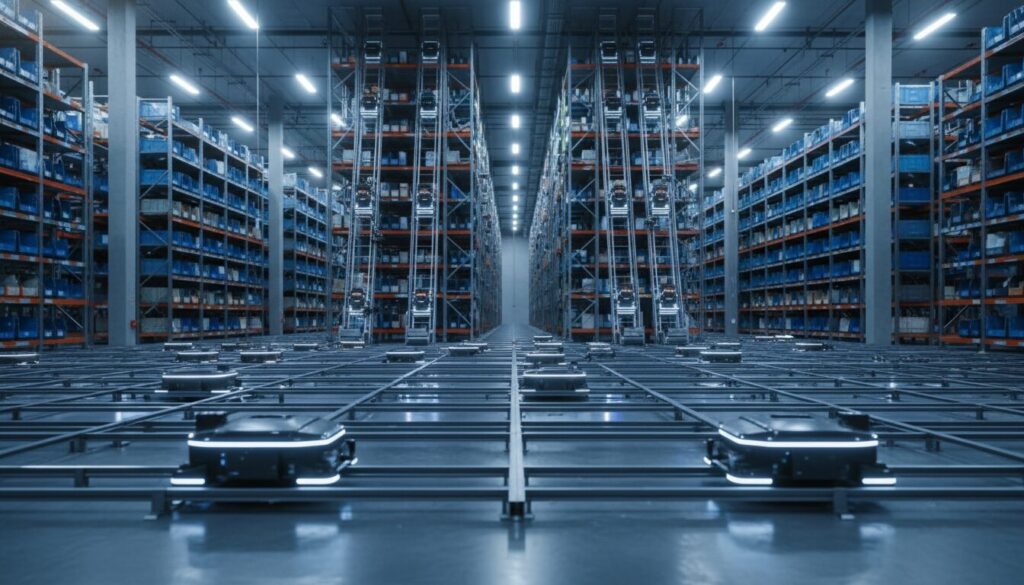
The Exotec solution distinguishes itself through its 3D mobility. Unlike traditional AMRs that stay on the floor, or shuttle systems that are trapped in racks, Skypod robots traverse the floor and then climb the racks (up to 12 meters) to retrieve bins.
Deepsky: The Orchestration Engine
Perhaps more important than the hardware is the integration of ‘Deepsky,’ Exotec’s proprietary Warehouse Execution System (WES).
In the Brühl facility, Deepsky will act as the “conductor,” orchestrating the movement of the 89 robots in real-time. It interfaces directly with Renault’s central systems to prioritize urgent orders (e.g., a “Vehicle Off Road” emergency part) over standard restocking orders. This software capability allows Renault to maintain a consistent logic between its French and German sites.
Strategic Expansion from Villeroy
This project is a direct successor to the deployment at Renault’s Villeroy site in France. The Villeroy site proved that the Skypod system could handle the variability of automotive spare parts—specifically the ability to mix fast-moving consumables (filters, wipers) with slow-moving repair parts (sensors, brackets) in the same grid.
By validating the ROI in France first, Renault minimized the risk for the German expansion. This “Prove then Scale” methodology is a textbook example for global logistics strategists.
Key Takeaways for Logistics Leaders
For executives looking at the Renault-Exotec partnership, the lessons extend beyond the automotive sector.
1. Standardization is the New Efficiency
Customizing every warehouse to local preferences is no longer sustainable. Leaders must identify a “Gold Standard” technology stack and replicate it globally. Renault’s move proves that cross-border technology transfer reduces implementation time and simplifies IT support.
2. The Rise of the WES
Hardware is becoming a commodity; the competitive advantage lies in the software. The ‘Deepsky’ integration highlights that the ability to orchestrate robots, humans, and inventory flow (WES) is more critical than the robot’s physical speed.
3. Solving the Picking Paradox
As order lines increase (1,500/hour at Brühl), the bottleneck shifts from storage to the picking station. High-speed robotics must be paired with ergonomic, high-velocity picking stations to ensure the human workers can keep up with the machines.
For strategies on handling increased picking demands, refer to: How to Scale Picking: The Nowaste & Cognibotics Method.
4. Reliability in the Aftermarket
In the spare parts industry, reliability trumps pure speed. An automated system that guarantees 99.9% accuracy eliminates the costs of returns and redelivery—a massive expense line in automotive logistics.
Future Outlook: The Connected European Supply Chain
Looking toward 2027 and beyond, the Renault-Exotec partnership signals a broader trend of European Supply Chain Unification.
We anticipate three major shifts following this deployment:
- Multi-Site Orchestration: Future WES updates may allow Renault to view inventory across Villeroy and Brühl as a single virtual pool, dynamically routing orders based on real-time robot availability at each site.
- Sustainability Metrics: Exotec robots are notable for their lack of energy-heavy elevators or conveyors. As EU regulations on carbon footprints tighten (CSRD), automation choices will increasingly be driven by energy consumption data.
- Brownfield Revitalization: The Brühl project confirms that massive construction projects aren’t always necessary. Intelligent robotics can turn standard warehouses into high-performance fulfillment centers.
Renault has successfully moved past the “innovation theatre” phase. By expanding their partnership with Exotec into Germany, they are building a resilient, standardized, and highly automated backbone for the future of automotive logistics.