The logistics industry is currently facing a “perfect storm.”
Operations leaders are grappling with a shrinking labor force, skyrocketing wages, and the relentless pressure of e-commerce delivery expectations. If you are a warehouse executive or manager, you likely face the daily reality of unfilled shifts and the high cost of turnover.
Traditional automation (conveyors, sorters) has long been the answer, but it is rigid, expensive, and takes months to install. The solution to bridging the gap between labor shortages and operational flexibility lies in the next evolution of technology.
This article explores how Physical AI will reshape the warehouse, moving beyond simple automation to intelligent, embodied robotic systems that adapt to your business needs.
What is Physical AI?
To understand how Physical AI will reshape the warehouse, we must first distinguish it from the AI most people know.
While Generative AI (like ChatGPT) processes text and images, Physical AI refers to artificial intelligence models that interact directly with the physical world. It is the “brain” inside a robot that allows it to perceive, reason, and act within a dynamic environment.
The Shift to Embodied Intelligence
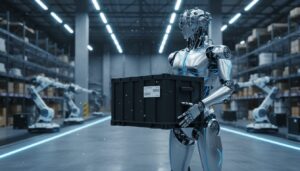
Physical AI is often referred to as “Embodied AI.” Unlike a standard robotic arm programmed to move from coordinate A to coordinate B repeatedly, a robot powered by Physical AI “sees” the object, understands its texture and weight, and calculates the best way to grasp it in real-time.
This capability is crucial for handling the immense variety of SKUs in modern logistics.
- Perception: Using cameras and LiDAR to map the warehouse in real-time.
- Reasoning: Deciding the most efficient path or grip strategy without explicit coding for every scenario.
- Actuation: Executing fluid movements that mimic human dexterity.
For a deeper dive into the mechanics of this movement, refer to our detailed analysis: The hidden technology behind fluid robot motion: 2025 Guide.
Why Now? The Drivers of Physical AI
Why is the conversation about how Physical AI will reshape the warehouse happening right now? Three converging trends are accelerating adoption in 2025.
1. The Global Labor Crisis
The logistics workforce is aging, and younger generations are less inclined to accept physically demanding warehouse jobs. This is not a temporary shortage; it is a structural demographic shift. Warehouses can no longer rely solely on human muscle to scale operations during peaks.
2. The Limits of “Hard” Automation
Traditional automation requires bolting hardware to the floor. Once installed, changing a workflow is incredibly costly. In an era of volatile consumer demand, warehouses need systems that can be redeployed in hours, not months.
3. Technological Convergence
We are witnessing an innovation explosion. Startups are rapidly developing general-purpose robots that are cheaper and smarter than ever before.
For instance, new players are entering the market with “general robotics” platforms designed to handle multiple tasks rather than just one.
See also: Sharpa Case Study: Hesai General Robotics Innovation
Benefits: How Physical AI Improves Operations
The transition to Physical AI offers both quantitative and qualitative advantages over traditional methods.
Comparing Automation Types
The following table illustrates the shift from traditional automation to Physical AI-driven systems.
| Feature | Traditional Automation | Physical AI (Robotics) |
|---|---|---|
| Flexibility | Low (Fixed infrastructure) | High (Mobile, re-programmable) |
| Setup Time | Months to Years | Weeks to Months |
| Scalability | Hard to scale down | Add/remove robots as needed |
Key Operational Advantages
1. Unmatched Scalability
Physical AI allows you to solve the “Picking Paradox”—the challenge of increasing throughput without linear increases in cost. By deploying intelligent robots that work alongside humans, you can handle peak seasons by simply adding more units to the floor.
Learn more about scaling these operations here: How to Scale Picking: The Nowaste & Cognibotics Method.
2. Enhanced Safety
Physical AI systems are equipped with 360-degree sensory awareness. They can predict collisions and stop instantly, significantly reducing workplace accidents compared to forklifts or “blind” AGVs.
3. Handling Complexity
Standard automation fails when a box is dented or placed at an odd angle. Physical AI adapts. It can recognize “edge cases” and adjust its approach, reducing the number of stops and jams that require human intervention.
Where Physical AI Will Reshape the Warehouse First
Physical AI is not an all-or-nothing proposition. It is best deployed in specific zones where variability is high.
1. The Loading Dock
The loading dock is the bottleneck of the warehouse. It is physically grueling and chaotic. Physical AI is transforming this area by introducing robots capable of autonomously loading and unloading trailers, handling heavy lifting that leads to injury.
This evolution is critical for flow. For a step-by-step breakdown of this area, read: How to Automate Loading Docks: A 5-Step Evolution Guide.
2. Piece Picking
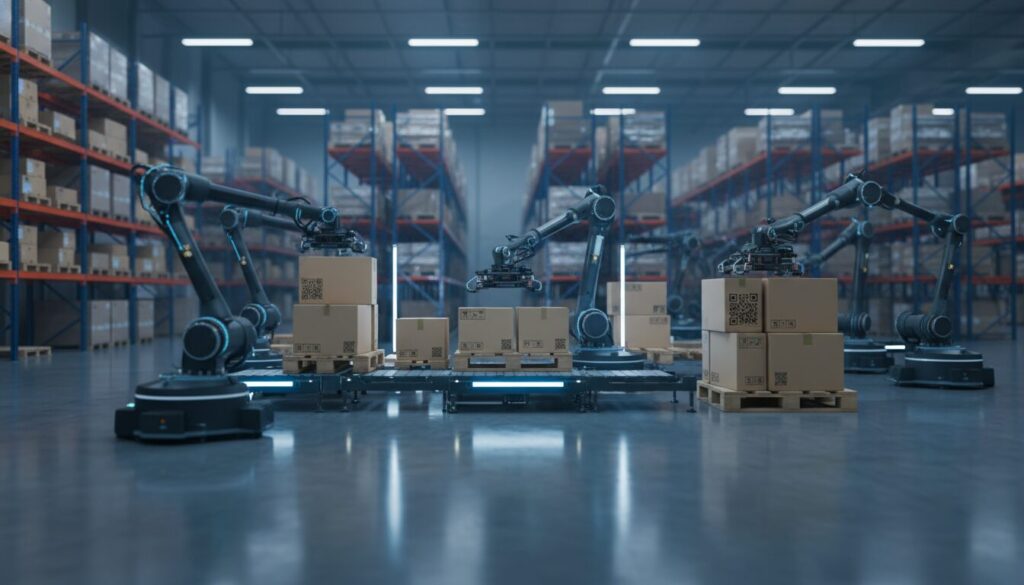
Robotic arms equipped with computer vision can now pick individual items (eaches) from bins, a task previously thought to be exclusive to human dexterity.
3. Pallet Movement
Intelligent Autonomous Mobile Robots (AMRs) are replacing conveyors for pallet transport, allowing for dynamic routing that changes based on warehouse congestion.
Implementation: Integrating Physical AI
Understanding how Physical AI will reshape the warehouse is one thing; implementing it is another. Many leaders hesitate due to fear of technical debt or failure.
Successful implementation requires a structured approach.
Step 1: Define the Problem, Not the Tech
Do not buy a robot because it looks futuristic. Identify your specific pain point. Is it picking accuracy? Is it dock congestion? Is it the travel time of your workers?
Step 2: Proof of Concept (PoC)
Never roll out Physical AI across the entire facility on day one. Run a Proof of Concept (PoC) in a controlled zone. This allows you to validate the AI’s ability to handle your specific SKUs and integrate with your WMS.
This is particularly relevant for advanced forms of Physical AI, such as Humanoid robots. We have analyzed a clear roadmap for this process.
Essential Reading: 5 Steps to Industrialize Humanoids via Siemens PoC Guide
Step 3: Data Harmonization
Physical AI runs on data. Ensure your WMS (Warehouse Management System) can communicate seamlessly with the robot fleet management software. The AI needs to know what to pick and where it is in real-time.
Step 4: Change Management
Physical AI is collaborative. Your staff needs to trust the robots. Position the technology as a tool that removes the “heavy lifting” and repetitive drudgery, allowing humans to focus on supervision and complex problem-solving.
Future Outlook: The Autonomous Ecosystem
As we look toward 2030, how Physical AI will reshape the warehouse involves the creation of fully autonomous ecosystems.
We will move from “Islands of Automation” (where robots work in fenced-off areas) to a “Fluid Workflow” where:
- AMRs transport goods.
- Robotic Arms pick and pack.
- Humanoid Robots handle multi-purpose tasks and exceptions.
- AI Software orchestrates the entire flow like a conductor.
This shift will reduce the Cost Per Unit (CPU) significantly and allow logistics hubs to operate 24/7 with minimal human oversight.
Conclusion
The question is no longer if Physical AI will enter the logistics space, but when your organization will adopt it.
How Physical AI will reshape the warehouse is clear: it converts rigid, labor-intensive storage facilities into flexible, data-driven fulfillment centers. For operations leaders, this technology offers the only viable path to navigating the labor shortage while maintaining profitability.
Recommended Next Steps:
- Audit your workflows: Identify the tasks with the highest labor hours and injury rates.
- Educate your team: Share resources on Embodied AI and robotics.
- Start small: Review our guides on PoC strategies and loading dock automation to begin your journey.
The future of warehousing is not just digital; it is physical, intelligent, and already here.