In the grand tapestry of global logistics, the period between 2024 and 2026 has been defined by rapid digitization. We have seen Warehouse Management Systems (WMS) reach maturity and Transportation Management Systems (TMS) become ubiquitous. Yet, as we enter the second quarter of 2026, a critical operational “blind spot” has been exposed, threatening to undo the efficiency gains made inside the warehouse and on the road.
A groundbreaking new report by Better Supply Chains reveals a stark reality: Yard Bottlenecks Ripple Through Supply Chains in 2026.
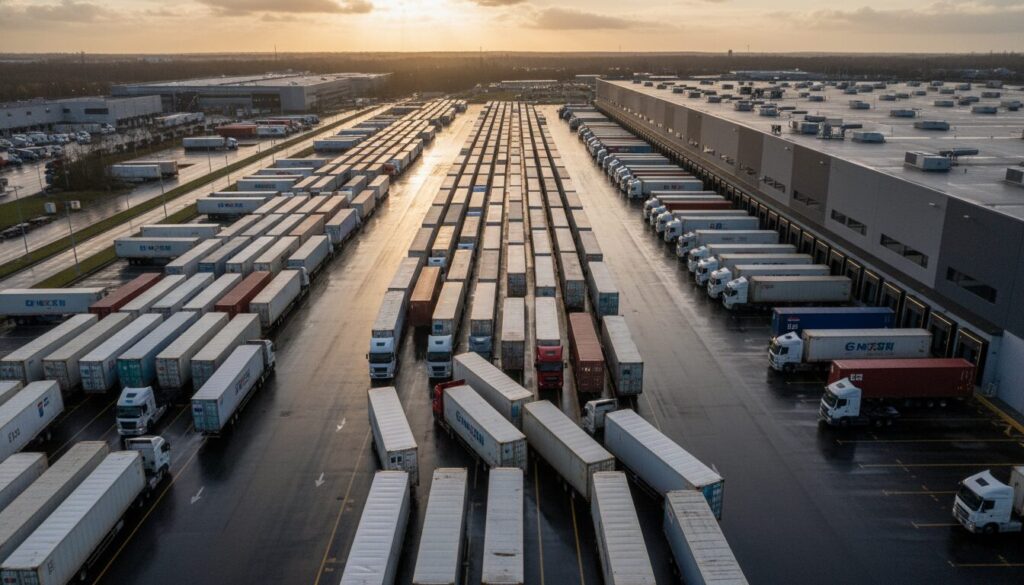
The report highlights that while the factory floor and the delivery route are optimized, the yard—the physical nexus connecting transport and warehousing—remains dangerously analog. With 90% of global yards lacking dedicated management systems (YMS), this gap has evolved from a minor nuisance into a primary driver of detention fees, labor waste, and sustainability failures.
For innovation leaders and strategy executives, the message is clear: the yard is no longer just a parking lot; it is the new frontier of supply chain resilience.
1. Why It Matters: The High Cost of the “Black Hole”
To understand the gravity of the 2026 report, one must recognize the yard’s function. It is the valve that controls the flow of goods into the warehouse and the flow of products out to the market. When this valve is clogged or unmanaged, the pressure builds up on both sides.
The Financial Impact of Invisibility
The report identifies three major areas where unmanaged yards are bleeding revenue:
- Detention and Demurrage: With carriers tightening schedules, dwell time in the yard has become exorbitantly expensive. Without digital visibility, trucks wait unnecessarily for open docks, accruing fees that are often written off as “cost of doing business.”
- Labor Inefficiency: Yard jockeys and gate staff often operate via radio and clipboard. This manual orchestration leads to idle time for warehouse crews waiting for trailers that are “somewhere on the lot” but cannot be located instantly.
- Inventory Stagnation: A trailer sitting in the yard is essentially floating inventory. In 2026, where just-in-time (JIT) has evolved into “predictive availability,” losing sight of a trailer for four hours can disrupt an entire production line.
As discussed in our previous guide on warehouse evolution, optimizing the physical interface is crucial. The yard is the precursor to the dock.
See also: How to Automate Loading Docks: A 5-Step Evolution Guide
The Sustainability Imperative
Modernizing yard operations is also cited as a prerequisite for scaling electrification. You cannot effectively manage a fleet of electric trucks if you do not know which docks have charging stations or if you cannot predict the dwell time required for a recharge. The chaotic yard of 2025 is incompatible with the green goals of 2030.
2. Global Trend: Regional Responses to the Crisis
The Better Supply Chains report emphasizes that while the yard bottleneck is a global phenomenon, the drivers and responses vary significantly across key markets.
United States: The Battle Against Labor Shortages
In the US, the primary driver for yard modernization is labor cost and availability. With a persistent shortage of skilled yard drivers and gate clerks, US companies are turning to automation.
- Trend: Rapid adoption of Autonomous Yard Tractors. Companies like Outrider have seen massive deployment scaling in 2026, moving from pilot programs to full fleet replacements in distribution centers across the Midwest.
- Focus: Reducing human intervention in the “danger zone” of the yard to lower insurance premiums and solve labor gaps.
Europe: The Green Deal Mandate
In the EU, the regulatory pressure of the Green Deal forces companies to optimize every movement.
- Trend: Integration of YMS with Carbon Accounting. European logistics leaders are implementing systems that prioritize docking for low-emission vehicles or optimize trailer moves to reduce fuel consumption by yard dogs.
- Focus: Sustainability compliance and reducing the carbon footprint of the “extended site.”
Asia (China/Singapore): Volume and Velocity
In high-volume hubs like Shanghai and Singapore, the yard is often an extension of the port. Space is at a premium.
- Trend: High-Density Smart Parking. Utilization of AI-driven slotting algorithms (similar to automated valet parking) to maximize trailer density.
- Focus: Throughput speed and space utilization rates.
Comparison of Global Yard Priorities (2026)
| Region | Primary Driver | Dominant Technology Solution | Key KPI |
|---|---|---|---|
| North America | Labor Shortage & Detention Costs | Autonomous Yard Trucks (AVs) | Dwell Time Reduction |
| Europe | Sustainability & Regulation | YMS integrated with EV Charging | Carbon per Move |
| Asia-Pacific | Space Scarcity & Volume | AI-Driven Slotting & Gate Automation | Gate Throughput per Hour |
3. Case Study: Unilever and the Digital Twin Yard
To illustrate the potential of solving the yard bottleneck, we look at a prominent success story featured in the industry landscape of 2026: Unilever’s partnership with Körber and FourKites to create a “Dynamic Yard.”
The Challenge
Unilever operates hundreds of distribution centers globally. In 2024, they identified that site-level fragmentation was causing volatility. One site might have a rigorous digital check-in, while another relied on spreadsheets. This inconsistency made it impossible to predict when raw materials would actually reach the production line once they entered the gate.
The Innovation: The Yard Digital Twin
Unilever implemented a comprehensive YMS solution that acted as a “Digital Twin” of their physical yards.
- Gate Automation: Drivers use a mobile app to check in before arrival, receiving a QR code. Upon arrival, automated kiosks scan the code and direct the driver to a specific parking slot or door.
- Real-Time Visibility: The system integrated with FourKites’ in-transit visibility. The yard crew knew a truck was delayed before it missed its appointment, allowing them to reshuffle dock schedules dynamically.
- Task Interleaving: Instead of yard jockeys returning empty after moving a trailer, the system used AI algorithms to assign “next-best moves,” reducing empty travel miles within the yard by 30%.
The Results
By 2026, the results of this standardized governance were transformative:
- Detention Fees: Reduced by 45% globally, saving millions annually.
- Throughput: Gate throughput increased by 20% without adding physical infrastructure.
- Sustainability: Reduced yard truck CO2 emissions by 15% through optimized routing.
This case proves that the yard is not just a storage space; it is an active asset that, when digitized, unlocks value across the entire supply chain.
4. Key Takeaways for Logistics Leaders
The report makes it clear: the era of the manual yard is over. To survive the volatility of 2026 and beyond, companies must bridge the gap between the warehouse and the road.
A. Integrate, Don’t Isolate
A Yard Management System (YMS) cannot stand alone. It must communicate bi-directionally with the WMS (to know what needs to be shipped) and the TMS (to know what is arriving).
- Action: Audit your current tech stack. If your yard data is not flowing into your ERP, you have a blind spot.
B. Standardize Processes Before Technology
Technology cannot fix a broken process. As seen in the LTL sector, missed pickups and “ghost trucks” often result from poor communication protocols at the site level.
- Action: Establish a standard “Gate Operating System” (GOS) across all sites before rolling out software.
See also: Stop LTL Missed Pickups with C.H. Robinson’s AI Strategy
C. Embrace AI Agents for Coordination
The sheer volume of coordination required—between drivers, guards, and warehouse managers—is overwhelming for humans. AI agents are now essential for handling routine communications and appointment rescheduling.
See also: How to Fast-Track Responses in Missed LTL Pickups with AI
5. Future Outlook: The Autonomous Nexus
Looking beyond 2026, the yard is set to become the first fully autonomous zone in the supply chain.
Because yards are private property (controlled environments), they face fewer regulatory hurdles than public roads. We predict that by 2028:
- Robotic Arms at the Dock: Automated systems will not only park trailers but also connect pneumatic lines and open trailer doors.
- Dynamic Charging: As electric semi-trucks become standard, YMS will evolve into “Energy Management Systems,” deciding which truck gets which charger based on its next scheduled departure and current battery price rates.
- The “Dark Yard”: Similar to “Dark Warehouses,” we will see yards that operate 24/7 with zero human presence on the tarmac, managed entirely by AI supervisors.
Conclusion
The “New Report: Yard Bottlenecks Ripple Through Supply Chains in 2026” serves as a wake-up call. The yard has been the neglected middle child of logistics for too long. By bringing digital governance to this chaotic space, companies can eliminate hidden costs, improve safety, and prepare for an electrified, autonomous future.
For strategy executives, the question is no longer “Do we need a YMS?” but rather “How quickly can we close the gap?”