When the world’s largest athletic footwear and apparel company redesigns its supply chain, the ripples are felt across every vertical in the logistics industry. Nike’s recent announcement to lay off 775 employees across its Tennessee and Mississippi distribution centers is not merely a cost-cutting headline; it is a definitive signal of the industry’s pivot from pandemic-era capacity expansion to a new era of automated efficiency and asset consolidation.
For supply chain executives, this move serves as a critical case study in “operational rightsizing.” Under the leadership of CEO Elliott Hill, Nike is executing a sharpened strategy to improve Earnings Before Interest and Taxes (EBIT) margins. The implication is clear: the future of logistics is not about having the most warehouses, but about having the most intelligent ones.
This analysis dissects the strategic rationale behind Nike’s consolidation, the role of automation in displacing manual labor, and what this trend means for the broader logistics landscape in 2025 and beyond.
The Facts: Nike’s Strategic Consolidation
Nike’s decision to reduce its workforce in the Southern United States is a calculated move to streamline operations. The layoffs affect facilities in Memphis, Tennessee—a massive global logistics hub—and Pontotoc, Mississippi. This is part of a broader “multi-year journey” to reduce complexity within their fulfillment network.
Below is a summary of the critical data points surrounding this development:
| Category | Key Details |
|---|---|
| Who | Nike Inc., under CEO Elliott Hill’s leadership team. |
| What | Laying off approx. 775 employees; consolidating US distribution footprint. |
| Where | Distribution centers in Memphis, TN, and Pontotoc, MS. |
| Why | To improve EBIT margins, reduce operational complexity, and increase agility. |
| How | Replacing manual legacy processes with advanced automation and technology. |
| Timeline | Announcements made in early 2025; execution is immediate/ongoing. |
| Goal | A “sharpened” supply chain focused on efficiency rather than raw capacity. |
This move aligns with a broader corporate turnaround strategy. After years of focusing on Direct-to-Consumer (DTC) growth which required massive, disparate inventory pools, Nike is now seeking to optimize how that inventory moves.
Industry Impact: The Ripple Effect of Consolidation
Nike’s restructuring is symptomatic of a larger trend affecting the logistics and real estate sectors. As discussed in our analysis of Mytra’s $120M Round: The Shift to Software-Defined Logistics, the industry is moving away from rigid, labor-intensive infrastructure toward flexible, software-defined systems.
1. The Shift from Labor to Automation
The most immediate impact is on the labor market. For decades, the “solution” to supply chain bottlenecks was adding headcount. Nike’s pivot demonstrates that the cost-benefit analysis has tipped in favor of automation.
- Legacy Model: High headcount, manual picking, high variable costs, vulnerability to labor shortages.
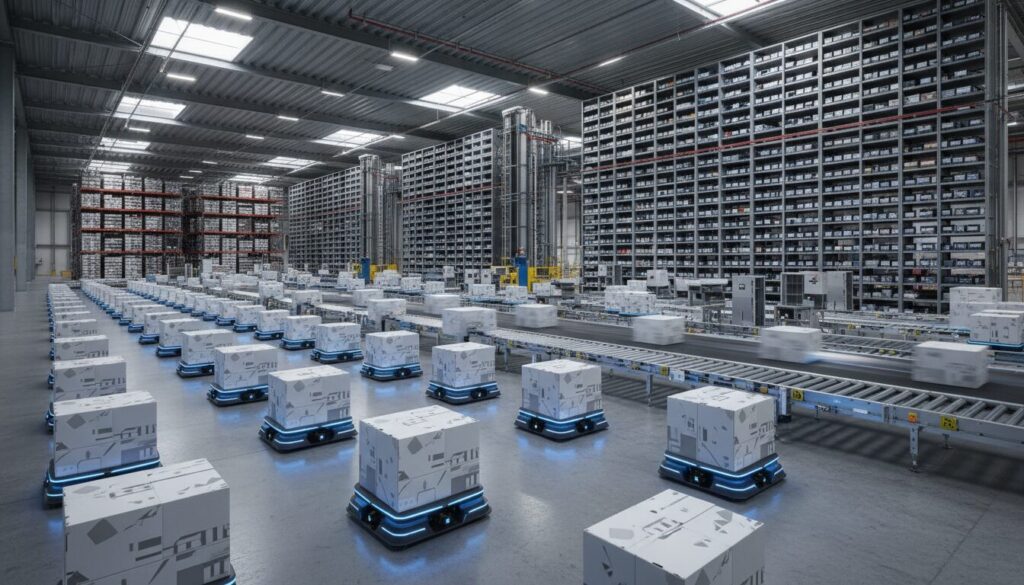
- New Model: Automated storage and retrieval systems (AS/RS), robotics, fixed capital costs but lower variable operational costs.
This transition is not just about replacing humans with robots; it is about changing the nature of the warehouse. Companies are realizing that to improve margins, they must decouple revenue growth from headcount growth. This mirrors the innovations seen in Boozt & Cognibotics: Advanced AutoStore Automation, where solving the “picking bottleneck” became a function of technology, not staffing.
2. Real Estate and Hub Centralization
Memphis has long been the logistics capital of America due to its proximity to FedEx’s global hub. However, Nike’s reduction in footprint there suggests a change in network strategy.
- Consolidation: Retailers are closing older, smaller satellite facilities to focus on “Mega-Hubs” equipped with high-density automation.
- Inventory Placement: Rather than holding stock in every state (Just-in-Case), advanced predictive algorithms allow companies to centralize inventory without sacrificing delivery speed significantly.
3. Margin Pressure and Macroeconomics
The drive for EBIT improvement suggests that Nike is bracing for continued economic headwinds. Rising operational costs and potential trade barriers are forcing companies to look inward for savings.
As explored in our Aritzia Case Study: Tariffs & De Minimis End, tightening trade borders and tariff implications are squeezing margins for apparel retailers. By consolidating distribution centers, Nike reduces its overhead exposure, creating a buffer against external economic volatility.
LogiShift View: The Era of the “EBIT-First” Supply Chain
The “So What” for logistics leaders is significant. Nike’s move marks the end of the “Growth at All Costs” era of supply chain management that defined the 2020-2022 period. We are entering the era of the EBIT-First Supply Chain.
The Role of Digital Planning
Before Nike announced these layoffs, they almost certainly simulated the outcome. Closing a distribution center is high-risk; getting it wrong results in stockouts and lost revenue. This highlights the absolute necessity of Digital Twin technology.
Executives must visualize the impact of closing a node in their network before executing it. As detailed in How PepsiCo Uses Digital Twins to Trial Changes: 4 Steps, using virtual replicas to stress-test supply chain changes is the only way to ensure that a consolidation strategy will actually yield the projected margin improvements without breaking customer service promises.
Operational Economics vs. Operational Activity
Historically, logistics metrics were physical: boxes moved, trucks loaded, lines picked. Nike’s justification for these cuts—improving EBIT—shows that logistics metrics are now financial.
Supply chain leaders must bridge the gap between the warehouse floor and the boardroom. It is no longer enough to say “we shipped on time.” The new question is, “What was the margin impact of that shipment?”
This alignment is critical. Emerging platforms are helping companies translate operational data into financial insights. For a deeper dive into this trend, see CVector $5M Funding: Impact on Operational Economics, which discusses how the industrial “nervous system” is being rewired to align factory metrics with ROI.
The Automation Tipping Point
Nike is not abandoning Memphis; they are upgrading the efficiency of their network. The 775 layoffs represent roles that likely involved repetitive manual tasks. The remaining workforce will need to be upskilled to manage the automated systems taking their place.
This creates a dichotomy in the logistics workforce:
- Decline in low-skill manual material handling roles.
- Surge in demand for mechatronics, system maintenance, and flow analysts.
Takeaway: Strategic Imperatives for 2025
Nike’s consolidation is a bellwether event. It signals that large-scale enterprises are willing to endure short-term restructuring pain for long-term automated resilience.
For logistics executives and supply chain managers, the following actions are recommended:
- Audit Your Network Footprint: Do you have too many nodes? Are your facilities legacy manual sites that drag down your margin? Consider if consolidation into fewer, highly automated sites yields a better ROI than maintaining a sprawling manual network.
- Evaluate Automation Readiness: If Nike is automating to improve margins, your competitors are too. Review your capital expenditure plans. Are you investing in “brownfield” automation (upgrading existing sites) or holding onto manual processes that are becoming economically obsolete?
- Bridge the Financial Gap: Ensure your supply chain KPIs are directly linked to EBIT and EBITDA. Use tools (like those from CVector or digital twins) to prove that your logistics strategy supports the company’s financial health.
- Prepare for Talent Shifts: If you plan to automate, start an upskilling program now. The labor market for technicians who can fix an AutoStore grid or a robotic arm is fiercely competitive.
Nike has pulled the trigger on a difficult transformation. The rest of the industry must now decide whether to follow suit or risk being left behind in a landscape where efficiency is the only currency that matters.