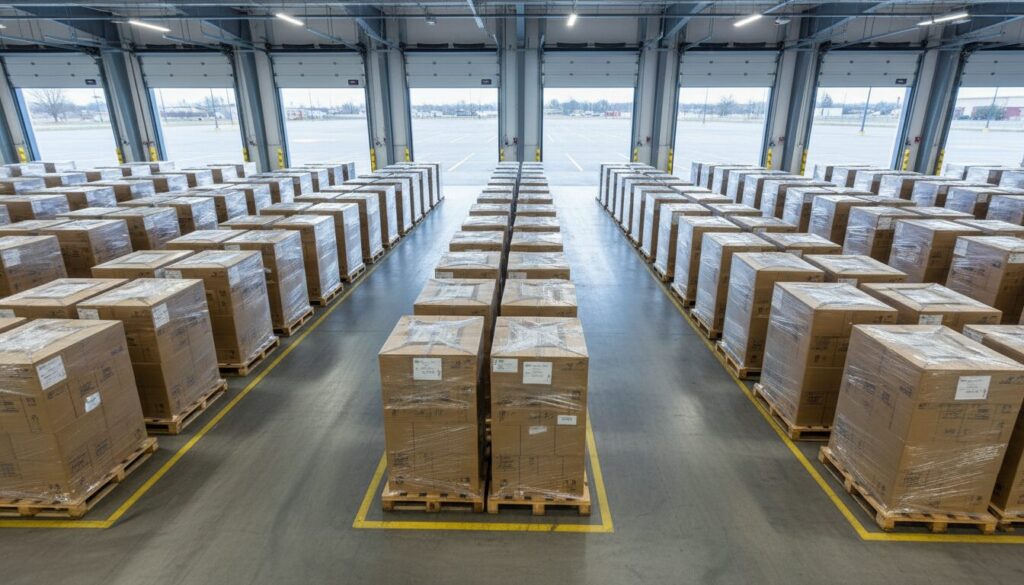
For warehouse managers, few things are as frustrating as the “Ghost Truck.” Your outbound staging lanes are full, your pickers have staged the orders perfectly, and the paperwork is printed. But the LTL (Less-Than-Truckload) carrier never shows up.
The ripple effect is immediate and costly: clogged docks, detention fees for other trucks, overtime pay for staff waiting around, and inevitably, an angry customer asking why their shipment is delayed.
In the volatile world of LTL, missed pickups have traditionally been accepted as “part of the business.” However, Digital Transformation (DX) is changing this narrative. Leading logistics providers like C.H. Robinson are deploying predictive Artificial Intelligence (AI) to identify and prevent missed pickups before they happen.
This guide explores how this specific AI application works and how you can implement a similar data-driven strategy to eliminate the “Ghost Truck” phenomenon from your facility.
The Hidden Cost of LTL Volatility
Before diving into the solution, we must quantify the pain. LTL networks are inherently complex. Unlike Full Truckload (FTL), where a driver moves point-to-point, LTL involves multiple stops, cross-docks, and hub-and-spoke models. One delay at a previous stop cascades down the entire route.
For a warehouse manager, a missed pickup isn’t just a nuisance; it is an operational bottleneck.
The “Day 2” Problem
When a pickup is missed on Monday, that freight sits on your dock. On Tuesday (Day 2), you now have Monday’s rollover freight plus Tuesday’s scheduled outbound volume.
- Space Constraint: You lose valuable staging floor space.
- Labor Inefficiency: You must pay labor to move the freight out of the way, then move it back when the truck finally arrives.
- Inventory Inaccuracy: Goods sitting on a dock are in system limbo—technically shipped but physically present.
As discussed in Automation — A Strategic Growth Enabler: The Ultimate Guide, modern logistics requires moving beyond reactive firefighting. The goal is to use technology to predict disruptions, not just report them.
The Solution: Predictive Carrier Scoring
C.H. Robinson, one of the world’s largest logistics platforms, addressed this issue not by buying more trucks, but by analyzing data. They developed an AI model that predicts the probability of a carrier missing a pickup hours before the pickup window begins.
How the AI Works
The core of this solution is shifting from Descriptive Analytics (what happened?) to Predictive Analytics (what will happen?). The AI analyzes millions of historical data points to create a “reliability score” for every potential carrier on a specific lane for a specific day.
The variables analyzed include:
- Historical Performance: Has this carrier missed pickups in this region before?
- Market Conditions: Is capacity tight in this zip code right now?
- External Factors: Weather patterns, traffic data, and holiday schedules.
- Freight Attributes: Is the freight difficult to handle (e.g., non-stackable, hazardous)?
The “Proactive Swap” Mechanism
The true innovation lies in the automated action. If the AI calculates that Carrier A has a high probability (e.g., 80%) of missing the pickup due to a storm in a neighboring state or a pattern of overbooking, the system automatically rejects Carrier A and tenders the load to Carrier B—even if Carrier B is slightly more expensive.
This happens in the background, often before the warehouse manager even knows there was a risk. The result is a truck that actually shows up.
Process: Implementing the AI Strategy in Your Warehouse
You do not need to be a data scientist to leverage this technology. However, you do need to align your warehouse operations to integrate with platforms that utilize this AI.
Here is a step-by-step guide to modernizing your LTL pickup strategy using these principles.
Step 1: Digital Integration (The Foundation)
AI requires data. If you are calling carriers on the phone or emailing spreadsheets, AI cannot help you. You must connect your Warehouse Management System (WMS) or ERP to a digital freight platform (like C.H. Robinson’s Navisphere or similar TMS).
- Action: Ensure your WMS can transmit “Ready Times” and “Pallet Counts” via API or EDI.
- Why: AI needs accurate pickup windows to calculate probability. If you say the freight is ready at 1:00 PM but it’s actually ready at 4:00 PM, the AI’s prediction will fail.
Step 2: Shift Procurement Priority
Traditionally, LTL carriers are selected based on the lowest cost per pound. To fix missed pickups, you must shift your procurement strategy to value reliability scores over raw cost.
- Action: When setting up routing guides, ask your logistics partners if they utilize predictive tendering.
- The Shift: explicit permission for your 3PL or TMS to “auto-swap” carriers. Allow the system to pay a $20 premium for a carrier with a 98% reliability score over a cheaper carrier with a 70% score. The $20 cost is far lower than the cost of a missed pickup (detention, overtime, missed sales).
Step 3: Optimize Appointment Windows
AI models work best with flexibility. If you demand a pickup strictly between 2:00 PM and 3:00 PM, you limit the AI’s ability to find a reliable match.
- Action: Widen pickup windows where possible.
- Strategy: analyzing your dwell times. If you can open a window from 12:00 PM to 4:00 PM, the AI has a 4-hour range to find the optimal carrier who is actually in the area, rather than forcing a carrier who is likely to fail.
Step 4: The Feedback Loop
AI learns from success and failure. You must provide accurate feedback data.
- Action: timestamp every carrier arrival and departure accurately in your WMS.
- Why: If a carrier arrives on time but you make them wait 3 hours, that is not a carrier failure—that is a facility failure. The AI needs to know the difference so it doesn’t unfairly penalize the carrier (which would increase your future rates).
Implementation Checklist
Use the following table to track your progress in adopting this AI-driven methodology.
| Phase | Action Item | Goal |
|---|---|---|
| 1. Audit | Review last 6 months of LTL pickups. | Identify top offending carriers and “ghost truck” frequency. |
| 2. Connect | Implement API/EDI connectivity with 3PL/TMS. | Eliminate manual email tendering; enable real-time data flow. |
| 3. Configure | Enable “Predictive Tendering” in your TMS. | Allow the system to bypass cheap-but-risky carriers automatically. |
| 4. Align | Adjust warehouse shifts to match carrier density. | Align pickup windows with times when carrier capacity is highest in your region. |
Results: The “After” State
What happens when you successfully allow AI to manage your LTL carrier selection? The results are often dramatic and touch several areas of warehouse operations.
Operational Metrics
The most immediate impact is on the dock. By reducing missed pickups, you smooth out the flow of goods.
- Reduced Dock Congestion: Freight moves out when planned.
- Lower Administrative Burden: Staff spends less time calling dispatchers asking “Where is the truck?”
- Improved OTIF (On-Time In-Full): Your customers receive goods on schedule.
Before vs. After Comparison
The table below illustrates the operational shift when moving from manual LTL management to AI-driven predictive management.
| Feature | Manual / Legacy Approach (Before) | AI-Driven Approach (After) |
|---|---|---|
| Carrier Selection | Based strictly on lowest historical price. | Based on real-time probability of success + cost. |
| Missed Pickups | Reactively managed. “Truck didn’t show, call another.” | Proactively managed. “Risk detected, carrier swapped 4 hours ago.” |
| Dock Status | Congested with rollover freight from yesterday. | Clear lanes; freight flows FIFO (First-In, First-Out). |
| Data Visibility | Phone calls and emails. | Real-time tracking and predictive alerts. |
| Cost Impact | Hidden costs (OT, detention, lost sales). | Visible costs (freight spend) but lower total landed cost. |
A Case in Efficiency
Consider a mid-sized distribution center in Chicago. During winter, snowstorms frequently disrupt LTL networks. Under the old model, the warehouse manager would book Carrier X, who would inevitably get stuck in weather and miss the pickup.
With C.H. Robinson’s AI model, the system detects the weather pattern and Carrier X’s location history. It predicts a 90% chance of failure. The system automatically routes the load to Carrier Y, a regional carrier with winter-equipped fleets already located near the industrial park. The pickup happens on time. The warehouse manager didn’t have to lift a finger.
Summary: Keys to Success
Solving the LTL missed pickup problem is no longer about shouting at dispatchers; it is about smarter data utilization. C.H. Robinson’s use of AI demonstrates that the technology exists to predict supply chain failures before they occur.
For the Warehouse Manager, the keys to success are:
- Embrace Integration: Move away from manual bookings. Connect your WMS to digital freight platforms.
- Value Reliability: Be willing to pay slightly more for a carrier with a high AI reliability score to save on backend operational costs.
- Clean Data: Ensure your facility’s data (ready times, loading times) is accurate so the AI can learn effectively.
By adopting these “How-to” steps, you move your warehouse from a reactive struggle against volatility to a proactive, automated logistics operation. The era of the “Ghost Truck” is ending—make sure your facility is ready for what comes next.
See also: Automation — A Strategic Growth Enabler: The Ultimate Guide for a broader look at how automation is reshaping logistics strategy.