
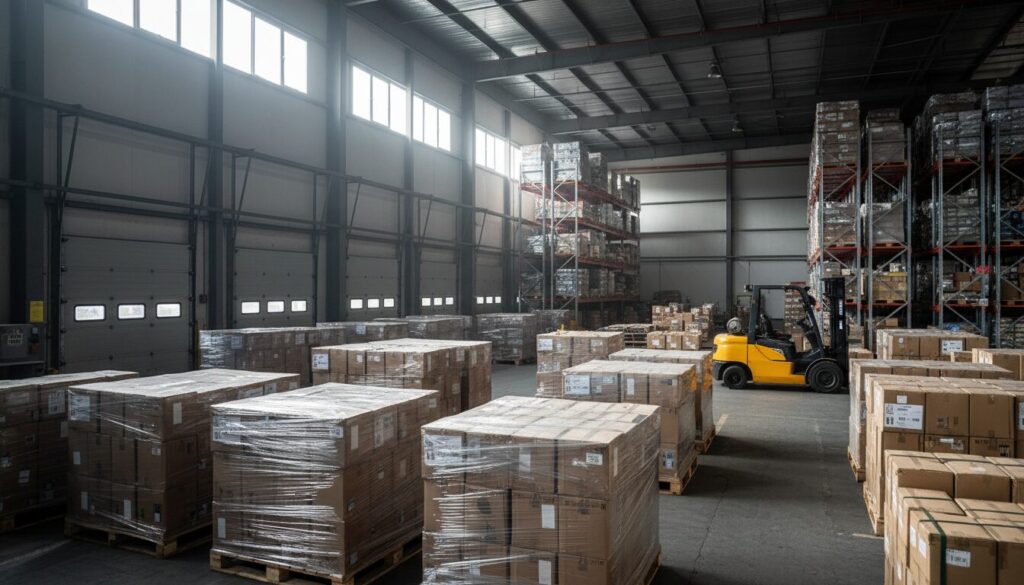
It is Tuesday morning. Your inbound dock is at 95% capacity. Your labor schedule is locked for the week. Suddenly, the Sales Director sends an email: “Great news! We just closed a deal with a major retailer. 5,000 units need to ship out by Friday.”
For the Sales team, this is a victory. For you, the Warehouse Manager, it is a disaster. You don’t have the staging space, you don’t have the headcount, and you are now forced to pay expedited freight premiums just to meet an impossible deadline.
This scenario is the hallmark of the “Silo Trap.” In many organizations, Sales generates demand, and Operations is expected to magically fulfill it, often finding out about requirements far too late.
As we discussed in Peak Season Is Dead: 4 Steps to Master 2026 Volatility, predictable logistics patterns are gone. To survive modern volatility, warehouse managers cannot operate in isolation. You need a Cross-Functional Sales and Operations Planning (S&OP) process.
This guide provides a practical, step-by-step method to build an S&OP process that doesn’t just result in more meetings, but actually synchronizes your warehouse floor with commercial strategy.
The Disconnect: Why Traditional Planning Fails the Warehouse
Before implementing a solution, we must define the problem. Many companies claim to have S&OP, but for the warehouse manager, it often feels like a “forecast dump” rather than a collaborative process.
The Common Operational Pain
Without a functioning S&OP process, the warehouse suffers from three specific symptoms:
- The Bullwhip Effect: Small fluctuations in sales orders cause massive panic in the warehouse (hiring frenzies followed by layoffs).
- Inventory Mismatch: You have an abundance of products that aren’t selling (clogging your racks) and zero stock of the items that are moving fast.
- Cost Bleeding: Operational budgets are destroyed by last-minute overtime (OT) and rush fees caused by poor visibility.
True S&OP is not just about predicting sales revenue; it is about balancing Demand (what the market wants) with Supply (what your warehouse and logistics network can actually handle).
Solution: The “Operational S&OP” Framework
To build a process that works, we must shift the mindset from “Order Taking” to “Capacity Management.”
A successful cross-functional S&OP process creates a single operating plan that aligns the commercial side (Sales/Marketing) with the execution side (Logistics/Production). For a warehouse manager, your role in this process is to provide the “Reality Check.”
You are not there to simply accept the forecast; you are there to validate whether the physical infrastructure can support it.
Process: How to Build the System in 5 Steps
Here is the step-by-step guide to establishing a robust S&OP loop.
Step 1: Establish a “Single Source of Truth”
The biggest enemy of S&OP is conflicting data. Sales uses optimistic numbers from the CRM; Finance uses budget spreadsheets; Logistics uses WMS history. You cannot plan if you are arguing about whose numbers are right.
Action:
Create a unified data repository. This does not require expensive software immediately, but it does require a strict rule: Decisions are made based on the consensus dataset only.
- Sales Input: Unconstrained demand (what they could sell).
- Logistics Input: Constraints (max pallet positions, max throughput per hour).
As highlighted in From Insight to Action: The Agentic Supply Chain Guide, modern logistics is moving toward automated decision-making. If your data is fragmented, automation is impossible. Start by cleaning your data today to enable “Agentic” capabilities tomorrow.
Step 2: The Pre-S&OP Warehouse Review
Never walk into the executive S&OP meeting unprepared. You must conduct an internal Operations Review 2-3 days prior. This is where you translate the proposed demand into physical logistics terms.
Calculate your constraints:
- Storage Capacity: If Sales forecasts a 20% lift in bulky items, do you have the bin locations?
- Labor Capacity: Convert the forecast units into “Man-Hours.”
- Formula: (Forecasted Lines / Average Lines Per Hour) = Required Hours.
- Throughput Capacity: Can your dock doors physically handle the inbound/outbound volume in the proposed window?
If the math doesn’t work, you now have data to push back or request budget for expansion.
Step 3: The Cross-Functional Alignment Meeting
This is the core event. It should happen monthly (or weekly during high-volatility periods). The goal is not to report history, but to decide on the future (typically a rolling 3-12 month horizon).
Who must attend:
- Sales/Marketing: To present demand and upcoming promos.
- Logistics/Warehouse: To present capacity and constraints.
- Finance: To approve budget variances (e.g., authorizing OT).
- Procurement: To confirm supply availability.
The Golden Rule:
“Bad news must travel fast.” If the warehouse cannot support a promo due to labor shortages, state it here. It is better to kill a promo in a meeting than to fail a customer at the dock.
Step 4: Scenario Planning and Trade-offs
S&OP is about negotiation. Often, the demand will exceed your capacity. This is where the cross-functional aspect is critical. You must present options, not just “No.”
Example Scenario:
Sales wants to push 10,000 extra units for end-of-quarter. Your warehouse is capped.
The Logistics Manager’s Proposal (The “How-to”):
| Scenario | Operational Requirement | Financial Impact | Service Level Risk |
|---|---|---|---|
| A: Do Nothing | Standard capacity | Lost sales revenue | High (Backorders) |
| B: Overtime | Weekend shifts required | +$15,000 in labor | Low |
| C: 3PL Overflow | Rent external storage | +$25,000 in logistics | Medium (Complexity) |
By presenting the data this way, you shift the decision from “Logistics is the bottleneck” to a business decision: “Is the extra revenue worth the extra cost?”
This approach aligns with the strategies mentioned in Supply Chain Chaos Meets Its Match in 2026: Expert Guide, where shifting from disruption to a “controlled response” is the key to resilience.
Step 5: Execute and Close the Feedback Loop
Once the plan is agreed upon (The “One Number Plan”), the warehouse executes. However, the process doesn’t end there.
You must measure Forecast Accuracy vs. Execution Performance.
- Did Sales actually sell what they promised?
- Did Operations achieve the throughput rates promised?
Post-Mortem Analysis:
If Sales forecasted 100 units and sold 200, causing a stockout, the S&OP process must flag this to prevent recurrence. If Operations promised to clear the dock in 2 days but took 4, the capacity model needs updating.
Results: The Impact of Integration
Implementing this 5-step process transforms the warehouse from a cost center into a strategic partner. Here is what you can expect in terms of operational improvement.
Before vs. After S&OP Implementation
| Metric | Before (Siloed Operations) | After (Cross-Functional S&OP) |
|---|---|---|
| Visibility | Warehouse learns of promos 3 days prior. | Warehouse sees demand 3-6 months out. |
| Inventory | High stock of slow movers; stockouts of winners. | Balanced inventory aligned with sales plan. |
| Labor Cost | High reactionary overtime; frequent temp labor panic. | Planned shifts; stable workforce; reduced OT. |
| Team Dynamic | “Sales sells it, Ops fails to ship it.” (Blame) | “We agreed on the plan and executed it.” (Alignment) |
| Response | Chaotic firefighting. | Controlled scenario execution. |
Expected Quantitative Improvements
- Inventory Reduction: 15-30% reduction in obsolete stock.
- Freight Savings: 10-20% reduction in expedited shipping costs.
- Labor Efficiency: 5-10% improvement in units-per-man-hour (UPMH) due to better resource leveling.
Summary: Keys to Success
Building a cross-functional S&OP process that actually works is not about buying the most expensive planning software. It is about communication discipline.
For the Warehouse Manager, the keys to success are:
- Speak with Data: Don’t complain about “being busy.” Show the capacity utilization percentage.
- Engage Early: Don’t wait for the meeting. Talk to Sales informally to understand their sentiment.
- Propose Solutions: Always offer a “Yes, if…” option rather than a flat “No.”
By mastering this process, you insulate your warehouse against the volatility of the modern economy. You move away from the “chaos” described in our 2026 outlook and toward a structured, agentic, and efficient operation.
Recommended Reading
- To understand the macro-economic pressures driving the need for S&OP, read: LMI Alert: How the K-Shaped Economy Stalls Logistics.
- For details on automating your data flow: From Insight to Action: The Agentic Supply Chain Guide.