As logistics professionals, we often find ourselves caught in the “Picking Paradox.” We invest millions in high-density Automated Storage and Retrieval Systems (AS/RS) like AutoStore to optimize space, yet our throughput remains tethered to the limits of human endurance at the picking port.
This bottleneck is the single largest barrier to scaling operations during peak seasons.
In this guide, we will explore a groundbreaking solution: the implementation of the Nowaste Logistics advances automation with Cognibotics robot picking cell. By analyzing this specific case study and methodology, we will outline a practical, step-by-step process for warehouse managers to transition from manual bottlenecks to autonomous fluidity.
As discussed in Automation — A Strategic Growth Enabler: The Ultimate Guide, automation is no longer just about cost-cutting; it is the primary engine for survival and growth in a labor-constrained market.
1. The Operational Pain: The “Last Meter” Bottleneck
Before diving into the solution, we must clearly define the problem (The “Before” state). Even in the most advanced warehouses, the efficiency of the entire facility often relies on the “last meter”—the transfer of an item from a storage bin to a shipping carton.
For 3PLs like Nowaste Logistics, dealing with diverse SKUs ranging from fresh food to apparel creates specific challenges:
- Human Fatigue: A human picker can maintain peak rates (e.g., 300-600 picks per hour depending on the setup) for only short bursts. Over an 8-hour shift, average rates drop significantly.
- Labor Shortages: Finding reliable staff for night shifts or peak seasons is increasingly difficult and expensive.
- Throughput Ceilings: Adding more shifts helps, but there is a physical limit to how many humans can work effectively around a grid without congestion.
- Ergonomics: Repetitive motions lead to strain injuries, increasing absenteeism.
The Reality Check:
Your storage is automated, but your retrieval is manual. You have built a Ferrari engine (the AS/RS) but are limiting it with manual transmission.
2. The Solution: Nowaste Logistics Advances Automation with Cognibotics Robot Picking Cell
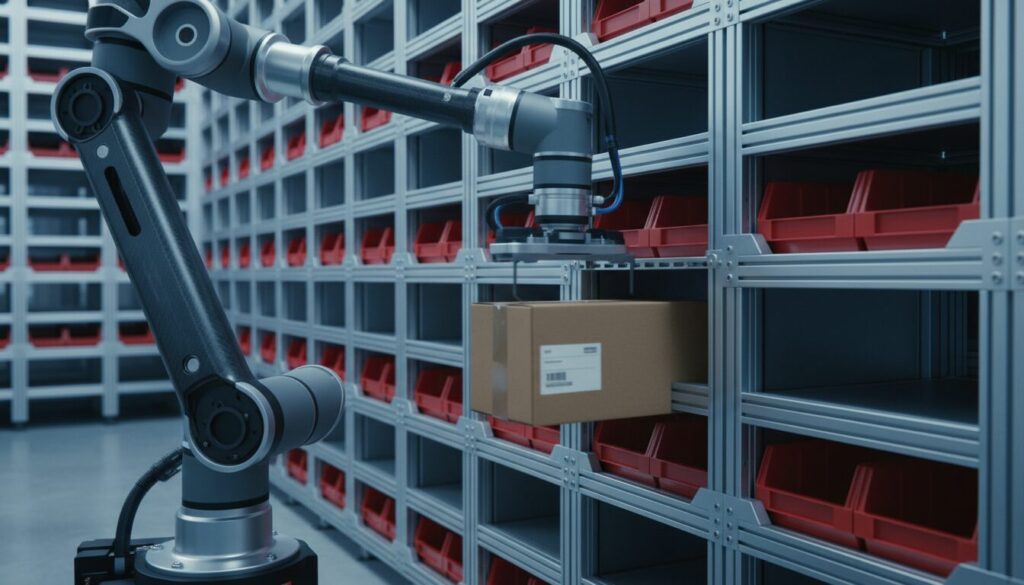
To solve this, Nowaste Logistics partnered with Cognibotics to deploy a specialized robot picking cell. This is not just a standard industrial arm dropped in front of a port; it is a purpose-built kinematic solution designed for the nuances of e-commerce fulfillment.
What Makes This Cell Different?
The Cognibotics solution differs from traditional heavy industrial robots in three key areas:
- Lightweight Kinematics: It utilizes a structure that allows for extreme speed and acceleration without the mass associated with traditional 6-axis arms. This is crucial for matching the cycle times of systems like AutoStore.
- Advanced Vision & Gripping: The system doesn’t just “grab”; it sees. It identifies the best grasp point for items of varying shapes (polybags, boxes, cylinders) in real-time.
- Software Integration: It integrates deeply with the Warehouse Control System (WCS), allowing for seamless handoffs between the storage grid and the robot.
For a deeper dive into the mechanics that allow this delicacy and speed, I highly recommend reading The hidden technology behind fluid robot motion: 2025 Guide. Understanding “fluid motion” is essential to realizing why these robots don’t damage fragile goods.
3. The Implementation Process: A 4-Step Guide
How can a warehouse manager replicate the success of Nowaste Logistics? While the technology is complex, the implementation strategy follows a logical path. Here is the 4-step framework for integrating a robot picking cell.
Step 1: The Pareto Analysis of SKUs
Robots are incredible, but they are not magic. They cannot pick everything (yet). The first step is data analysis.
- Action: Analyze your SKU master data.
- Filter Criteria:
- Dimensions & Weight: Is the item within the gripper’s payload capacity?
- Surface Texture: Is it porous (hard for suction) or slippery?
- Packaging: Is it a rigid box or a deformable polybag?
Goal: Identify the “Top Movers” that are robot-compatible. Typically, you want to automate the top 20% of SKUs that generate 80% of the volume.
Step 2: Designing the “Hybrid” Workflow
The Nowaste Logistics advances automation with Cognibotics robot picking cell model succeeds because it doesn’t aim for 100% automation immediately. It uses a hybrid approach.
- The Robot Lane: Dedicate specific AutoStore ports (or conveyor spurs) to the robot cell for high-velocity, compatible SKUs.
- The Human Lane: Route complex, heavy, or fragile items to manual stations.
- Exception Handling: Define a protocol for when the robot fails to pick. Does the bin automatically route to a human station? (The answer should be yes).
This parallels the strategy seen in other major deployments. For instance, Boozt & Cognibotics: Advanced AutoStore Automation highlights how integrating robotics into an existing AutoStore ecosystem requires a seamless handshake between automated and manual workflows.
Step 3: Integration and Calibration
This is the technical heavy lifting.
- Vision Training: The robot needs to learn your products. In the Cognibotics system, advanced AI allows the robot to generalize. It doesn’t necessarily need to see every specific SKU, but it needs to recognize types of items (e.g., “This is a shampoo bottle,” “This is a t-shirt”).
- WMS Handshake: The Warehouse Management System must know before a bin arrives whether it is destined for a Human or a Robot.
- Safety Zoning: Installing light curtains and safety cages to ensure human workers can operate nearby without risk.
Step 4: The “Ramp-Up” Phase
Do not switch to full speed on Day 1.
- Week 1-2: Run at 50% speed. Verify grip success rates. Monitor for dropped items.
- Week 3-4: Increase to 75%. Introduce more SKU variety.
- Week 5+: Full speed operation (Targeting 1000+ picks/hour depending on the specific robotic configuration).
4. Results: Transforming Warehouse Metrics
Implementing a solution like the Cognibotics picking cell drastically alters the operational landscape. Below is a comparison of the expected operational metrics before and after implementation.
Operational Comparison: Human vs. Robot Cell
The following table illustrates the shift in performance metrics when moving from a purely manual process to a hybrid automated cell.
| Metric | Manual Picking (Before) | Cognibotics Robot Cell (After) | Improvement Factor |
|---|---|---|---|
| Operating Hours | 8-16 hours (Shift dependent) | 24/7 Potential | 3x Capacity |
| Picks Per Hour (PPH) | 300 – 450 (Variable) | 600 – 1,200 (Consistent) | 2x Speed |
| Error Rate | 0.5% – 1.0% | < 0.1% | 10x Accuracy |
| Dependencies | Breaks, Lunches, Shift Changes | Maintenance only | High Uptime |
| Scalability | Linear (Hire more people) | Exponential (Add more cells) | Fast Scaling |
The “Nowaste” Impact
By adopting this technology, Nowaste Logistics achieved:
- Resilience: The ability to handle Black Friday spikes without panic hiring.
- Consistency: Predictable throughput allows for better trucking and last-mile planning.
- Employee Satisfaction: Human workers are moved from repetitive, mind-numbing picking tasks to supervisory or value-added roles (handling complex returns, gift wrapping, etc.).
5. Summary: Keys to Success
The story of how Nowaste Logistics advances automation with Cognibotics robot picking cell is not just about a cool robot arm; it is a blueprint for the future of fulfillment.
To successfully replicate this in your facility, focus on these three pillars:
- Data First: Don’t buy a robot; buy a solution for your SKU profile. Analyze your data to ensure you have enough “robot-able” volume to justify the ROI.
- Hybrid Mindset: Accept that humans and robots will work together. Design your WMS logic to route difficult tasks to humans and repetitive tasks to robots.
- Partner for Motion: Choose robotics partners that understand logistics motion, not just automotive manufacturing. The fluidity of the movement determines the safety of the product.
Final Thought
The era of manual picking as the standard for high-volume logistics is closing. By following the path laid out by pioneers like Nowaste and technology leaders like Cognibotics, warehouse managers can build facilities that are not only faster but more humane and resilient to market shocks.
Start your assessment today. Look at your top 100 selling items. If they are small, rigid, and high-volume, you are ready for the next step in your automation journey.
See also: