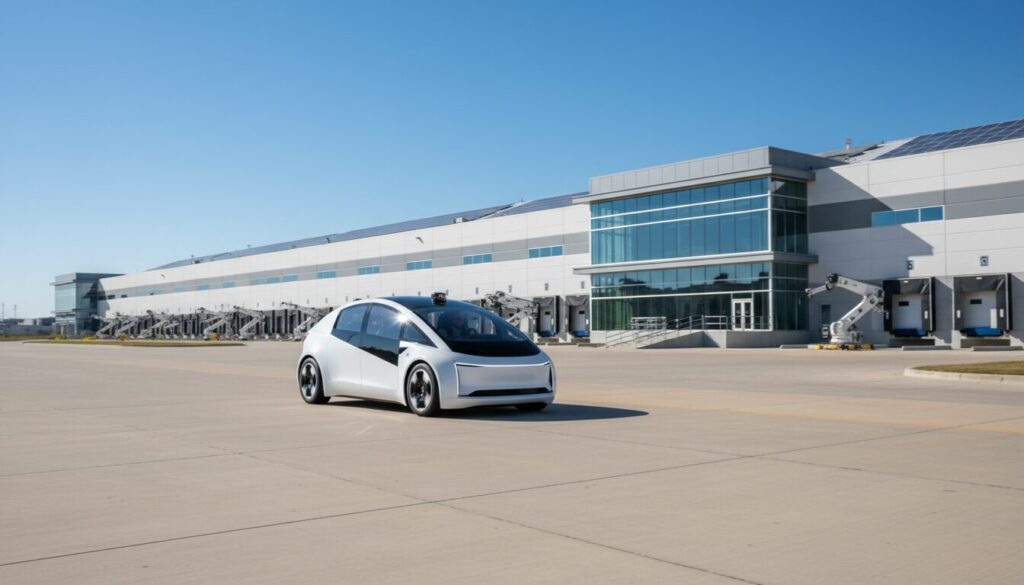
The gap between “futuristic concept” and “revenue-generating reality” just closed significantly in Austin, Texas. Tesla has officially launched fully driverless robotaxi rides for public passengers, removing the human safety monitor from the front seat.
For logistics executives, this is not merely automotive news; it is a critical signal for the supply chain. Tesla’s transition from testing to a commercial, unsupervised revenue model in a complex urban environment serves as a definitive proof-of-concept for the future of last-mile delivery and autonomous fleet management.
This analysis explores the operational details of this launch and dissects what the removal of the human driver means for carriers, shippers, and warehouse operators aiming to stay ahead of the automation curve.
The Facts: Unsupervised Autonomy Goes Live
Tesla’s move in Austin represents a specific, calculated step toward mass autonomy. Unlike previous beta tests where employees or safety drivers were present to intervene, these vehicles are now operating with empty front seats while carrying paying public passengers.
To understand the scope of this deployment, we break down the operational parameters below:
| Component | Detail | Strategic Implication |
|---|---|---|
| Operational Status | Unsupervised Public Rides | The AI is trusted enough to handle liability without immediate human intervention inside the cab. |
| Business Model | Commercial Charging | Moves beyond “free pilots” to a validated revenue model, proving market willingness to pay for driverless service. |
| Safety Net | Chase Car Support | A trailing vehicle monitors operations, acting as a bridge between full independence and supervised testing. |
| Fleet Mix | Hybrid Deployment | The fleet currently mixes supervised and unsupervised units, allowing for gradual data validation and risk management. |
| Location | Austin, Texas | A complex, real-world urban environment, not a geofenced, simplified testing track. |
The crucial differentiator here is the commercial charging model. While many competitors have run free trials to gather data, Tesla is signaling that the product is finished enough to be sold. This shift from R&D expense to revenue generation is the milestone logistics leaders have been waiting for to justify heavy investment in autonomous transport.
Industry Impact: The Ripple Effect on Logistics
While the current cargo is passengers, the underlying technology stack—vision-based neural networks—is identical to what is required for freight. The success of the Austin deployment validates the technology that will power the next generation of logistics.
1. The Redefinition of “Last-Mile” Economics
The single largest cost component in last-mile delivery is the human driver, accounting for 40-60% of the total delivery cost. Tesla’s removal of the safety driver in Austin proves that the technology is mature enough to remove that cost center in complex urban grids.
If a vehicle can safely navigate Austin traffic with a human passenger (where safety stakes are highest), it can certainly navigate the same streets with a parcel (where the stakes are lower). This suggests that Autonomous Delivery Vehicles (ADVs) are closer to mass commercial viability than previously estimated.
For a deeper look at how autonomous strategies are expanding globally, see our analysis: MINIEYE Case Study: 1,000 AVs & The “Overseas 2.0” Strategy.
2. From Fleet Dispatch to “Remote Oversight”
The presence of a “chase car” in Tesla’s current model offers a glimpse into the transitional phase of logistics workforce management. We are not moving immediately to zero-human interaction. Instead, we are moving to a 1:N supervision model.
Currently, one chase car might monitor one robotaxi. In the near future logistics scenario:
- One remote operator will monitor 10 to 20 delivery vans.
- Intervention will only occur during “edge cases” (e.g., blocked driveways, construction zones).
This shifts the labor requirement from driving skills to monitoring and crisis management skills.
3. Infrastructure and “Vision” Reliance
Tesla’s approach relies heavily on camera-based vision rather than expensive LiDAR maps. This has massive implications for warehouse and yard management. If vehicles can navigate using vision alone, the cost of implementing autonomous yard tractors drops significantly.
Facilities will need to ensure their physical environments—markings, signage, and lighting—are optimized for AI vision systems. The vehicle is no longer just moving; it is “reading” the environment.
To understand how vision systems are already changing facility operations, refer to: AI Vision Systems: Transform Yard & Warehouse Ops Guide.
LogiShift View: The “So What?” for Supply Chain
Why should a warehouse manager or a freight forwarder care about a taxi in Texas? Because the software architecture is universal.
The Convergence of Embodied AI
Tesla’s FSD (Full Self-Driving) software is effectively a “World Model”—an AI that understands physics, object permanence, and prediction. This is the same technological frontier being explored in humanoid robotics for warehousing.
As discussed in our article on the 1X World Model: Critical Shift for Logistics AI, the ability of an AI to predict what happens next in a video sequence is the key to autonomy. Tesla’s robotaxi is the largest commercially active “World Model” currently in operation.
The Insight:
The “Chase Car” mentioned in the news is not a failure of autonomy; it is the prototype for the Logistics Platoon. In freight, we predict a model where a lead human-driven truck is followed by 3-4 autonomous “follower” units on highways. Austin is the urban beta test for this tiered safety structure.
Furthermore, the data Tesla gathers in Austin regarding pedestrian behavior, unpredictable traffic, and road closures is directly applicable to urban logistics delivery bots. The “fluidity” required for a robotaxi to merge into traffic is the same fluidity required for a warehouse robot to merge into a picking aisle without stopping the flow.
See also: The hidden technology behind fluid robot motion: 2025 Guide.
The Shift to “Utilization” as the Core Metric
With human drivers, vehicles are limited by Hours of Service (HOS) regulations. An unsupervised robotaxi—and by extension, an autonomous delivery van—is limited only by battery charge.
This changes the fundamental math of logistics:
- Current State: Asset utilization is capped at ~11 hours/day (driver limits).
- Future State: Asset utilization approaches 22+ hours/day (charging downtime only).
This means carriers can move the same amount of freight with fewer vehicles, provided those vehicles are autonomous.
Takeaway: Strategic Moves for Logistics Leaders
The launch of unsupervised robotaxis in Austin is the signal that the technology has graduated from the lab. Logistics leaders must now prepare for the commercial reality of autonomy.
1. Audit Your “Vision Readiness”
Does your facility have clear signage? Are your loading docks standardized? Autonomous vehicles rely on visual cues. If a Tesla can read a stop sign, an autonomous yard truck needs to read your dock numbers. Ensure your physical infrastructure is “machine-readable.”
2. Re-evaluate Fleet ROI Models
Stop calculating ROI based on human driver shifts. Start modeling scenarios where vehicle uptime doubles. If you are planning fleet purchases for 2026-2028, consider that the depreciation curve of non-autonomous vehicles may accelerate as autonomy becomes standard.
3. Prepare for the “Hybrid” Decade
Just as Tesla is using chase cars, logistics will use hybrid fleets for the next decade. Do not wait for “Level 5” (perfect) autonomy. Investigate “Level 4” solutions for specific lanes or yards today. The companies that learn to manage the interaction between humans and machines now will dominate the market later.
For insights on the broader robotics landscape fueling this shift, read: Sharpa Case Study: Hesai General Robotics Innovation.
Final Thought: Tesla has removed the driver from the seat. The logistics industry must now prepare to remove the friction from the supply chain. The race is no longer about who has the best truck; it is about who has the best intelligence driving it.
」、25年調達額が1億ドル超え。物流コスト半減、170都市で2000台稼働_hero-300x171.jpg)