
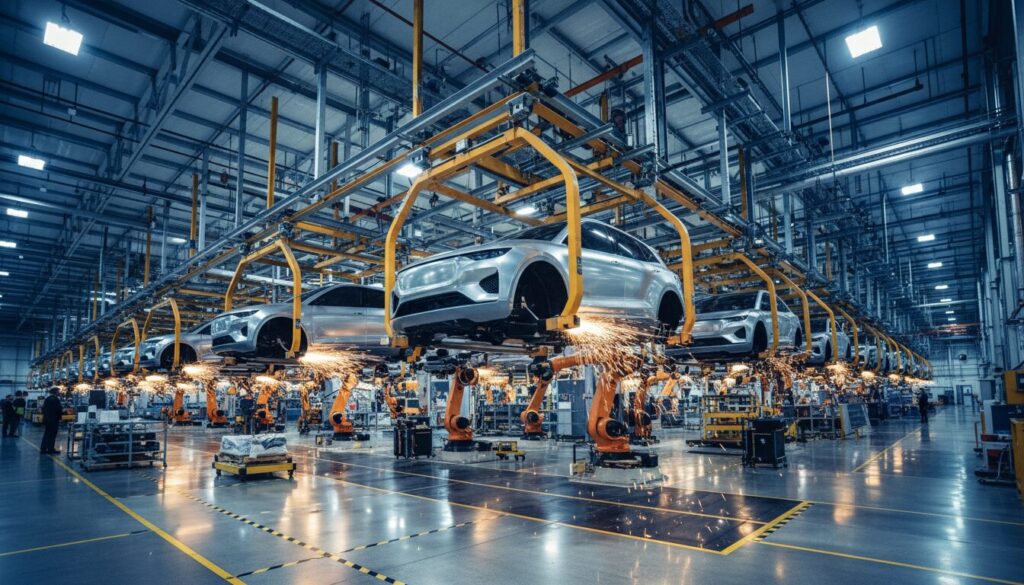
Introduction
The era of unfettered globalization, defined by chasing the lowest labor costs regardless of geography, is undergoing a radical structural correction. In a definitive move that signals the future of manufacturing, General Motors (GM) has announced a major strategic pivot: GM to end Chevy Bolt EV production next year, move China-made Buick to US factory space, and repatriate the Chevrolet Equinox from Mexico.
This decision is not merely a product cycle update; it is a masterclass in modern supply chain strategy. It represents a shift from “Just-in-Time” global efficiency to “Just-in-Case” regional resilience. For innovation leaders and logistics executives, GM’s reshuffling of its Fairfax Assembly Plant in Kansas serves as a critical case study on how tariff volatility, federal incentives, and supply chain security are redefining global logistics footprints.
As we navigate through 2025 and approach 2026, the logic driving GM is clear: the cost of compliance and the risk of trans-oceanic logistics now outweigh the savings of foreign labor arbitrage.
Why It Matters: The End of Pure Globalization
For decades, the automotive logistics model was predicated on cross-border manufacturing. Components were sourced globally, assembled in low-cost regions (like Mexico or China), and shipped to high-demand markets (US/EU). However, the geopolitical and economic landscape has shifted dramatically.
The Triple Threat to Global Supply Chains
- Tariff Wars: The lingering Section 301 tariffs and renewed trade friction have made importing vehicles from China financially unsustainable. A 25% (or higher) tariff on Chinese-made vehicles erodes margins instantly.
- Incentive Structures: The US Inflation Reduction Act (IRA) links the $7,500 consumer tax credit to North American assembly and battery material sourcing. Importing a Buick Envision from China automatically disqualifies it from these incentives, rendering it uncompetitive.
- Logistics Volatility: As discussed in our analysis of Supply Chain Chaos Meets Its Match in 2026: Expert Guide, reliance on long maritime routes exposes companies to unprecedented disruption risks, from canal blockages to geopolitical flashpoints.
GM’s decision to localize production is a direct response to these pressures. It matters because it proves that total landed cost calculations have changed. It is no longer cheaper to build in China if the logistics, tariffs, and lost tax credits cost more than American union labor.
Global Trend: The Great Reshoring and Regionalization
GM is not acting in isolation. This move is part of a broader “Reshoring” and “Nearshoring” trend sweeping across the US, Europe, and Asia.
United States: The “Battery Belt” and Reshoring
The US is seeing a manufacturing renaissance driven by policy. The “Battery Belt”—stretching from Michigan to Georgia—is attracting billions in investment. Companies are moving assembly lines closer to these battery plants to minimize logistics costs for hazardous materials.
- Trend: Shifting from Trans-Pacific flows to North American rail and truck networks.
- See also: Trump Admin Clarifies Tariff Refund Scope: Global Impact
Europe: Local for Local
Europe is adopting a similar stance, albeit driven more by the Carbon Border Adjustment Mechanism (CBAM) and energy independence. European OEMs are moving production out of volatility-prone regions and deepening ties with Eastern Europe and North Africa to shorten supply chains.
Asia: China Plus One
In Asia, the narrative is “de-risking.” While China remains the factory of the world, multinationals are hedging their bets. However, for the US market specifically, “China Plus One” (often Vietnam or India) is no longer enough due to strict Rules of Origin requirements for EVs. This pushes production all the way back to the US.
- Regional Context: For a deeper dive on North American trade dynamics, read Canada-China Trade Truce: Global Logistics Case Study.
Case Study: GM’s Fairfax Transformation
This section analyzes the specific logistics and strategic maneuvers behind GM’s decision to end the Chevy Bolt and repatriate the Buick Envision and Chevy Equinox.
The Strategic Shuffle
GM plans to end production of the Chevrolet Bolt EV (based on the older BEV2 platform) at the Fairfax Assembly Plant in Kansas. After a retooling period, the plant will begin producing:
- Buick Envision: Currently imported from China.
- Chevrolet Equinox (Gas): Currently imported from Mexico.
The Drivers of Change
| Feature | Previous Strategy (China/Mexico) | New Strategy (Kansas, USA) | Logistics Impact |
|---|---|---|---|
| Tariffs | High exposure (China tariffs approx. 27.5%) | Zero exposure (Domestic production) | Elimination of duty drawback complexity. |
| Incentives | Ineligible for $7,500 IRA tax credit | Fully Eligible (pending battery sourcing) | Demand stimulation offsets higher labor costs. |
| Logistics Mode | RoRo Ships (30+ days transit) | Rail & Truck (2-5 days transit) | Drastic reduction in inventory carrying costs. |
| Supply Chain Risk | High (Port congestion, geopolitical risk) | Low (Domestic rail/road) | Increased supply chain resilience. |
| Labor Cost | Low (Arbitrage advantage) | High (UAW contract rates) | Offset by automation and logistics savings. |
The Logistics Pivot: From Ocean to Rail
Moving the Buick Envision from China to Kansas is a massive logistical undertaking.
- Old Flow: Parts aggregated in China $\rightarrow$ Assembly in Yantai $\rightarrow$ Ocean Freight to US West Coast $\rightarrow$ Rail to Distribution Centers.
- New Flow: Tier 1 suppliers (potentially reshored or stockpiled) $\rightarrow$ Rail/Truck to Kansas $\rightarrow$ Assembly $\rightarrow$ Outbound via N. American Rail.
This eliminates the “Pacific variable” from the lead time. GM can now respond to US demand fluctuations in weeks rather than months. Furthermore, by moving the Equinox from Mexico to Kansas, GM consolidates platform manufacturing. While Mexico remains a crucial hub, bringing the Equinox north hedges against potential future border frictions.
For more on the complexities of Mexican manufacturing logistics, see Borderlands Mexico: 2026 Tariff Noise & Resilience Strategy.
The Cost-Benefit Analysis
Critics argue that US labor costs are too high. However, GM’s strategy relies on the “Total Cost of Ownership” model.
- Inventory Reduction: Shorter lead times mean less capital tied up in floating inventory on the ocean.
- Premium Positioning: The Buick Envision is a premium product; margins can absorb higher labor costs better than a budget entry-level car.
- The “Bolt” Factor: Ending the Bolt (a low-margin EV) frees up capacity for higher-margin vehicles (Envision/Equinox) while GM pivots to its more profitable Ultium-based EVs in other factories.
Key Takeaways for Logistics Leaders
The phrase “GM to end Chevy Bolt EV production next year, move China-made Buick to US factory” is more than a headline; it is a signal for strategic alignment. Here are the lessons for the industry:
1. Regulatory Compliance is the New Efficiency
In the 2000s, efficiency meant cheap labor. In the late 2020s, efficiency means maximizing tax credits and avoiding tariffs. Logistics networks must be designed around policy maps, not just geographical maps. If your supply chain cannot adapt to a new trade agreement or subsidy ruling, it is obsolete.
2. Resilience Requires Geographic Proximity
The era of “ship it and forget it” is over. Long supply chains are liability chains. By moving production to Kansas, GM centralizes its distribution node in the heart of the US market, insulating itself from port strikes, ocean freight rate spikes, and international trade disputes.
3. Agility in Manufacturing Footprints
GM is repurposing an existing brownfield site (Fairfax) rather than building greenfield. This agility—swapping out the Bolt for the Envision—demonstrates the need for flexible manufacturing systems that can handle different platforms (EV vs. ICE) and origins (China vs. US design) under one roof.
4. The Hidden Cost of Inventory
Executives often overlook the cost of capital tied up in transit. Reshoring slashes transit times from 45 days to 4 days. In an environment of fluctuating interest rates, releasing that working capital is a significant financial advantage.
Future Outlook: The Reshored Supply Chain
As we look toward 2027 and 2028, when these Kansas lines are fully operational, we expect three major shifts:
1. Supplier Migration
Tier 1 and Tier 2 suppliers currently in China will face immense pressure to set up satellite operations in the US Midwest. We will see a secondary wave of logistics demand for industrial machinery moving from Asia to the US to equip these new supplier factories.
2. Automation as the Equalizer
To make “Made in USA” profitable, GM will likely deploy higher levels of automation in Kansas than were used in the Chinese or Mexican plants. This will drive a boom in robotics logistics and technical maintenance supply chains.
3. The “Hybrid” Logistics Model
Companies will adopt a hybrid approach: high-value, complex goods (like the Envision) will be produced domestically to capture incentives. Low-value, commoditized components will still flow from low-cost regions, but with increased safety stock buffering.
Conclusion
GM’s bold move to end the Bolt and bring the Buick home is the canary in the coal mine for global logistics. It signifies that the US market is becoming an “island of production” for itself. For strategy executives, the message is clear: Evaluate your exposure to trans-oceanic risks and calculate the true cost of your global footprint. The future of logistics is not just about moving goods; it’s about moving where the goods are made.
- Further Reading: To understand how to build a strategy that thrives on this kind of structural volatility, read 5 Supply Chain Management Trends 2026: New Strategy.