In the high-stakes world of logistics, “trial and error” is the most expensive strategy a warehouse manager can employ. Yet, traditionally, optimizing a facility layout or introducing new automation involved significant risk. You plan on paper, install the equipment, and cross your fingers that the conveyor throughput matches the spreadsheet calculations.
The gap between design and reality often results in costly retrofits, extended downtime, and operational bottlenecks that weren’t visible in 2D CAD drawings.
This is where Digital Transformation (DX) changes the game. By observing how PepsiCo uses digital twins to trial plant changes, warehouse managers can learn to simulate failure in a virtual world to ensure success in the real one. This guide translates PepsiCo’s manufacturing strategy into actionable steps for warehouse logistics.
The Operational Pain: The Cost of Physical Guesswork
Before diving into the solution, we must define the problem. For most logistics centers, facility modifications share a common set of pain points.
The “Traditional Implementation Cycle” usually looks like this:
- Design: Engineers draft a layout based on historical averages.
- Purchase: Expensive hardware (racks, conveyors, sorters) is ordered.
- Installation: Operations are paused or disrupted for installation.
- Discovery: Upon startup, unforeseen collisions, bottlenecks, or sensor dead zones occur.
- Remediation: Costly on-site fixes and engineering change orders (ECOs) are required.
This cycle is slow and rigid. Once the steel is bolted to the concrete, the cost of change skyrockets.
The Solution: What is the PepsiCo Approach?
PepsiCo, specifically in their Cheetos manufacturing facilities, adopted a Digital Twin strategy to eliminate this risk. They utilized NVIDIA Omniverse and Siemens technology to create a photorealistic, physics-based replica of their factory.
This was not merely a 3D visual walkthrough. It was a simulation of physics—gravity, friction, fluid dynamics, and speed. By doing so, PepsiCo could simulate how products would move down the line, how distinct machine parts would interact, and where jams were likely to occur before a single piece of equipment was purchased.
Why This Matters for Warehousing
While PepsiCo focused on manufacturing lines, the principle is identical for logistics. Whether you are deploying Autonomous Mobile Robots (AMRs) or redesigning a packing station, the goal is the same: Validate before you validate.
As discussed in our previous analysis of the industry, technology partners are crucial here. Universal Robots, for instance, has partnered with Siemens to bring AI capabilities to physical tasks.
See also: UR, Robotiq & Siemens: The AI Shift in Smart Palletizing
Process: Implementing the “PepsiCo Model” in Your Warehouse
You do not need the budget of a Fortune 50 corporation to apply these principles. The concept of “using digital twins to trial changes” can be scaled. Here is a 4-step guide to applying this methodology to your next warehouse improvement project.
Step 1: Digitize the Environment (Data Aggregation)
A Digital Twin requires two things: Geometry (what it looks like) and Data (how it behaves).
Actionable Steps:
- Laser Scanning: Use LiDAR scanning to create a precise point-cloud map of your current warehouse. This captures columns, low-hanging pipes, and uneven flooring that 2D prints miss.
- Asset Cataloging: Gather the technical specifications of your intended equipment. You need more than dimensions; you need acceleration rates, turning radii for forklifts, and sensor ranges.
Step 2: Establish the Physics-Based Simulation
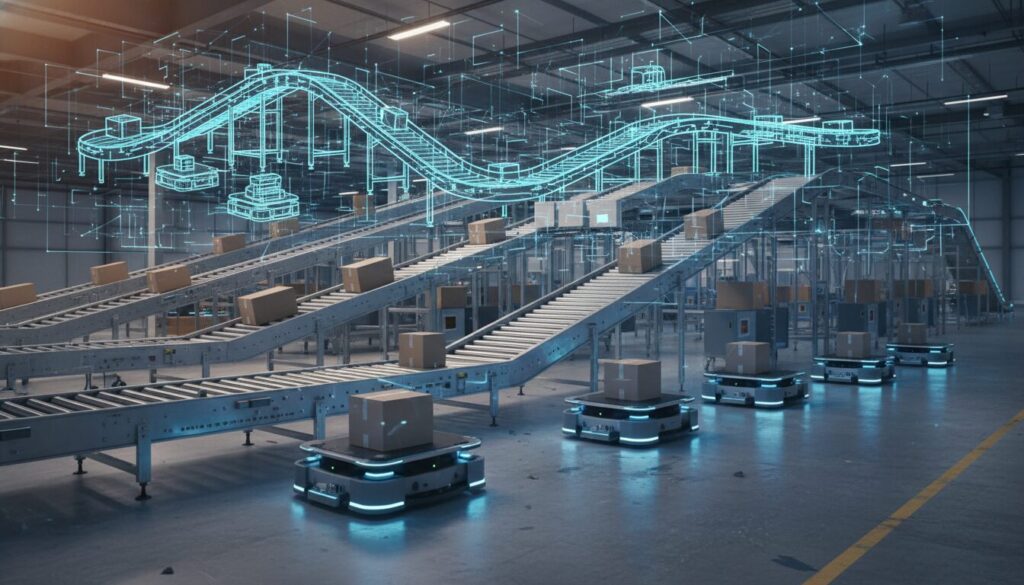
The “magic” in how PepsiCo uses digital twins to trial plant changes lies in the physics engine. A static 3D model shows you if a conveyor fits in the room. A physics-based simulation shows you what happens when a package falls off that conveyor.
Key Simulation Parameters:
- Friction and Gravity: How do packages behave on a spiral chute?
- Collision Detection: Will the new AGV path intersect with manual forklift lanes?
- Throughput Logic: What happens to the sorter if inbound volume spikes by 300%?
By integrating these physics, you move from a “drawing” to a “living model.”
Step 3: Run “What-If” Stress Tests
This is the critical optimization phase. Instead of debating theories in a conference room, you test them in the simulation.
Scenarios to Run:
- Scenario A: What if we reduce the number of packing stations but increase conveyor speed?
- Scenario B: What if we introduce a humanoid robot for palletizing?
Regarding the integration of advanced robotics, Siemens has established specific protocols for validating these technologies before deployment.
See also: 5 Steps to Industrialize Humanoids via Siemens PoC Guide
Step 4: Virtual Commissioning
Before physical installation begins, perform “Virtual Commissioning.” This involves connecting your actual WMS (Warehouse Management System) or WCS (Warehouse Control System) software to the Digital Twin.
The Goal: Your software controls the digital warehouse exactly as it would the real one. If the digital sorter diverts to Lane 3 when it should go to Lane 4, you fix the code now—not when 50 trucks are waiting at the dock.
Results: The Impact of Digital Validation
Implementing a digital trial process dramatically alters the project outcome. Below is a comparison of a typical warehouse retrofit project using traditional methods versus the Digital Twin approach.
Comparison: Traditional vs. Digital Twin Methodology
| Metric | Traditional Approach | Digital Twin Approach (PepsiCo Model) |
|---|---|---|
| Design Validation | Static 2D/3D layouts; reliance on spreadsheets. | Dynamic simulation with real-world physics. |
| Error Detection | During physical installation (Expensive). | During virtual design (Near-zero cost). |
| Downtime | High; adjustments made during live ops. | Low; “Plug and Play” deployment. |
| Throughput | Often lower than calculated due to friction. | Optimized to +95% of theoretical max. |
| Cost | High contingency budget required (10-15%). | Reduced contingency; CapEx is accurate. |
Expected Improvements
By adopting this method, warehouse managers can expect:
- 30% Reduction in Commissioning Time: Because the software is pre-debugged.
- Zero “Surprise” Clashes: Physical interferences are resolved in the digital model.
- Data-Driven CapEx: Justification for new equipment is based on proven simulation data, not estimates.
Summary: Keys to Success
The headline “PepsiCo uses digital twins to trial plant changes” is more than a news story; it is a blueprint for the future of logistics management.
To succeed in this transition, remember three core rules:
- Physics Over Aesthetics: A pretty 3D model is useless if it doesn’t simulate gravity and friction.
- Software in the Loop: Test your WMS/WCS code against the model, not just the hardware layout.
- Start Small: You do not need to model the whole warehouse. Start by simulating a single new packing line or AGV route.
By moving mistakes from the warehouse floor to the computer screen, you transform logistics from a reactive struggle into a predictive science.