
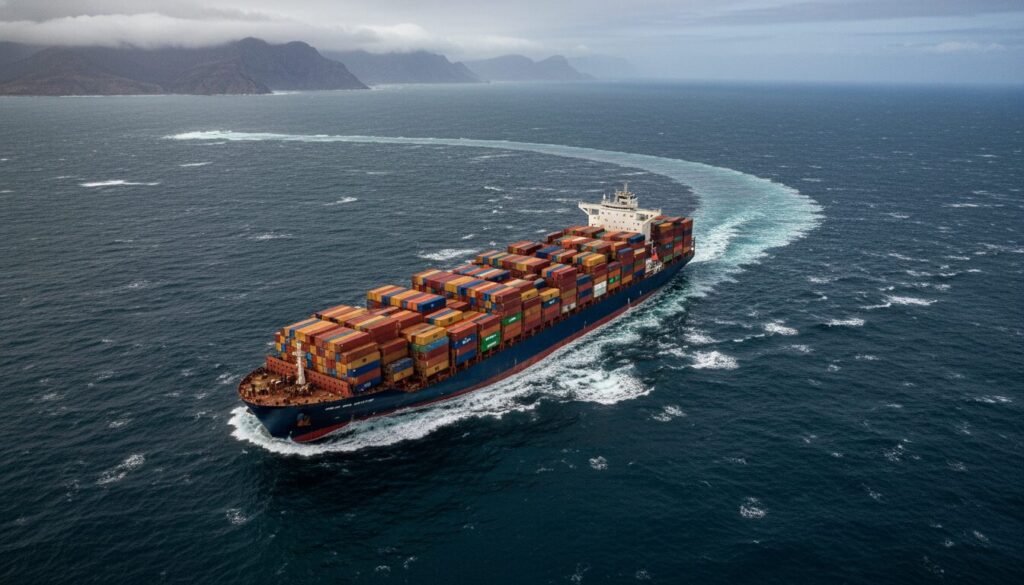
The fragile nature of global supply chain recovery has once again been exposed. Just as major carriers began testing the waters for a return to the Suez Canal, geopolitical realities have forced a rapid strategic retreat. The recent decision by French shipping giant CMA CGM to abandon its planned return to the Red Sea—rerouting vessels back around the Cape of Good Hope—serves as a critical case study in modern logistics risk management.
For innovation leaders and strategy executives, this is not merely an operational update; it is a signal that the era of “Permanent Uncertainty” is here to stay. This article analyzes why CMA CGM reverses course on return to Red Sea transits, the divergence in carrier strategies, and the ripple effects on global trade between Asia, Europe, and the Americas.
Why It Matters: The Geopolitical Feedback Loop
The logistics sector has historically operated on the assumption that trade routes are static infrastructure. However, the events of 2024 through early 2026 have proven that maritime corridors are geopolitical assets.
The decision by CMA CGM to abort its Red Sea transit trials was triggered by escalated threats from Iran regarding commercial shipping, specifically in response to potential U.S. military maneuvers. This highlights a critical vulnerability: supply chains are now directly coupled with military posturing.
For global stakeholders, the implications are severe:
- Europe & Mediterranean: Direct delays of 10-14 days for imports, impacting manufacturing schedules and retail stock.
- Asia (China/Far East): Exporters face container shortages as equipment remains tied up on longer voyages.
- North America: While the Transpacific route is separate, the removal of capacity on the Suez lane tightens global vessel supply, putting upward pressure on rates everywhere.
As discussed in our analysis of market volatility, these disruptions are rarely isolated. They feed into broader pricing instability, similar to how Transpacific Ocean Rates Spike to Start 2026, driven by capacity constraints that ripple across all trade lanes.
Global Trend: The Great Divergence in Risk Appetite
What makes this current situation unique in logistics history is the strategic divergence among the major alliances. In previous crises, carriers tended to move in a pack. Today, we are seeing a fragmentation of strategy based on risk tolerance and national alignment.
The Split in Strategy: US, EU, and Asian Carriers
While CMA CGM has pulled back, other carriers like Maersk and ONE (Ocean Network Express) have taken different approaches, creating a fragmented service map.
| Strategy Type | Carriers | Action Taken | Operational Impact |
|---|---|---|---|
| Risk Averse | CMA CGM | Rerouting to Cape of Good Hope | High fuel costs, high schedule certainty (ironically), 10+ days delay. |
| Cautious Return | Maersk / ONE | Limited Suez Transits | Lower cost, high risk of attack/disruption, volatile schedules. |
| Strictly Cape | Hapag-Lloyd | Commited to Cape since Day 1 | Consistent long transit times, avoided the “flip-flop” confusion. |
Regional Impacts
- United States: The US supply chain is currently more insulated from the Red Sea crisis than Europe, largely due to the robust performance of West Coast ports. As highlighted in our recent case study, the Port of Long Beach 2025 Record: Innovation Case Study demonstrates how diverting volume to stable gateways is a primary mitigation strategy for US importers.
- Europe: The reversal is devastating for Mediterranean ports (e.g., Marseille, Valencia), which are bypassed or served via feeders when motherships take the Cape route.
- Asia: The inability to secure a stable route to Europe complicates the “China Plus One” strategy, as Southeast Asian hubs (Singapore, Tanjung Pelepas) become congested transshipment points for rerouted cargo.
Case Study: CMA CGM’s Strategic Reversal
To understand the gravity of the situation, we must look at the specifics of CMA CGM’s maneuver. This was not a blanket decision made months ago; it was a real-time reversal of a publicly announced strategy.
The Failed Experiment
In late 2025, CMA CGM announced it would resume transits through the southern Red Sea on a case-by-case basis, utilizing naval escorts. The industry viewed this as the first step toward normalization.
However, in mid-January 2026, the geopolitical landscape shifted. Intelligence reports regarding Iranian capabilities and intent to target commercial vessels—regardless of ownership—forced the carrier’s hand.
Specific Services Rerouted:
- FAL 1 (French Asia Line 1): The flagship loop connecting China to Northern Europe.
- FAL 3 (French Asia Line 3): A secondary critical loop for Asia-Europe trade.
- MEDEX (Mediterranean Express): Vital for connecting the Middle East and Indian Subcontinent to the Mediterranean.
The Cost of Reversal
The immediate consequence of this “U-turn” is a loss of trust. Xeneta, a leading ocean freight benchmarking platform, warned that sudden route changes are more damaging than consistent delays.
- Shipper Confusion: Cargo owners who booked on FAL 1 expecting a 35-day transit are now looking at 45+ days while the cargo is already on the water.
- Inventory Shocks: The sudden addition of two weeks to lead times wreaks havoc on Just-in-Time (JIT) models.
- Surcharge Volatility: With the return to the Cape, Emergency Risk Surcharges (ERS) are replaced by Transit Disruption Surcharges (TDS), complicating freight audits.
This situation perfectly illustrates the risks we identified regarding inventory management. As transit times fluctuate wildly, the safety stock logic breaks down. For a deeper dive into the risks of low inventory, see: Empty Warehouses Alert: The Dangerous Return of JIT.
Comparative Analysis: Why CMA CGM?
Why did CMA CGM attempt the return while Hapag-Lloyd stayed away?
- Naval Support: Being a French carrier, CMA CGM relied heavily on French naval escorts. When the threat level exceeded naval defensive capabilities, the commercial risk became untenable.
- Market Position: CMA CGM has significant investments in Lebanese and Eastern Mediterranean infrastructure (e.g., Beirut, Tripoli). They have a strategic imperative to keep the Suez open that exceeds that of their German or Danish competitors.
Key Takeaways for Innovation Leaders
The CMA CGM reversal provides four critical lessons for logistics strategy executives.
1. Dynamic Routing is the New Standard
Fixed schedules are becoming obsolete. Logistics systems must be able to handle “Dynamic ETAs.” If your ERP or WMS relies on static transit time data tables, your planning will fail. Systems must ingest real-time AIS data to adjust production and distribution planning automatically.
2. The High Cost of “Hope”
CMA CGM hoped for a return to normalcy. That hope caused them to market shorter transit times that they ultimately could not deliver.
- Lesson: It is better to plan for the “Worst Case” (Cape Route) and be pleasantly surprised by early arrival than to plan for the “Best Case” (Suez) and face a stock-out.
3. Geopolitical Risk Intelligence is Mandatory
Supply chain managers can no longer ignore foreign policy. The China Bans Dual-Use Item Exports to Japan: Global Impact is another example where political decisions instantly severed supply lines. Companies need Chief Risk Officers who understand geopolitical nuance, not just financial hedging.
4. Carbon Implications of Rerouting
The return to the Cape route increases CO2 emissions by approximately 30-40% per TEU due to the extra distance and speed required to recover time. Sustainability leaders must adjust their Scope 3 emission forecasts immediately. The “Green Supply Chain” targets for 2026 will likely be missed due to these security maneuvers.
Future Outlook: Navigating the “Long Way Round”
As we look toward the remainder of 2026, the CMA CGM case suggests that the Red Sea route will remain unstable for the foreseeable future. The illusion that a few naval convoys could secure the passage has been shattered.
What to Watch Next
- Alliance Restructuring: Will the Gemini Cooperation (Maersk/Hapag-Lloyd) and Ocean Alliance (CMA CGM/COSCO/Evergreen) fundamentally differ on routing permanently? This could lead to a two-tier market: “Fast & Risky” vs. “Slow & Safe.”
- The Rise of Air-Sea Hybrids: Expect a surge in volume for Dubai and Saudi sea-air hubs, where cargo is shipped to Jebel Ali and then flown to Europe to bypass the Red Sea chokepoint.
- Permanent Rate Floors: The extra fuel and capacity absorption of the Cape route sets a new, higher floor for global freight rates. Cheap shipping is unlikely to return in 2026.
Conclusion
When CMA CGM reverses course on return to Red Sea transits, it is a microcosm of the global state of logistics: reactive, fragile, and heavily influenced by forces outside the industry’s control. For strategy executives, the path forward requires building resilience not just against weather or demand, but against the geopolitical tides that now steer the world’s fleets.
For further reading on navigating these disruptions, refer to our analysis on Port of Long Beach 2025 Record: Innovation Case Study.