
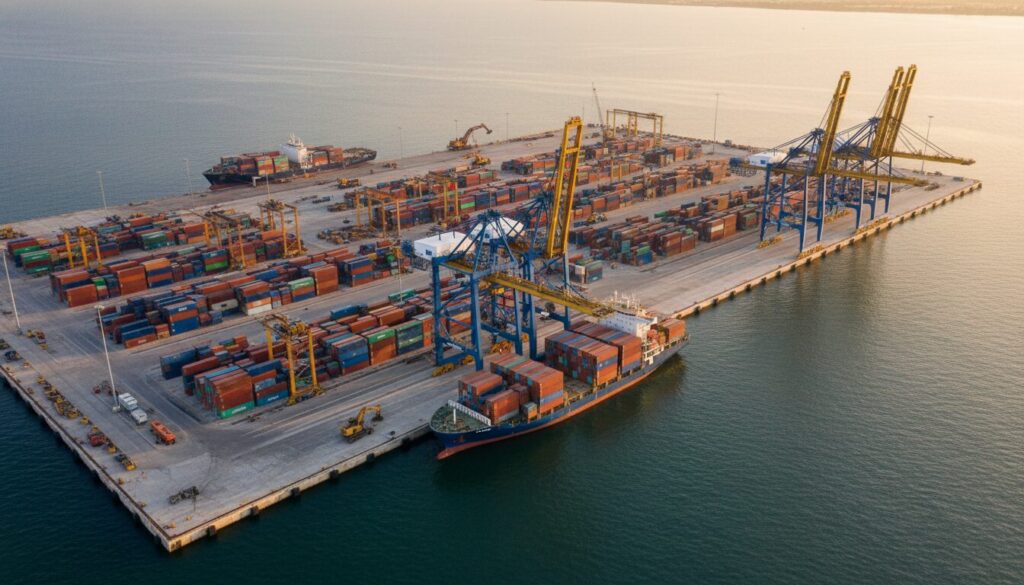
For global logistics strategists and infrastructure investors, the Mediterranean has always been a chessboard of high stakes. Yet, amidst the noise of established hubs like Valencia, Piraeus, and Gioia Tauro, a massive shift is occurring on the Southern rim. The recent announcement of a multinational $2.7 billion deal to develop the Misrata Free Zone in Libya represents more than just port expansion; it is a signal of a new era in cross-border infrastructure financing and supply chain resilience.
In a move that bypasses traditional state-budget reliance, Libya has secured a landmark Foreign Direct Investment (FDI) partnership involving Qatar, Italy, and the Swiss shipping giant MSC. This project aims to transform Misrata into a trans-Mediterranean heavyweight with a capacity of 4 million TEUs annually.
For executives in the US, EU, and Asia, this case study offers critical insights into the future of “frontier logistics” and the growing trend of private-public partnerships (PPPs) stabilizing volatile regions.
Why It Matters: The Strategic Mediterranean Revival
The logistics sector is currently undergoing a “Great Realignment.” The post-pandemic era, coupled with geopolitical tensions in the Red Sea and Eastern Europe, has forced supply chain leaders to seek redundancy. The Mediterranean Sea, handling approximately 15% of global shipping activity, is the pivot point for this realignment.
However, the North-South connectivity has historically been unbalanced, with European ports handling the bulk of value-added logistics. The Misrata deal challenges this status quo.
The Geopolitical Pivot
This $2.7 billion project is not occurring in a vacuum. It sits at the intersection of energy security and logistics strategy:
- Europe’s Energy Hunt: Italy, through its “Mattei Plan,” is aggressively seeking to turn Italy into an energy and logistics bridge between Africa and Europe. Strengthening Libyan infrastructure is essential for this.
- Gateway to Africa: Misrata is not just a destination; it is a gateway. With the African Continental Free Trade Area (AfCFTA) gaining traction, global shippers need efficient entry points to access landlocked Sub-Saharan markets (Chad, Niger).
- Bypassing Bottlenecks: As congestion plagues Northern European ports and the Suez Canal remains susceptible to regional flare-ups, a high-capacity terminal in the Central Mediterranean offers a necessary transshipment alternative.
Global Trend: Infrastructure Diplomacy and the “Corridor Wars”
To understand the magnitude of the Misrata deal, we must place it alongside similar trends occurring in the US, China, and Europe. We are witnessing a shift from purely commercial port development to “Infrastructure Diplomacy.”
The United States: The Lobito Corridor Model
The US has shifted its strategy in Africa from aid to infrastructure investment, exemplified by the Lobito Corridor in Angola.
- The Strategy: Linking the mineral-rich Copperbelt (DRC, Zambia) to the Atlantic Ocean via rail and port upgrades.
- The Goal: Securing critical supply chains for EV batteries while countering Chinese dominance.
- Relevance: Like Misrata, this relies on a consortium approach (US, EU, African Development Bank) to de-risk investment in a frontier market.
China: The Evolution of the Belt and Road (BRI)
China’s approach is evolving from massive greenfield loans to strategic asset acquisition.
- Case Study: COSCO Shipping’s majority stake in the Port of Piraeus (Greece).
- The Shift: China is now focusing on “small and beautiful” projects—high-yield, strategic logistics nodes rather than sprawling, debt-heavy infrastructure.
- Competition: The Misrata deal, backed by Qatar and Italy (with Swiss MSC), represents a rare instance of a major Mediterranean node being developed without primary Chinese financing, signaling a Western/Gulf counter-move.
Europe: The Global Gateway
The EU’s “Global Gateway” initiative aims to mobilize €300 billion by 2027.
- Focus: Sustainable transport corridors.
- Italy’s Role: Italy is positioning itself as the European hub for this initiative. The involvement of the Italian government in the Misrata deal aligns perfectly with Rome’s strategy to stabilize Libya through economic integration rather than just military aid.
Comparative Analysis: Global Port Investment Models
The following table contrasts the emerging Misrata model against established global norms.
| Feature | Chinese Model (BRI) | US/EU Model (Global Gateway/PGII) | The Misrata Model (Hybrid) |
|---|---|---|---|
| Primary Funding | State-backed Loans | Development Finance & Private Capital | Multinational FDI & Private Operator (MSC) |
| Operational Control | Often State-Owned Enterprise (e.g., COSCO) | Private Concessions | Hybrid: Free Zone Authority + Global Carrier (MSC) |
| Risk Tolerance | High (Sovereign Debt focus) | Medium (Requires Reforms) | High (project-finance based, bypassing state budget) |
| Strategic Goal | Export Markets & Political Leverage | Critical Minerals & Supply Chain Security | Regional Stability & Transshipment Dominance |
Case Study: Libya in Multinational $2.7 Billion Deal to Develop Misrata Zone
This project stands out as a masterclass in structuring a deal within a “fragile state” context. Despite Libya’s fragmented political landscape, the Misrata Free Zone (MFZ) has operated with relative autonomy and success, currently handling 60% of Libya’s non-oil trade.
The Deal Structure and Players
The consortium brings together three critical pillars: Capital, Political Cover, and Operational Expertise.
- The Capital (Qatar): Providing the financial muscle. Qatar has been a long-time stakeholder in Libyan stability and sees this as a diversification of its sovereign wealth portfolio.
- The Diplomacy (Italy): The Italian government’s backing provides the necessary political assurances and links the project to broader European supply chains.
- The Operator (MSC – Mediterranean Shipping Company): The Swiss giant is the linchpin. By committing to the project, MSC guarantees volume. This is not a “build it and they will come” project; the world’s largest container shipping line is effectively anchoring the demand.
Technical Ambitions and Capacity
The scope of the project is transformative for the North African coast.
- Investment Target: $2.7 Billion.
- Capacity Expansion: From current levels to 4 million TEUs (Twenty-foot Equivalent Units) annually.
- Revenue Projection: Expected operating revenue of $600 million per year.
Innovation in Financing: Bypassing the State Budget
The most innovative aspect for strategy executives to note is the funding mechanism.
- Fiscal Independence: Libya is plagued by disputes over the Central Bank and oil revenue distribution.
- The Solution: This project utilizes Foreign Direct Investment (FDI) directly into the Free Zone authority, bypassing the gridlocked central state budget.
- Result: It allows infrastructure development to proceed despite national political paralysis, creating a “pocket of efficiency.”
Operational Advantages
Misrata offers unique geographic advantages that MSC is keen to exploit:
- Deviation Distance: It requires minimal deviation from the main Suez-Gibraltar trunk line compared to other North African ports.
- Draft and Depth: The expansion plans include dredging to accommodate the latest generation of Ultra Large Container Vessels (ULCVs) exceeding 20,000 TEUs.
- Energy Costs: Access to cheap local energy for terminal operations and potential future cold-chain logistics.
Key Takeaways: Lessons for the Logistics Industry
For leaders in logistics and supply chain strategy, the Misrata deal offers distinct lessons on navigating the modern global market.
1. The “Operator-First” Investment Model is Superior
Infrastructure projects where the primary user (in this case, MSC) is a co-investor significantly de-risk the venture. For executives, this means looking for infrastructure opportunities where major carriers like Maersk, CMA CGM, or MSC have skin in the game.
2. Resilience Requires “Friend-Shoring” in Non-Traditional Regions
“Friend-shoring” is not just about moving factories to Mexico or Vietnam. It involves securing logistics nodes in regions that are geographically critical, even if politically complex. The Italy-Qatar alliance demonstrates how multinational coalitions can stabilize these nodes.
3. Free Zones as Autonomous Economic Engines
The success of the Misrata Free Zone highlights the power of Special Economic Zones (SEZs) to function independently of central government dysfunction.
- Strategy Tip: When assessing market entry into volatile regions, look for empowered SEZs rather than relying on national-level infrastructure.
4. The Rise of the “Med-African” Gateway
Supply chain executives must redraw their maps. The Mediterranean is no longer just a sea that separates Europe and Africa; it is becoming a connective tissue. Companies should evaluate distributing inventory in North African hubs to serve both Southern Europe and emerging African markets, leveraging lower labor and energy costs.
Future Outlook
What lies ahead for the Misrata project and the broader region?
The Green Hydrogen Nexus
The long-term play for Misrata is likely not just containers, but energy. As Europe demands Green Hydrogen, North Africa is positioned to be the primary supplier. A developed port infrastructure is the precursor to exporting hydrogen derivatives (ammonia/methanol).
- Prediction: Within 5 years, we will see amendments to this deal including dedicated terminals for green energy exports to Italy and Germany.
The Transit Trade to the Sahel
The “trans-Saharan” route remains the holy grail of African logistics. If Misrata achieves its 4 million TEU capacity, it will aggressively compete to be the primary sea access for landlocked Chad and Niger, potentially displacing traditional routes through West Africa (Nigeria/Benin) which are plagued by congestion and piracy.
Risks to Watch
While the deal bypasses the state budget, it cannot fully bypass politics.
- Security: The stability of the approach roads to Misrata is vital.
- Rivalry: How will competing powers (specifically Eastern Libyan factions or other external actors like Russia/Turkey) react to this Italo-Qatari dominance in the West?
Conclusion
The Libya in multinational $2.7 billion deal to develop Misrata zone is a definitive case study in modern logistics resilience. It combines the financial heft of sovereign funds, the strategic imperative of European governments, and the operational dominance of private shipping giants.
For the global logistics community, this project proves that with the right structure, high-value infrastructure can rise even in the most challenging geopolitical environments. As the map of global trade is redrawn, Misrata is positioning itself to be a permanent ink spot on the Mediterranean route.