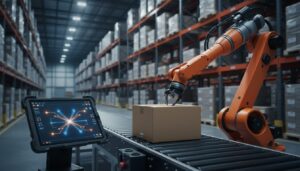
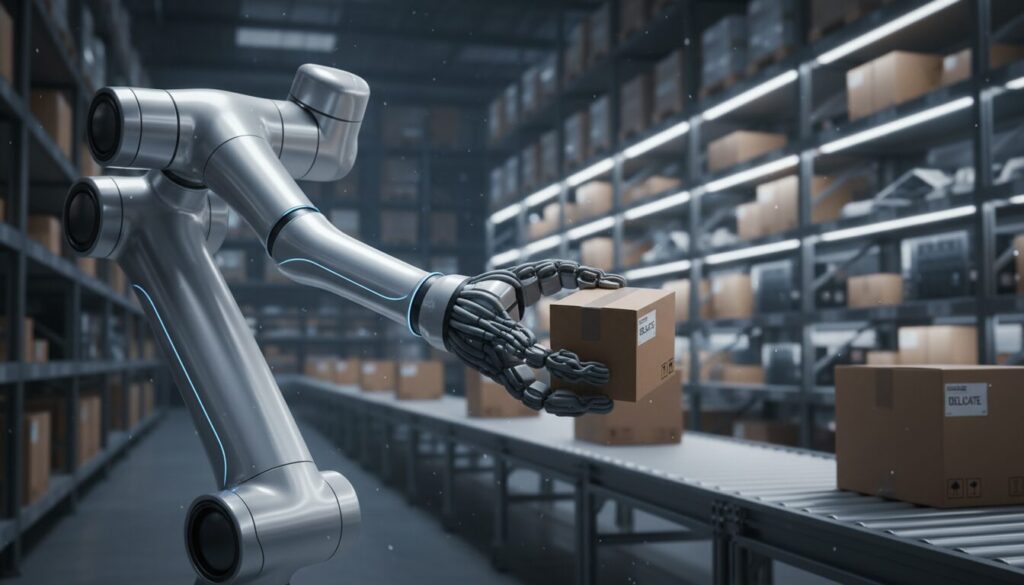
The logistics sector is currently facing a perfect storm. Operations leaders are grappling with an unprecedented labor shortage, skyrocketing warehouse costs, and consumer demands for faster, more accurate delivery. For years, automation has been the proposed solution. Yet, traditional industrial robots—rigid, jerky, and confined to safety cages—have often failed to handle the delicate, variable tasks required in modern fulfillment centers.
If you have ever watched a robot struggle to grasp a oddly shaped package or pause awkwardly between movements, you are witnessing the limitations of legacy programming. However, a revolution is underway.
This article decodes the engineering and artificial intelligence breakthroughs enabling the new wave of agile automation. We will explore how “fluidity” is achieved and why it is the missing link for scalable, cost-effective logistics operations.
The Hidden Technology Behind Fluid Robot Motion Explained
When we speak of “fluid robot motion,” we are not just talking about aesthetics. In logistics, fluidity equates to speed, energy efficiency, and the ability to handle fragile inventory without damage.
The “hidden technology” is not a single component, but a convergence of advanced hardware and cutting-edge software known as Embodied AI. It moves beyond simple coordinate programming to dynamic, physics-based interaction.
1. The “Brain”: Motion Planning and World Models
Traditionally, robots were programmed with explicit waypoints: “Move to X, then Y, then Z.” This results in robotic, stop-and-go movement.
The new standard relies on Motion Planning Algorithms and World Models. Instead of following a strict script, the robot acts like a human. It perceives its environment, predicts the physics of objects, and calculates a smooth trajectory in real-time.
- Inverse Kinematics (IK): The mathematical process of calculating the variable joint angles needed to place a robot hand in a specific position. Advanced solvers now do this in milliseconds, allowing continuous movement.
- World Models: As discussed in our analysis of the 1X World Model: Critical Shift for Logistics AI, robots are shifting from rigid programming to “teaching.” By simulating the physical world, the robot anticipates the weight and friction of a parcel before touching it, resulting in a confident, fluid grab rather than a tentative, jerky one.
2. The “Nervous System”: Proprioception and Sensors
Fluid motion requires constant feedback. Just as you know where your hand is without looking at it (proprioception), modern logistics robots utilize high-frequency data loops.
- Torque Sensors: Located in the joints, these measure the force being applied. If a robot encounters unexpected resistance (e.g., a jammed box), it “feels” it immediately and adjusts its force, preventing damage.
- Vision Systems (Lidar/Depth Cameras): These act as the eyes, updating the motion planner instantly if an obstacle (like a human worker) enters the path.
3. The “Muscle”: Compliance and Actuation
Old industrial robots were “stiff.” If you pushed them, they wouldn’t budge until they broke. Fluid motion relies on Compliant Actuation.
- Series Elastic Actuators (SEA): These contain springs or elastic elements. They absorb shock and allow the robot to move with a natural “bounce” or flexibility, similar to human muscle tendons.
- Back-drivability: This feature allows the robot’s motors to be moved by external force. It is essential for safety and smoothness, allowing the robot to “go with the flow” rather than fighting physics.
Why Now? The Convergence of AI and Hardware
Why is this technology emerging as a standard in 2025? The logistics industry is undergoing a massive Digital Transformation (DX), driven by the necessity to handle high-mix, low-volume orders.
The Shift from Repetition to Adaptability
In the past, robots were excellent at welding a car door in the exact same spot 1,000 times. In a warehouse, however, no two packages are identical.
The market demand has shifted towards Human-Centric Automation. We need robots that can navigate narrow aisles, reach into disorganized bins, and collaborate with humans.
Industry Insight: The partnership between UR, Robotiq & Siemens highlights this shift. By combining standard robotic arms with AI-driven path planning, warehouses are moving toward dynamic, predictive logistics where the robot adjusts its motion based on pallet stability and box size in real-time.
The Rise of the “Data Factory”
Fluid motion is learned, not just coded. This learning requires massive datasets of human movement. Companies are now capturing human motion data to train robots, essentially transferring human dexterity into machine form.
For a deeper dive into how human movement data is powering this revolution, read about Noitom Robotics: The Data Engine for Logistics Humanoids. This approach dramatically shortens the time it takes to deploy a robot that moves smoothly.
Quantitative and Qualitative Benefits
Adopting robots capable of fluid motion is not just about having “cool-looking” tech. It directly impacts the bottom line.
Comparison: Rigid vs. Fluid Motion in Logistics
| Feature | Traditional Rigid Motion | Fluid / Adaptive Motion | Impact on Logistics |
|---|---|---|---|
| Cycle Time | Stop-and-go (Slow) | Continuous trajectory (Fast) | 20-30% increase in pick rates |
| Product Safety | High grip force, rigid impact | Force feedback, soft touch | Reduced breakage/shrinkage |
| Energy Use | High acceleration/braking spikes | Momentum conservation | Lower energy costs |
| Safety | Requires safety cages | Collaborative (Cobot) safe | Floor space optimization |
1. Maximized Throughput
Fluid motion eliminates the micro-pauses between movements. An arm that curves smoothly from a conveyor to a pallet moves faster than one that moves in straight lines with stops at every corner. Over a 24-hour shift, these saved milliseconds compound into thousands of additional picks.
2. Reduced Maintenance Costs
Jerky motion creates mechanical stress. The sudden starts and stops wear out gears and motors. Fluid motion, by definition, manages acceleration and deceleration smoothly, significantly extending the lifespan of robotic hardware.
3. Scalable Deployment
Because these systems use AI and vision to understand their environment, they require less hard-coding. This means a robot can be moved from a palletizing station to a kitting station with minimal reprogramming.
Real-world applications are already scaling up. For instance, Schaeffler Deploys Hundreds of Humanoids, proving that this technology is ready for mass industrial adoption, not just R&D labs.
Implementation: Integrating Fluid Motion Technology
For operations leaders, the challenge is not building the robot, but integrating it into an existing ecosystem. Here are the key steps for successful implementation.
Step 1: Define the “Zone of Fluidity”
Identify processes where variability is high. Rigid robots are fine for consistent palletizing, but fluid motion technology is best ROI-positive in:
- Bin picking (e-commerce fulfillment).
- Trailer unloading (loose loaded boxes).
- Kitting and assembly.
Step 2: Proof of Concept (PoC) with Simulation
Before physical installation, use Digital Twins. Simulate the fluid motion algorithms in a virtual replica of your warehouse. This allows you to verify cycle times and collision avoidance without disrupting operations.
This step is critical for risk management. For a structured approach, refer to the 5 Steps to Industrialize Humanoids via Siemens PoC Guide.
Step 3: Data Infrastructure
Fluid robots are data-hungry. Ensure your warehouse has the Wi-Fi bandwidth (or 5G private network) to support real-time communication between the robot’s sensors and the central Warehouse Management System (WMS).
Step 4: Employee Training
The transition to fluid, collaborative robots requires a culture shift. Workers need to understand that these machines are “aware” and safe to work alongside. Training should focus on how to collaborate with the robot, rather than just how to operate it.
Conclusion
The hidden technology behind fluid robot motion is transforming logistics from a rigid, mechanical process into a dynamic, adaptive ecosystem. By combining advanced sensors, AI-driven world models, and compliant actuation, warehouses can achieve levels of efficiency and flexibility that were previously impossible.
For logistics executives, the question is no longer “Should we automate?” but “How fluid is our automation?”
Recommended Next Steps:
- Audit your current bottlenecks: Look for tasks where rigid automation has failed or where human dexterity is currently the only option.
- Investigate AI-driven motion controllers: Talk to your integrators about “Embodied AI” and “force-torque sensing” capabilities.
- Start a PoC: Select a single high-variability station and test a fluid-motion robot solution.
The era of the “clunky” robot is ending. The era of the fluid, intelligent logistics partner has arrived.