
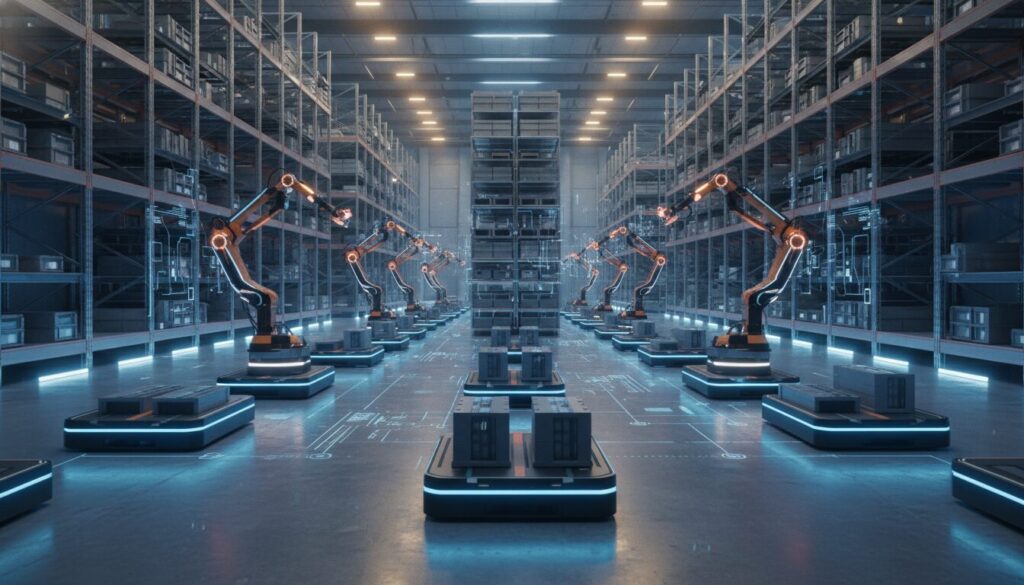
The era of robotic “pilot purgatory” is ending. For years, global logistics hubs have tested Autonomous Mobile Robots (AMRs) in isolation—one vendor for pallets, another for bin-picking, and a third for cleaning. The result? A fragmented ecosystem of “islands of automation” that refuse to talk to one another.
This fragmentation is the specific problem addressed by the recent news that Botsync brings in investment from SGInnovate to continue scaling robots, software, and orchestration capabilities across the Asia Pacific (APAC) and into the US and European markets.
As a Global Logistics Trend Watcher, I view this Series A funding not just as a win for a Singaporean startup, but as a signal flare for the industry. The focus has shifted from hardware acquisition to software orchestration.
Why It Matters: The Shift to Interoperability
The global supply chain is currently navigating a transition from “adoption” to “integration.” In the early 2020s, the priority was simply getting robots onto the floor to mitigate labor shortages. Today, the challenge is managing a mixed fleet of robots from different manufacturers (Ford, Geek+, Omron, MiR, etc.) under one roof.
Botsync’s success in securing funding from SGInnovate highlights three critical shifts in the global logistics strategy:
- Vendor Agnosticism is Essential: Enterprises like Caterpillar and Nestle operate globally. They cannot be tied to a single robot vendor that may not have support coverage in every region. They need a software layer that manages any robot.
- Brownfield Deployment: Most warehouses are not brand new. Automation must fit into existing, messy environments without requiring a complete infrastructure rebuild.
- Data Unification: Without a central operating system (SyncOS), data remains siloed in proprietary dashboards, making holistic optimization impossible.
This shift mirrors the trends we analyzed recently regarding software-defined logistics. The value is migrating from the metal chassis of the robot to the code that directs it.
See also: Mytra’s $120M Round: The Shift to Software-Defined Logistics
Global Trend: The Race for Orchestration Standards
While Botsync is making waves from Singapore, the drive for interoperability varies significantly across major economic zones. Understanding these regional nuances is crucial for strategy executives planning global rollouts.
United States: The Labor-Driven Integrator Market
In the US, the primary driver is the labor shortage. Companies are deploying robots faster than IT teams can integrate them. Consequently, the US market is seeing a surge in “Third-Party Fleet Management” solutions. The focus here is less on standardization protocols and more on API-based “plug-and-play” capabilities that offer immediate ROI.
Europe: The Standardization Heavyweight (VDA 5050)
Europe, particularly Germany, is taking a standards-first approach. The VDA 5050 interface standard is gaining traction, allowing AGVs and AMRs to communicate with a master control system regardless of the manufacturer. European innovation leaders are prioritizing compliance with these standards to ensure long-term viability and safety.
Asia Pacific (China & SEA): High Volume, High Speed
China dominates in hardware production volume. However, the software landscape has historically been fragmented with proprietary “walled gardens.” The trend in APAC, led by hubs like Singapore (and companies like Botsync), is to bridge the gap between low-cost Asian hardware and high-level Western enterprise software (WMS/ERP).
Comparison of Global Automation Maturity
| Feature | United States | Europe | Asia Pacific (APAC) |
|---|---|---|---|
| Primary Driver | Labor Shortage & Speed | Standardization (VDA 5050) | Cost Efficiency & Scale |
| Integration Style | API/Middleware heavy | Protocol/Standard heavy | Hardware-bundle focused |
| Key Challenge | Legacy WMS integration | Strict Safety/GDPR regs | Multi-vendor fragmentation |
| Trend Watch | Rise of RaaS (Robots as a Service) | Interoperable Fleets | Cross-border Orchestration |
Case Study: Botsync’s Scalable Success
Botsync’s recent Series A funding, led by deep tech investor SGInnovate, is a validation of their “SyncOS” platform. This case study offers a blueprint for how mid-to-large enterprises can approach automation scaling.
The Company Profile
- Company: Botsync
- HQ: Singapore
- Key Product: SyncOS (No-code orchestration platform).
- Key Clients: Ford, Caterpillar, Nestle, Coca-Cola.
- Growth Metrics: 230% revenue growth; 240% increase in production trips.
- Target: 1 million live trips by 2025.
The Problem: The Integration Bottleneck
Major global brands like Ford and Coca-Cola face a common dilemma: they have facilities worldwide using different robotic vendors based on local availability. One site might use Omron, another MiR. Integrating these into a corporate SAP or Oracle system traditionally requires months of custom coding for each integration.
The Solution: SyncOS and “No-Code” Integration
Botsync’s value proposition lies in removing the coding barrier. SyncOS acts as a universal translator.
- Vendor Neutrality: It connects to the APIs of various robot brands.
- WMS Bridging: It serves as the middleware between the robots and the Warehouse Management System (WMS).
- No-Code Interface: Operations managers can change workflows (e.g., “Move pallet A to Zone B”) without calling a software engineer.
The Results
The impact of this approach is measurable. Botsync reported a 230% revenue growth and a 240% increase in production trips. By targeting 1 million live trips by 2025, they are moving beyond pilot programs into mission-critical logistics operations.
Their strategic expansion into the U.S., Australia, and South Africa suggests that these markets have reached a saturation point with hardware and are now desperate for the software layer to manage it.
For companies looking to achieve similar growth, understanding the link between automation and strategic expansion is vital.
See also: Automation — A Strategic Growth Enabler: The Ultimate Guide
Key Takeaways for Innovation Leaders
What can Strategy Executives and Logistics Directors learn from the Botsync investment news?
1. Avoid “Vendor Lock-In” at All Costs
When selecting AMR vendors, prioritize those with open APIs. If a robot manufacturer refuses to integrate with third-party orchestrators like SyncOS or standards like VDA 5050, they are a risk to your long-term supply chain resilience.
2. The “No-Code” Revolution is Operational, Not Just Technical
The ability for floor managers to adjust robotic workflows without IT intervention is a game-changer. It increases agility. If a loading dock changes or a conveyor breaks, the operation can adapt in minutes, not weeks.
3. Metric Visibility is the Key to Scale
Botsync’s focus on “production trips” as a metric is telling. It’s not about how many robots you have; it’s about how many successful trips they complete. Leaders must shift their KPIs from asset ownership to asset utilization.
To properly measure this success, you need a rigorous framework for tracking performance before and after deployment.
See also: How to Track Before-and-After Automation Metrics in 5 Steps
4. Brownfield is the Battlefield
Innovation isn’t just for new “Gigafactories.” The real ROI lies in retrofitting existing warehouses. Botsync’s Magni robots and SyncOS are designed to work in environments that weren’t built for robots. This “adaptability” is a critical criteria for vendor selection in 2025 and beyond.
Future Outlook: The Orchestrated Supply Chain
The investment from SGInnovate into Botsync is part of a larger narrative: The commoditization of hardware and the valuation of intelligence.
As we look toward 2026 and beyond, we expect:
- Consolidation of Fleet Management: We will see more M&A activity where WMS providers acquire orchestration platforms to offer a “unified logistics stack.”
- Predictive Orchestration: Platforms like SyncOS will evolve from “managing” traffic to “predicting” it, using AI to pre-position robots before orders are even released from the WMS.
- Global Standardization: The gap between European standards and US/Asian agility will close, likely through middleware solutions that translate between protocols automatically.
For logistics leaders, the message is clear: Stop buying robots in isolation. Start investing in the ecosystem that makes them work together.
If you are struggling to scale your operations without tearing down your current infrastructure, consider how software-first strategies can improve accuracy and throughput.
See also: 5 Steps to Scale Accuracy Without Rebuilding Operations