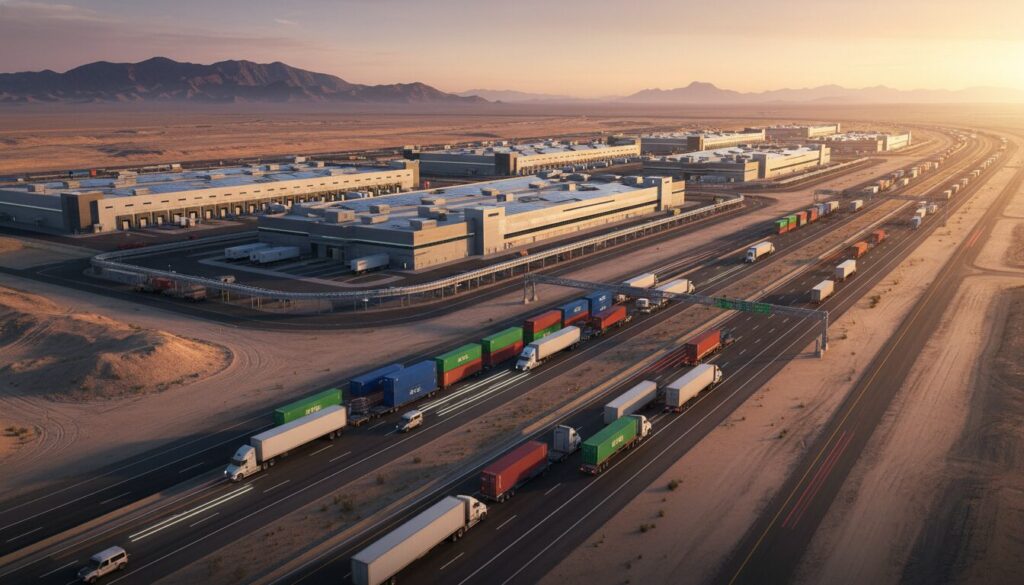
The corridor between the United States and Mexico—often referred to as the “Borderlands”—has evolved from a simple trade route into one of the most complex and volatile logistics environments in the world. As nearshoring accelerates, the infrastructure connecting these two economies is straining under the weight of increased volume, fluctuating tariffs, and rising carrier costs.
For global innovation leaders and strategy executives, the Borderlands is no longer just a regional concern; it is a testing ground for the future of cross-border logistics. The traditional model of relying on a single legacy carrier is collapsing. In its place, a new, dynamic ecosystem is emerging—defined by automated rate shopping, aggressive new market entrants like Cainiao, and asset-heavy specialists like Speedora.
This article explores how volatile trade and rising costs are reshaping shipping strategies in the Borderlands, offering a blueprint for global supply chain resilience.
Why It Matters: The Global Context of the Borderlands
The volatility seen at the US-Mexico border is a microcosm of broader global trade friction. Whether it is the post-Brexit complications in the UK-EU corridor or the shifting manufacturing hubs in Southeast Asia, the core challenge remains the same: How do you maintain speed and margins when borders become “thicker” due to tariffs and congestion?
The era of predictable, static shipping contracts is over. As discussed in our analysis of Borderlands Mexico: 2026 Tariff Noise & Resilience Strategy, political and economic friction is forcing companies to abandon “set it and forget it” logistics.
For executives, the stakes are high:
- Margin Erosion: Rising carrier costs are eating into the profitability of nearshored goods.
- Customer Experience: Inconsistent delivery times in cross-border trade lead to lower conversion rates and higher churn.
- Strategic Agility: Companies locked into rigid single-carrier agreements lack the flexibility to pivot when capacity tightens or rates spike.
The industry is currently witnessing a pivotal shift from Cost-Centric strategies (seeking the absolute lowest rate regardless of risk) to Value-Centric strategies (balancing speed, reliability, and cost).
Global Trend: The Rise of Automated, Multi-Carrier Ecosystems
Across the US, China, and Europe, the dominant trend in logistics is the move toward Automated Diversity.
1. The Breakdown of Single-Source Reliance
In the past, a US retailer importing from Mexico might have exclusively used a major integrator (like UPS or FedEx) for end-to-end service. Today, that model is proving too expensive and too fragile.
- In the US: Retailers are adopting “rate shopping” software that compares carriers in real-time for every single package, selecting the best option based on current constraints.
- In China: The ecosystem has long been fragmented and hyper-competitive. Chinese logistics giants are now exporting this model to the Americas.
- In Europe: Multi-carrier parcel lockers and PUDO (Pick-up Drop-off) networks are the norm, driven by sustainability and cost.
2. The DDP (Delivery Duties Paid) Imperative
With tariff rules in flux—a topic we covered in Trump Admin Clarifies Tariff Refund Scope: Global Impact—merchants are prioritizing DDP solutions.
Merchants are shifting to automated tools that calculate and collect duties at checkout. This ensures that the end consumer is not surprised by hidden fees upon delivery, a critical factor in maintaining conversion rates for cross-border e-commerce.
3. Structural Volatility as a Constant
As noted in our article on 5 Supply Chain Management Trends 2026: New Strategy, structural volatility is the new normal. The winners are those who build optionality into their networks. This means having a mix of low-cost carriers, premium “white glove” services, and asset-light aggregators active simultaneously.
Case Study: Disruption in the Corridor (Cainiao vs. Speedora)
The transformation of the Borderlands shipping strategy is best illustrated by two distinct, yet complementary, innovations occurring simultaneously: the aggressive entry of Chinese tech giants and the rise of specialized regional asset owners.
Disruption A: The Low-Cost Aggressor – Cainiao
Cainiao, the logistics arm of Alibaba Group, has aggressively entered the Mexican market, challenging legacy incumbents with a model built on extreme efficiency and technology.
- The Strategy: Cainiao is applying its “global 72-hour delivery” vision to the Americas. By establishing a self-operated network rather than relying solely on third-party handoffs, they have dramatically lowered overhead.
- The Impact:
- Cost: Cainiao’s cross-border service is priced at approximately 60% of the market average.
- Coverage: Their self-operated network now covers 99% of Mexico, challenging the notion that low cost means limited reach.
- Implication: This forces US retailers and logistics providers to re-evaluate their pricing structures. If a competitor can ship from Shenzhen to Mexico City faster and cheaper than a US brand can ship from Los Angeles to Guadalajara, the competitive landscape shifts seismicly.
Disruption B: The Asset-Owned Specialist – Speedora
While Cainiao targets volume and cost, regional players like Speedora are targeting the “quality gap,” particularly for big-and-bulky items where service failures are common.
- The Problem: Cross-border shipping often involves multiple handoffs. For large items (furniture, appliances), these handoffs result in damage and delays. Brokers often lack accountability because they don’t own the trucks.
- The Solution: Speedora is launching an asset-owned ‘white-glove’ fleet focusing on Arizona and California.
- The Strategy: By owning the trucks and employing the drivers, Speedora ensures “last-mile accountability.” They are not competing on the lowest rock-bottom price; they are competing on reliability.
- Implication: This validates the shift toward asset-based Digital Transformation (DX). Technology alone isn’t enough; sometimes you need to own the wheels to guarantee the service.
Strategic Comparison: Choosing the Right Tool
The table below illustrates how modern supply chain leaders are segmenting their volume between these emerging models vs. traditional carriers.
| Feature | Legacy Carriers (Integrators) | Emerging Disruptors (e.g., Cainiao) | Asset-Specialists (e.g., Speedora) |
|---|---|---|---|
| Primary Value Prop | Reliability & Brand Trust | Cost Efficiency & Speed | Control & Service Quality |
| Pricing Model | High (Premium) | ~60% of Market Average | Mid-to-High (Value-based) |
| Asset Model | Heavy Asset Ownership | Tech-First / Hybrid | Asset-Owned (Targeted) |
| Best Use Case | Urgent, High-Value Docs/Parcels | High Volume E-commerce | Big & Bulky, White Glove |
| Technology | Legacy Systems (Slow to adapt) | AI-Native / Automated | DX-Enhanced Fleet Ops |
Key Takeaways: Lessons for the Logistics Industry
The changes in the Borderlands offer critical lessons for global logistics leaders.
1. Diversification is No Longer Optional
Reliance on a single carrier is a single point of failure. The most resilient supply chains now utilize Automated Rate Shopping to dynamically allocate volume.
- Action: Implement multi-carrier management software that can switch between a low-cost provider (like Cainiao) for standard goods and a specialist (like Speedora) for sensitive freight instantly.
- See also: Alternative Delivery Networks: Competing with Big Carriers.
2. “Best Value” Trumps “Lowest Cost”
While Cainiao’s 60% price point is attractive, the trend among innovation leaders is not a race to the bottom. It is a race to conversion preservation.
- If a cheap carrier loses the package, the customer is lost forever.
- Strategy is shifting toward paying a premium for asset-owned carriers when the delivery experience is part of the brand promise (e.g., furniture installation).
3. Data Visibility is the New Currency
To manage a multi-carrier strategy effectively, data visibility is paramount. Merchants are investing in DDP tools to manage margin risk. Knowing the exact landed cost—including tariffs and last-mile surcharges—before the label is printed is the only way to protect margins in a volatile trade environment.
Future Outlook
The reshaping of shipping strategies in the Borderlands is just the beginning. As we look toward 2026 and beyond, we anticipate three major developments:
1. The “Tex-Mex” Logistics Hub Maturation
The border region (Texas, Arizona, Northern Mexico) will evolve into a sophisticated logistics super-hub comparable to the Greater Bay Area in China. This will attract further investment in automated warehousing and cross-docking facilities.
2. Capacity Constraints will Drive Innovation
As discussed in 2026 Trucking Capacity: Why It Tightens & Who Wins, the tightening of trucking capacity will favor shippers who have already diversified their networks. Those still relying on spot markets or single carriers will face severe service disruptions.
3. AI-Driven Carrier Selection
We expect the next generation of logistics platforms to use predictive AI not just to shop for rates, but to predict border congestion. These systems will automatically route shipments away from congested ports of entry or delayed carriers before the human manager is even aware of the problem.
Conclusion
The US-Mexico Borderlands are a crucible for global logistics innovation. The volatility here is forcing a rapid evolution from static, legacy models to dynamic, multi-carrier strategies. Whether through the cost-disruption of players like Cainiao or the service-assurance of asset-owners like Speedora, the message is clear: Agility is the only insurance against volatility.
For strategy executives, the time to audit your carrier mix and technological capabilities is now. The future belongs to those who can seamlessly toggle between cost, speed, and service in real-time.