
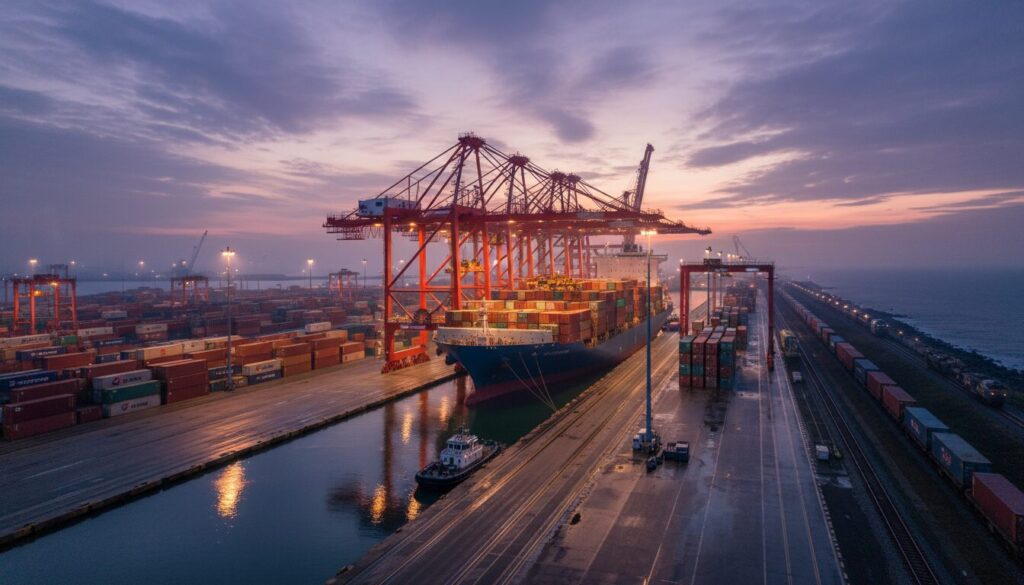
The monolithic trade wall surrounding North America has developed a strategic breach. In a move that signals a significant divergence from Washington’s protectionist trajectory, Canada has pivoted toward a “pragmatic foreign policy,” securing a trade truce with Beijing.
For global logistics leaders and strategy executives, this is more than political headline news; it is a signal that the North American supply chain is no longer a uniform regulatory bloc. Led by Prime Minister Mark Carney, Ottawa has negotiated a drastic reduction in tariffs, effectively creating a distinct “Maple Lane” for specific Chinese goods—primarily Electric Vehicles (EVs) and agriculture—that bypasses the volatility of the Trump administration’s trade war.
This article analyzes the logistics implications of this rupture, offering a case study on how companies are navigating this new geopolitical arbitrage.
Why It Matters: The Fracture of North American Unanimity
For the past decade, the dominant strategy for global supply chains was “Nearshoring to North America.” The assumption was that the US, Canada, and Mexico acted as a synchronized fortress against Asian imports, solidified by the USMCA (CUSMA).
However, as discussed in our analysis of Borderlands Mexico: 2026 Tariff Noise & Resilience Strategy, friction between the US and its neighbors is creating independent trade policies. Canada’s decision to break from the US-aligned containment strategy introduces a new variable: Regulatory Decoupling.
Key Shifts in the Agreement:
- EV Tariffs: Slashed from 100% to 6% (capped at 49,000 units/year).
- Agriculture: Chinese tariffs on Canadian canola/rapeseed dropping from 85% to 15% by March 1.
- Duration: Duty suspensions on lobsters and canola meal locked in through the end of 2026.
For logistics managers, this means Canada can no longer be treated simply as a northern extension of the US market. It is now a distinct entry point with its own favorable terms for Asian goods, provided those goods remain within Canadian borders.
Global Trend: The Rise of “Multi-Aligned” Supply Chains
While the US doubles down on isolationism and the EU pursues “Strategic Autonomy,” middle-power nations like Canada, Brazil, and Vietnam are adopting “Multi-Alignment.” They are hedging against US volatility by maintaining open channels with China.
This trend forces logistics networks to move from a Hub-and-Spoke model (centered on the US) to a Distributed Node model.
Comparative Tariff Regimes: Chinese EVs (2026)
The following table illustrates the stark divergence in tariff policy across major Western markets, highlighting Canada’s new position as a “soft landing” zone for Chinese OEMs compared to the US and EU.
| Feature | United States (Trump Admin) | European Union | Canada (Carney Admin) |
|---|---|---|---|
| Primary Tariff Rate | 100% + Section 301 Duties | 17% – 38% (Variable CVD) | 6% (Quota-based) |
| Strategic Goal | Total Exclusion | Level Playing Field | Inflation Reduction & Adoption |
| Import Quotas | None (Ban effective via tariff) | None | 49,000 Units/Year |
| Supply Chain Impact | Zero direct flow; nearshoring required. | Complex bond warehousing; selective entry. | Resumed direct shipping lanes from Shanghai/Shenzhen. |
Case Study: Tesla and The “Shanghai-Vancouver” Corridor
To understand the practical application of this policy shift, we examine Tesla and the Canadian agricultural giant Richardson International. These examples demonstrate how import and export logistics must adapt to the new regulatory environment.
The Import Angle: Tesla’s Model Y Logistics
Before the US-aligned 100% tariff was threatened, Tesla utilized its Gigafactory Shanghai to supply the Canadian market with Model Y and Model 3 units. This route was cost-effective compared to shipping from Fremont, California, or Austin, Texas, due to lower production costs in China.
When Canada initially mirrored the US 100% tariff, this logistics lane froze. Tesla was forced to reallocate US-made inventory to Canada, straining North American domestic capacity.
The Post-Truce Strategy:
With the new agreement allowing 49,000 Chinese EVs at a 6% duty, Tesla can reactivate the Shanghai-to-Vancouver shipping lane.
- Quota Management: Logistics planners must now track specific VINs against the 49,000-unit national quota. Once the cap is hit, the tariff reverts to 100%.
- Inventory Segregation: Vehicles imported under this truce are strictly for Canadian consumption. Rules of Origin (ROO) under USMCA prevent these cars from being re-exported to the US duty-free.
- Cost Advantage: By utilizing the 6% rate, Tesla stabilizes pricing in Canada, maintaining market share against competitors like Hyundai and emerging Chinese entrants like BYD, who are also eyeing the quota.
The Export Angle: Richardson International (Canola)
On the outbound side, the “rupture” with the US has saved Canada’s western logistics network. China had imposed an 85% retaliatory tariff on Canadian canola (rapeseed), effectively halting bulk carrier traffic from the Port of Vancouver.
The Logistics Pivot:
- Previous State: Exporters like Richardson International and Viterra were forced to find alternative, lower-margin markets or store excess grain, creating warehousing bottlenecks in Saskatchewan and Alberta.
- New State (March 1 onward): With the tariff dropping to 15%, bulk freight bookings from Vancouver to Chinese ports (e.g., Dalian, Qingdao) are surging.
This requires a rapid reallocation of rolling stock (rail cars) from US-bound routes back to West Coast ports. Supply chain directors in the ag-sector are now prioritizing rail fluidity to meet the March 1 tariff reduction deadline.
Key Takeaways: Lessons for Logistics Leaders
The Canada-China truce is a textbook example of why political agility is now a supply chain necessity. Here are the core lessons for strategy executives:
1. Implement “Geopolitical SKU Differentiation”
You can no longer treat North America as a single SKU region. Products destined for Canada may now have a completely different optimal sourcing origin (China) than identical products destined for the US (Mexico/Vietnam).
- Action: Update ERP systems to flag “Canada-Only” inventory that benefits from reduced tariffs but carries re-export restrictions.
2. Hedge Against “Bloc Volatility”
Reliance on a single trade bloc (e.g., USMCA) is risky. Canada’s pivot proves that even close allies will break ranks to protect their economic interests.
- Action: Diversify logistics corridors. Ensure you have active contracts with carriers capable of servicing both trans-Pacific (China-Canada) and cross-border (Mexico-US) routes. For broader strategies on this, see our guide on 5 Supply Chain Management Trends 2026: New Strategy.
3. Master the Quota Game
The 49,000 EV cap introduces a “race to the port” dynamic. Logistics speed is now directly tied to tax savings.
- Action: For quota-limited goods, prioritize Expedited Ocean Freight or air cargo early in the fiscal year to clear customs before the low-tariff quota is exhausted.
Future Outlook: The 2026 Horizon
While this truce offers stability for Canadian importers, it introduces friction with Washington. The Trump administration may view Canada’s “back door” for Chinese goods as a violation of the spirit of North American unity.
What to Watch:
- Transshipment Enforcement: Expect the US Customs and Border Protection (CBP) to intensify inspections of goods crossing from Canada to the US to ensure Chinese content isn’t leaking south.
- USMCA Review: This truce sets the stage for a contentious review of the USMCA.
- Tariff Refunds: As legal battles over tariffs continue, companies should remain vigilant regarding duty recovery opportunities. See: Trump Admin Clarifies Tariff Refund Scope: Global Impact.
The Bottom Line: Canada has chosen a path of independent economic pragmatism. For global supply chains, this creates complexity, but also opportunity. The winners will be those who can manage dual supply chains—one for the fortress US, and one for the globalized Canadian market.