
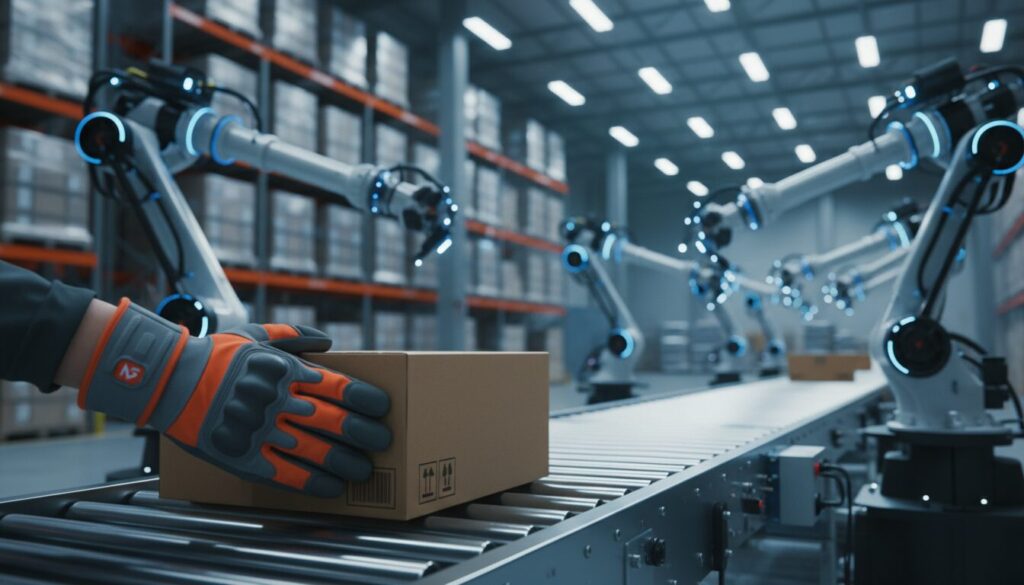
The narrative of the current industrial revolution has been dominated by Artificial Intelligence (AI) and its potential to automate white-collar tasks. However, a critical counter-narrative is emerging from the logistics and supply chain sectors: while AI can predict demand, it cannot yet fully replace the physical dexterity and complex decision-making required on the shop floor.
Indian startup Emversity’s recent $30 million Series A funding serves as a significant market signal. By doubling its valuation to $120 million, investors are betting heavily on the “grey-collar” workforce—roles in manufacturing, healthcare, and logistics that require specialized skills but are resistant to full AI automation. For logistics executives grappling with a chronic global labor shortage, Emversity’s rise represents a pivotal shift from merely “hiring” bodies to “engineering” a skilled talent pipeline.
The Facts: Emversity’s Strategic Expansion
Emversity operates at the intersection of edtech and workforce development. Unlike traditional vocational training, it integrates directly with universities to create degree programs tailored to specific industry needs.
Below is a breakdown of the key developments surrounding this funding round:
| Category | Details |
|---|---|
| Entity | Emversity (Indian Workforce Development Startup) |
| Funding | $30 Million Series A (Led by Premji Invest) |
| Valuation | $120 Million (Doubled from previous valuation) |
| Target Roles | “AI-Resistant” Grey-Collar Jobs: Healthcare, Hospitality, Manufacturing, EPC (Engineering, Procurement, Construction) |
| Business Model | B2B2C: Employer-designed curricula embedded in 23 universities across 40+ campuses. |
| Financial Health | Maintains ~80% gross margins via organic student acquisition (social media/partnerships). |
| Strategic Goal | To bridge the skills gap in India and supply labor to aging markets (Japan, Germany, Middle East). |
The involvement of Premji Invest—managed by the family office of Wipro founder Azim Premji—adds significant credibility, signaling a long-term view on the necessity of human capital in an increasingly digital world.
Industry Impact: Why This Matters to Logistics
While Emversity’s initial headlines focus on healthcare, the inclusion of manufacturing and EPC (Engineering, Procurement, and Construction) makes this directly relevant to the supply chain. The “Emversity Model” addresses three critical pain points currently plaguing the logistics industry.
1. The Rise of the ‘Grey-Collar’ Logistician
For decades, warehouse and transport roles were viewed as “blue-collar”—often synonymous with unskilled labor. This definition is outdated. Modern logistics facilities utilize complex WMS (Warehouse Management Systems), collaborative robotics, and IoT devices.
Emversity’s focus on “grey-collar” roles acknowledges this shift. These are positions that require:
- Technical Literacy: Ability to interact with digital interfaces.
- Soft Skills: Communication for customer-facing delivery or team coordination.
- Specialized Certification: Handling hazardous materials, operating precision machinery, or managing cold-chain integrity.
By formalizing the training for these roles within a university framework, the industry can move away from the high-turnover “gig” model toward a professionalized workforce.
2. Solving the Global Labor Arbitrage
The developed world faces a demographic cliff. As discussed in our previous analysis, The Japan-Cambodia Model: Solving the Global Driver Crisis, countries like Japan and Germany are desperate for skilled labor to keep their supply chains moving.
Emversity explicitly targets international placement in these aging markets. For global logistics carriers and 3PLs (Third-Party Logistics providers), this offers a scalable solution:
- Standardized Training: Instead of vetting individual certifications from disparate sources, companies can recruit cohorts trained under a unified, employer-vetted curriculum.
- Cultural & Language Integration: Part of the “grey-collar” upskilling involves language proficiency, reducing the friction of cross-border labor migration.
3. Complementing, Not Competing with, Robotics
There is a misconception that funding for human labor opposes funding for robotics. In reality, they are symbiotic.
As we explored in Noitom Robotics: The Data Engine for Logistics Humanoids, robotics companies are racing to gather data to train humanoids. However, full deployment of autonomous robots in unstructured environments (like chaotic loading docks) is still years away.
Emversity fills the immediate and medium-term gap. The roles they target are “AI-resistant,” meaning they involve non-repetitive tasks, empathy (in hospitality/healthcare), or complex troubleshooting (in manufacturing/EPC). A logistics strategy that bets 100% on automation ignores the reality of the next decade: Human-Machine Collaboration.
LogiShift View: The “Talent Supply Chain”
The significance of Emversity doubling its valuation lies in the validation of its business model. Logistics executives must stop viewing labor as a commodity to be bought on the spot market and start viewing it as a supply chain component that must be forecasted and procured strategically.
The “Just-in-Time” Talent Failure
The post-pandemic era proved that Just-in-Time (JIT) labor hiring fails during surges. Emversity’s model of integrating with universities creates a “Talent-as-a-Service” pipeline.
We predict a shift in 3PL procurement strategies:
Instead of relying solely on temp agencies, major logistics players (DHL, Maersk, FedEx) will likely begin partnering directly with institutions like Emversity. They will co-design curricula to ensure that a student graduating in Bangalore is ready to operate a specific forklift model in a fulfillment center in Berlin or Tokyo on Day 1.
The Financial Logic
Emversity’s 80% gross margin is remarkable for an education company. It achieves this by utilizing government infrastructure (skill centers) and organic social media acquisition. For the logistics industry, this proves that finding and training talent doesn’t have to be a high-cost, low-yield endeavor if the value proposition (a guaranteed career path) is strong enough to attract motivated youth.
Takeaway: Strategic Moves for Executives
The funding of Emversity is a wake-up call to formalize the “grey-collar” tier of your workforce.
- Audit Your “Unautomatable” Roles: Identify which tasks in your warehouse or fleet cannot be automated in the next 5 years. These are your “grey-collar” vulnerabilities.
- Partner for Pipelines: Do not rely on job boards. Look for partnerships with vocational institutes that allow you to influence the curriculum. If you need 500 technicians in 2026, you need to be training them in 2025.
- Embrace Global Mobility: If you operate in labor-starved regions (Western Europe, North East Asia), actively investigate channels for importing skilled labor from demographic surplus regions like India and Southeast Asia. The infrastructure for this (like Emversity) is maturing rapidly.
The future of logistics isn’t just about better robots; it’s about better-trained humans who can work alongside them. Emversity’s $120M valuation suggests the smart money already knows this.