For the better part of a decade, drone delivery has hovered in a state of “pilot purgatory”—technologically impressive, but commercially negligible. That narrative effectively ended this week.
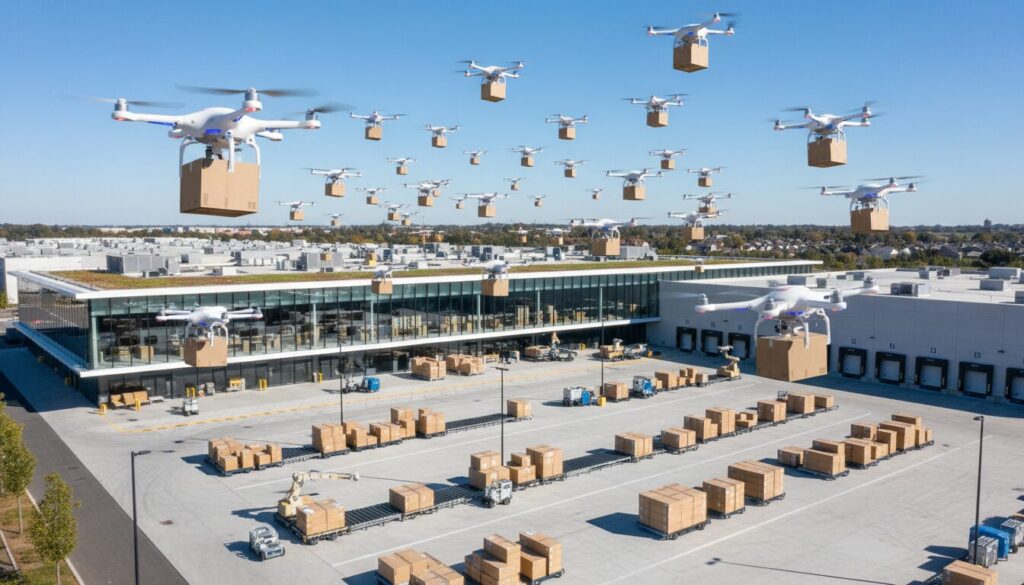
Wing (an Alphabet subsidiary) and Walmart have announced a massive expansion of their partnership, planning to deploy drone delivery services to an additional 150 stores. This move will bring the total number of operational sites to over 270, covering approximately 10% of the U.S. population by 2027.
For logistics executives, the headline isn’t just the number of stores; it is the strategic signal it sends. We are moving from experimental novelty to high-frequency supply chain integration. This analysis explores how Wing’s expansion fundamentally alters the last-mile landscape and what it means for your logistics strategy.
The Facts: From Novelty to Network
This expansion represents the largest commercial drone delivery deployment in U.S. history. Unlike previous iterations that focused on remote areas or limited SKUs, this rollout targets density and volume.
Here is the breakdown of the expansion:
| Metric | Detail | Strategic Implication |
|---|---|---|
| Scale | +150 Stores (270+ Total) | Moves beyond “proof of concept” to regional network dominance. |
| Reach | 10% of U.S. Population | Creates a statistically significant user base for data and regulatory validation. |
| Payload | Up to 5 lbs | Covers standard “fill-in” trips: dinner ingredients, medical essentials, and small electronics. |
| Usage | High Frequency | Top 25% of users order 3x per week. |
| Model | Store Co-location | Utilizes existing retail footprint as forward operating bases (hubs). |
The Pivot to Commercial Integration
The critical differentiator in this news is the shift in intent. Walmart and Wing are not testing if drones work; they are optimizing how they contribute to the bottom line.
The inclusion of aircraft capable of carrying a five-pound payload allows Walmart to address a specific basket size that is economically ruinous for traditional van delivery but perfect for aviation: the “forgotten item” or the “urgent need.”
Industry Impact: Ripples Across the Supply Chain
This expansion is not an isolated event; it is a pressure test for the entire logistics ecosystem. The integration of 270+ aerial nodes introduces new variables for carriers, warehouse operators, and competitors.
1. The “Store-as-Hub” Validation
As we explored in our analysis of Micro-Fulfillment to Adaptive Ecosystems Strategy, the future of logistics relies on moving inventory closer to the consumer. Wing’s strategy of co-locating hubs at Walmart Supercenters bypasses the need for expensive, standalone dark stores.
- For Retailers: This validates the asset-heavy approach. If you own the real estate, you own the launchpad. Competitors relying solely on 3rd party delivery networks (like DoorDash or Uber Eats) will face margin compression as Walmart eliminates the driver cost from the equation for small orders.
- For Real Estate: Parking lots and rooftops are no longer just dead space; they are potential revenue-generating “sky ports.”
2. Disruption of Last-Mile Economics
Traditional last-mile logistics relies on route density—a van dropping 100 packages in a tight cluster. However, the rise of on-demand delivery (1-hour windows) destroys this density.
Drones solve the “efficiency gap” for immediate, single-item orders.
- Van Logistics: Remains superior for batched, heavier, or planned deliveries.
- Drone Logistics: Captures the high-frequency, low-weight, immediate-need segment.
This bifurcation means traditional carriers may lose the “cream” of the volume—the small, frequent orders—leaving them with the heavier, costlier deliveries.
3. The Autonomous Ecosystem Convergence
Wing’s aerial expansion parallels developments on the ground. As discussed in White Rhino’s $100M Leap: Scaling Autonomous Last-Mile, ground-based autonomous delivery is also scaling rapidly to cut costs.
We are seeing a divergence in utility:
- Air (Wing): Speed-critical, light payload (Food, meds, emergency items).
- Ground (White Rhino/Starship): Cost-critical, medium payload (Groceries, bulk goods).
Logistics managers must prepare for a multi-modal autonomous future where a TMS (Transportation Management System) decides in milliseconds whether an order goes by van, bike, robot, or drone.
LogiShift View: The “Volume Flywheel”
The most significant data point in this announcement is not the store count, but the customer behavior: The top 25% of customers use the service three times per week.
This is the “So What?” for the industry.
The Frequency Game
In logistics, frequency drives the “volume flywheel.” Drones have high fixed costs (R&D, infrastructure) but incredibly low marginal costs (electricity, minimal wear). They only become profitable when they fly constantly.
By achieving a 3x weekly usage rate among power users, Wing has cracked the code on utilization. They aren’t just delivering packages; they are changing consumer habits. This level of adoption suggests that for a segment of the population, drone delivery has already transitioned from a “cool trick” to a utility as essential as running water.
Regulatory and Tech Synergy
This expansion will generate millions of flight hours of data. This data is the currency required to unlock the next regulatory tier: Beyond Visual Line of Sight (BVLOS) without visual observers.
Furthermore, the technology stack required to manage this traffic aligns with broader industry trends. As noted in Scaling L4 Logistics: Horizon Robotics & Youjia Partnership, the shift toward Level 4 autonomy is not limited to cars. The sensor fusion and path-planning algorithms used by Wing are part of the same technological wave transforming ground logistics.
The “Suburban Moat”
Walmart’s geography is its greatest weapon against Amazon in this specific fight. Amazon dominates urban density where drones struggle (high-rises, no backyards). Walmart dominates the suburbs/exurbs—places with driveways, yards, and the exact spacing drones need to operate safely and effectively. This expansion is Walmart digging a “suburban moat” that Amazon Prime Air will struggle to cross.
Takeaway: Strategic Steps for 2025-2027
The expansion of Wing and Walmart serves as a wake-up call. The technology is stable, the regulatory environment is softening, and the unit economics are beginning to pencil out.
Here is how executives should respond:
-
Re-evaluate SKU Profiles:
Analyze your shipping data. What percentage of your orders are under 5 lbs and require <60 minute delivery? This is your “drone-able” volume. If you don’t have a strategy for this segment, you are vulnerable to competitors who do. -
Audit Real Estate Assets:
If you manage retail locations or warehouses, assess their “aviation readiness.” Do you have roof access? Designated parking zones? Power infrastructure for rapid charging? Future lease agreements should account for drone hub potential. -
Integrate Autonomous Workflows:
Stop viewing drones, sidewalk robots, and autonomous trucks as separate silos. They are all endpoints in a digital supply chain. Ensure your WMS and TMS are capable of API integrations with autonomous carriers. -
Monitor the “flywheel”:
Watch the utilization rates of this 150-store expansion. If Wing maintains high flight frequency at this scale, the cost per delivery will drop below human-courier levels within 24 months.
The Bottom Line: Wing’s expansion proves that drone delivery is no longer a science project. It is a logistics solution entering its industrial scaling phase. The question is no longer “Will it happen?” but “How quickly can you adapt?”