Introduction
Does your facility suffer from “Yard Blindness”?
It is a common scenario for operations leaders: You know a trailer arrived two hours ago, but it is currently missing in the yard. Meanwhile, detention fees are accumulating, your dock doors are congested, and your labor force is spending valuable time manually checking bin locations.
In an era defined by labor shortages and rising operational costs, manual tracking is no longer sustainable. The gap between digital inventory records and physical reality is where profit bleeds out.
This article explains how AI-enabled vision systems will transform yard and warehouse management. We will move beyond the buzzwords to explore how computer vision acts as an “always-on” supervisor, converting visual chaos into structured data that drives efficiency, safety, and cost reduction.
What Are AI-Enabled Vision Systems?
To understand how this technology transforms logistics, we must first define what it is.
AI-enabled vision (often called Computer Vision or CV) is a field of artificial intelligence that trains computers to interpret and understand the visual world. Unlike traditional CCTV, which simply records video for humans to watch later, AI vision systems analyze the footage in real-time.
The “Eye” and the “Brain”
- The Eye (Hardware): Cameras, drones, or sensors mounted on gates, forklifts, or robotic arms.
- The Brain (Software): Deep learning algorithms that identify objects (pallets, trucks, barcodes, humans), track their movement, and detect anomalies.
This technology allows a Yard Management System (YMS) or Warehouse Management System (WMS) to “see” operations without human intervention.
Traditional vs. AI-Enabled Systems
| Feature | Traditional CCTV/Sensors | AI-Enabled Vision Systems |
|---|---|---|
| Function | Passive recording | Active analysis |
| Data Output | Video files (unstructured) | Actionable data (structured) |
| Human Input | Requires manual review | Autonomous alerts |
| Scope | Security focus | Operations & Efficiency focus |
Why Now? The Convergence of Tech and Necessity
Why is this topic dominating boardroom discussions in 2025? The adoption of AI vision is not just a trend; it is a response to specific global pressures.
1. The Cost of Hardware and Compute
High-resolution cameras and the processing power required to run AI models have become significantly cheaper. What used to require a massive server room can now often be processed on the “edge” (directly on the device).
2. The Move Toward Physical AI
The industry is shifting from digital-only AI to “Physical AI”—intelligence that interacts with the real world. As discussed in our analysis of Nvidia’s ‘Android’ Strategy: The Age of Generalist Robotics, tech giants are building platforms that enable machines to reason, adapt, and master unstructured environments. This foundation makes implementing vision systems easier than ever.
3. Government and Infrastructure Support
Governments are actively subsidizing smart logistics to secure global supply chains. For example, Japan’s Smart Port Subsidy for Global Supply Chains highlights how container terminal gates are being upgraded with sophisticated visual tracking to synchronize global movements. This top-down support accelerates adoption across the private sector.
Transforming the Yard: From Black Hole to Control Tower
The yard is often the “black hole” of the supply chain—the blind spot between the highway and the dock door. AI vision illuminates this space.
Automated Gate Operations
The transformation begins at the entry point. AI cameras equipped with Optical Character Recognition (OCR) and object detection can:
- Identify Trucks: Instantly read license plates and container numbers.
- Verify Appointments: Cross-reference arrival times with scheduled slots in the YMS.
- Damage Inspection: scan the exterior of trailers for damage upon entry, creating an indisputable digital record to resolve liability claims.
Real-Time Asset Tracking
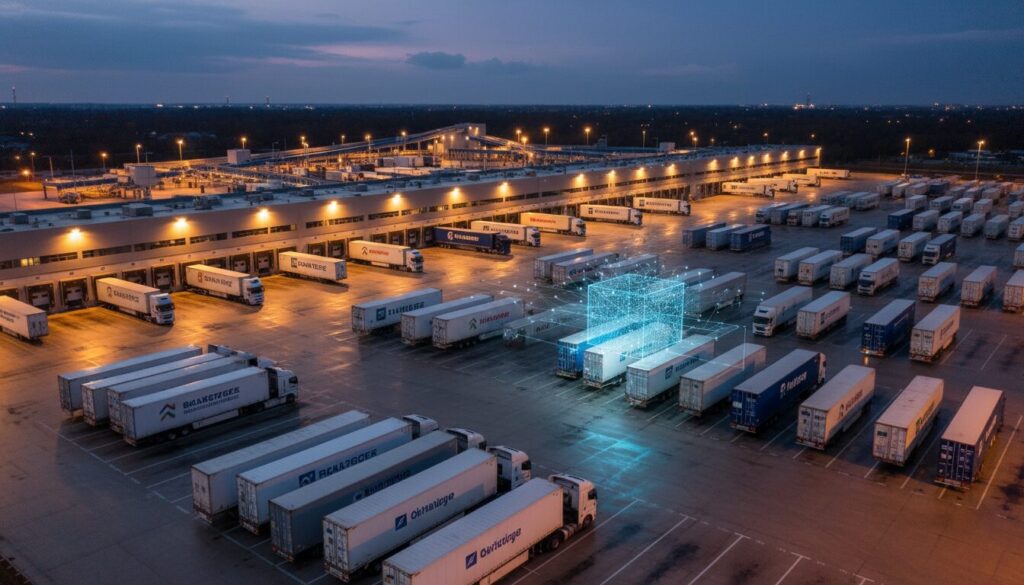
Instead of relying on spotter drivers to manually radio in trailer locations, AI vision systems cover the yard.
- Continuous Audits: Cameras monitor every parking spot. If a trailer is moved, the system updates the YMS location immediately.
- Detention Management: The system alerts managers when a trailer is approaching its detention free-time limit, allowing for prioritized unloading.
Safety Zones
Vision systems create “virtual fences.” If a human worker enters a high-risk zone (e.g., behind a reversing truck), the system can trigger alarms or even halt autonomous yard trucks.
Transforming the Warehouse: Accuracy at Scale
Inside the four walls, AI vision shifts the focus from “finding” inventory to “managing” flow.
Inventory Visibility and Cycle Counting
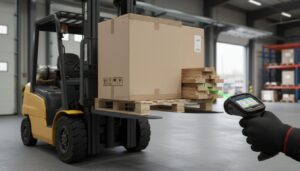
Manual cycle counting is tedious and error-prone. AI-enabled cameras—whether fixed on ceilings, mounted on forklifts, or deployed via drones—can scan barcodes and pallet configurations continuously.
This capability is crucial for scaling operations. As noted in 5 Steps to Scale Accuracy Without Rebuilding Operations, improving accuracy without stopping operations is a primary challenge for growing businesses. AI vision provides the necessary real-time feedback loop to catch errors as they happen, rather than days later.
Flexible Automation and Picking
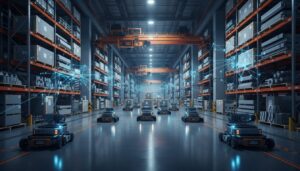
Vision is the key enabler for next-generation robotics. Robots no longer need strictly structured environments to function.
- Bin Picking: Advanced vision allows robotic arms to identify and pick specific items from a jumbled bin. For deep insight into this, read about Inbolt’s On-Arm AI: A New Era for Flexible Automation, which details how vision tech masters the “chaos test” in unstructured environments.
- Humanoid Integration: As companies pilot general-purpose humanoid robots, vision is their primary navigation tool. The recent Boston Dynamics’ Atlas Pilot: The Humanoid Logistics Shift demonstrates how vision-equipped humanoids are moving from R&D to performing actual logistical tasks alongside humans.
Workflow Optimization
Heat mapping technology can analyze footage to show high-traffic areas and bottlenecks in the warehouse layout. This data helps managers redesign workflows to minimize travel time and collision risks.
Benefits of Adoption
Implementing AI vision systems delivers measurable ROI across three main categories:
1. Operational Efficiency
- Reduced Gate Turn Times: Automated check-ins can reduce processing time by 50-80%.
- Higher Asset Utilization: Knowing exactly where trailers and forklifts are prevents “hoarding” assets and reduces fleet size requirements.
2. Cost Reduction
- Labor Reallocation: Staff move from low-value tasks (counting, checking) to high-value tasks (problem-solving, shipping).
- Damage Control: Visual proof of condition transfers liability fairly and reduces false claims.
3. Safety and Compliance
- Accident Prevention: Proactive alerts prevent collisions between forklifts and pedestrians.
- Security: Unauthorized access is detected immediately, not during a post-incident review.
Implementation Strategies for Success
Transforming your operations with AI vision is a journey. Here is a strategic framework for implementation.
Step 1: The “Pain Point” Audit
Do not try to “AI-enable” everything at once. Identify your single biggest pain point. Is it gate congestion? Lost inventory? Forklift accidents? Start there.
Step 2: Infrastructure Readiness
AI vision requires data transmission.
- Connectivity: Ensure your yard has adequate Wi-Fi or Private 5G coverage.
- Lighting: Cameras need light (or infrared capabilities) to function during night shifts.
Step 3: Integration, Not Isolation
A vision system that stands alone is just another dashboard to ignore. The data must flow directly into your WMS or YMS.
- Example: When the camera sees a truck at the dock, the WMS should automatically trigger the “Ready to Unload” status.
Step 4: Change Management
Technology often fails due to human resistance. Educate your workforce that these systems are not “surveillance tools” to punish them, but “digital assistants” to eliminate tedious paperwork and keep them safe.
Conclusion
The question is no longer if AI-enabled vision systems will transform yard and warehouse management, but how quickly your organization can adapt.
From the automated gates supported by smart port initiatives to the humanoid robots navigating warehouse aisles, the ability for machines to “see” and “understand” is the foundation of the next generation of logistics. By adopting these systems, operations leaders can move from reactive firefighting to proactive, data-driven management.
Next Steps:
- Review your current detention fees and lost inventory costs.
- Assess your facility’s network infrastructure.
- Explore pilot programs for specific high-friction areas like gate entry or cycle counting.
The transition to an AI-enabled supply chain is the definitive strategy for cost reduction and scalability in the coming decade.